Overview
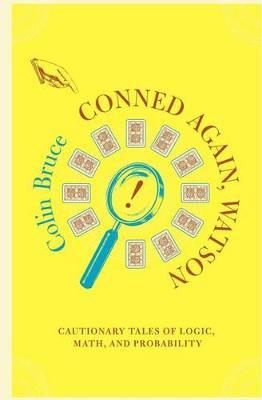
In Conned Again, Watson!, Colin Bruce re-creates the atmosphere of the original Sherlock Holmes stories to shed light on an enduring truth: Our reliance on common sense-and ignorance of mathematics-often gets us into trouble. In these cautionary tales of greedy gamblers, reckless businessmen, and ruthless con men, Sherlock Holmes uses his deep understanding of probability, statistics, decision theory, and game theory to solve crimes and protect the innocent. But it's not just the characters in these well-crafted stories that are deceived by statistics or fall prey to gambling fallacies. We all suffer from the results of poor decisions. In this illuminating collection, Bruce entertains while teaching us to avoid similar blunders. From ""The Execution of Andrews"" to ""The Case of the Gambling Nobleman,"" there has never been a more exciting way to learn when to take a calculated risk-and how to spot a scam.
Full Product Details
Author: Colin Bruce
Publisher: INGRAM PUBLISHER SERVICES US
Imprint: Perseus Books
Dimensions:
Width: 20.00cm
, Height: 2.20cm
, Length: 13.00cm
Weight: 0.280kg
ISBN: 9780738205892
ISBN 10: 0738205893
Pages: 302
Publication Date: 06 December 2001
Audience:
College/higher education
,
Professional and scholarly
,
Tertiary & Higher Education
,
Professional & Vocational
Format: Paperback
Publisher's Status: Active
Availability: In Print

This item will be ordered in for you from one of our suppliers. Upon receipt, we will promptly dispatch it out to you. For in store availability, please contact us.
Reviews
In this book, Bruce sets out 'twelve new Sherlock Holmes stories illuminating the everyday challenges of logic'. Adopting the cautionary approach of Aesop's Fables to get his message across, Bruce makes each of his stories a salutary lesson resting on a mathematically logical twist. In his preface Bruce expresses his hope that readers, not merely his characters, may be a little wiser by the book's end, but that first and foremost the book should be read for fun. The maths is therefore kept as simple as possible and supported at each stage by illustrations. Bruce touches upon many areas - Baye's logic, game theory and sampling, to name but three. Aside from the maths the stories are eminently readable in themselves. Narrated by Doctor Watson, the chapters are peopled by characters familiar to readers of Sherlock Holmes mysteries, such as Inspector Lestrade, together with historical characters like the Rev. Charles Dodgson (otherwise known as Lewis Carroll). Bruce takes minor liberties with historical 'visitors', chronology in particular, none of which detracts from a plausible fiction. He explains his actions in a detailed afterword. Superficially the 12 stories vary enormously - they include businessmen who cannot practicably apply theory and an individual fearful of a Martian invasion - but the use, or abuse, of numbers is the link. Core themes and characters are repeated to reinforce concepts and create cohesion. Throughout Holmes seeks to illustrate that instinctive first choices, especially where risk or money are involved, are not always right. Or as Holmes tells Watson, 'if you would only take time to think more clearly, resolve to be a little more logical, a little more scientific in your everyday decisions, you would be a happier and more prosperous man for it.' All in all this is an enjoyable book which should leave readers a little wiser if not mathematical whizzes. Points are well made and even old chestnuts are covered with a lightly humorous touch. In The Case of the Poor Observer, for example, Holmes demonstrates why buses always come in twos. Issues discussed often relate to everyday events - for instance, Holmes saves Watson from being duped by an offer to re-glaze his surgery for 'free' as a promotional property for a firm of glaziers. Should any point merit recap or further reading, Bruce's index gives references to specific theories and events mentioned in the text, and his afterword recommends further resources. (Kirkus UK)
Author Information
Colin Bruce is a physicist and science writer living in Oxford, England. He is an expert in mathematical paradoxes and a lover of mysteries.