Overview
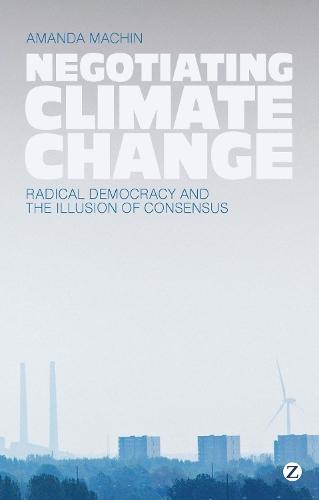
Climate change is the greatest challenge of the age, and yet fierce disagreement still exists over the best way to tackle the problem or, indeed, whether it should be tackled at all. In this original book, Amanda Machin draws on radical democratic theory to show that such disagreement does not have to hinder collective action; rather, democratic differences are necessary if we are to have any hope of acting against climate change. This is an important read for researchers, students, policy makers and anyone concerned about the current (lack of) politics in climate change.
Full Product Details
Author: Amanda Machin
Publisher: Bloomsbury Publishing PLC
Imprint: Zed Books Ltd
Edition: New ed.
Dimensions:
Width: 13.80cm
, Height: 13.80cm
, Length: 21.60cm
Weight: 0.340kg
ISBN: 9781780323985
ISBN 10: 1780323980
Pages: 176
Publication Date: 08 August 2013
Audience:
College/higher education
,
College/higher education
,
Professional and scholarly
,
Tertiary & Higher Education
,
Tertiary & Higher Education
Format: Hardback
Publisher's Status: Active
Availability: Manufactured on demand

We will order this item for you from a manufactured on demand supplier.
Reviews
'The post-political nature of contemporary debate on climate change tells us something fundamental about how politics is done today. In this wonderful book, Amanda Machin evaluates techno-economic, ethical-individual, green republican and deliberative approaches to climate change politics, concluding that by encouraging disagreement radical democracy most appropriately revitalises politics and foments engagement with the political stakes of climate change. Seeking to open up spaces of democracy in this way, Machin will surely revitalise debate surrounding one of the key challenges of our time.' - Jon Pugh, author of What is Radical Politics Today? and director of the Spaces of Democracy network 'Negotiating Climate Change joins the small but growing body of literature challenging the popular framing of climate change as a planetary crisis which must trump political dissent. As Amanda Machin shows in this lucid intervention, asking climate science to forge a consensus that will drive decisive political action misunderstands climate, science and politics in equal measure. We need more political disagreement, not more scientific consensus, about what climate change signifies for the present moment. Be warned: if you are sure about how climate change can be solved, and why it's not being, then this book is not for you.' - Mike Hulme, professor of climate and culture, King's College London. 'The issue of climate change is characterised by both scientific and political disagreement. The usual antidote to this is a drive towards consensus underpinned by a common ethic and deliberative democracy. In this highly original treatment, Amanda Machin invites us to overturn these terms of debate and to organise our response to climate change around local disagreement rather than an impossible and undesirable global agreement. Radical democracy, she argues, requires us to embrace rather than to shun disagreement - only then will the foundations for decisive action be laid'. - Andrew Dobson, professor of politics, Keele University
The issue of climate change is characterised by both scientific and political disagreement. The usual antidote to this is a drive towards consensus underpinned by a common ethic and deliberative democracy. In this highly original treatment, Amanda Machin invites us to overturn these terms of debate and to organise our response to climate change around local disagreement rather than an impossible and undesirable global agreement. ""Radical"" democracy, she argues, requires us to embrace rather than to shun disagreement - only then will the foundations for decisive action be laid. * Andrew Dobson, professor of politics, Keele University * The post-political nature of contemporary debate on climate change tells us something fundamental about how politics is done today. In this wonderful book, Amanda Machin evaluates techno-economic, ethical-individual, green republican and deliberative approaches to climate change politics, concluding that by encouraging disagreement radical democracy most appropriately revitalises politics and foments engagement with the political stakes of climate change. Seeking to open up spaces of democracy in this way, Machin will surely revitalise debate surrounding one of the key challenges of our time. * Jon Pugh, author of What is Radical Politics Today? and director of the Spaces of Democracy network * Negotiating Climate Change joins the small but growing body of literature challenging the popular framing of climate change as a planetary crisis which must trump political dissent. As Amanda Machin shows in this lucid intervention, asking climate science to forge a consensus that will drive decisive political action misunderstands climate, science and politics in equal measure. We need more political disagreement, not more scientific consensus, about what climate change signifies for the present moment. Be warned: if you are sure about how climate change can be solved, and why it's not being, then this book is not for you. * Mike Hulme, professor of climate and culture, King's College London. *
Author Information
Amanda Machin is a lecturer at the Department of Politics and IR, University of Westminster. After being awarded a PhD for her thesis in political theory, she worked as a research fellow to develop ideas on political responsibility and climate change. Her other research interests include political identification, politics and psychoanalysis, cohesion and citizenship, and embodied political protest.