|
|
|||
|
||||
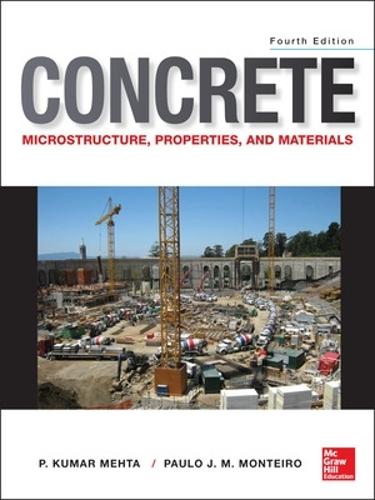
OverviewPublisher's Note: Products purchased from Third Party sellers are not guaranteed by the publisher for quality, authenticity, or access to any online entitlements included with the product. THE MOST COMPREHENSIVE AND CURRENT GUIDE TO THE PROPERTIES, BEHAVIOR, AND TECHNOLOGY OF CONCRETEThis thoroughly updated edition contains new information on: Recently built construction projects worldwide Shrinkage-reducing admixtures Self-consolidating concrete, pervious concrete, internal curing, and other cutting-edge innovations Modeling of ice formation and alkali-aggregate reaction in concrete Environmental impact of concrete Each chapter begins with a preview of the contents and ends with a self-test and a guide for further reading. More than 300 drawings and photographs illustrate the topics discussed in this definitive text on concrete. Comprehensive coverage includes: Microstructure of concrete Strength Dimensional stability Durability Hydraulic cements Aggregates Admixtures Proportioning concrete mixtures Concrete at early age Nondestructive methods Progress in concrete technology Advances in concrete mechanics Global warming and concrete in the future Full Product DetailsAuthor: P. Kumar Mehta , P. Mehta , Paulo J. M. MonteiroPublisher: McGraw-Hill Education - Europe Imprint: McGraw-Hill Professional Edition: 4th edition Dimensions: Width: 19.60cm , Height: 3.80cm , Length: 24.10cm Weight: 1.343kg ISBN: 9780071797870ISBN 10: 0071797874 Pages: 704 Publication Date: 16 October 2013 Audience: Professional and scholarly , Professional & Vocational Format: Hardback Publisher's Status: Active Availability: Manufactured on demand We will order this item for you from a manufactured on demand supplier. Table of ContentsPart I: Microstructure and Properties of Hardened Concrete: Ch. 1. Introduction; Ch. 2. Microstructure of Concrete; Ch. 3. Strength; Ch. 4. Dimensional Stability; Ch. 5. Durability; Part II. Concrete Materials, Mix Proportioning, and Early-Age Properties: Ch. 6. Hydraulic Cements; Ch. 7. Aggregates; Ch. 8. Admixtures; Ch. 9. Proportioning Concrete Mixtures; Ch. 10. Concrete at Early Age; Ch. 11. Nondestructive Methods; Part III: Recent Advances and Concrete in the Future: Ch. 12. Progress in Concrete Technology; Ch. 13. Advances in Concrete Mechanics; Ch. 14. The Future Challenges in Concrete Technology; IndexReviewsAuthor InformationPaulo J. M. Monteiro (Berkeley, CA), professor and group leader of the Structural Engineering Mechanics and Materials Group, Department of Civil and Environmental Engineering at the University of California at Berkeley, received his engineering degree from the University of Sao Paulo and master and Ph.D. degrees from U.C. Berkeley. Dr. Monteiro's professional experience includes working on a number of projects using mass concrete. Recent projects include working with roller-compacted concrete and architectural concrete. At U.C. Berkeley, he and his students are creating micromechanical models, characterizing deleterious reactions in concrete, and developing new microscopic techniques, such as low-temperature scanning electron microscopy, soft x-ray microscopy, and direction cooling. Dr. Monteiro has published over one hundred articles in archival journals. Tab Content 6Author Website:Countries AvailableAll regions |
||||