Overview
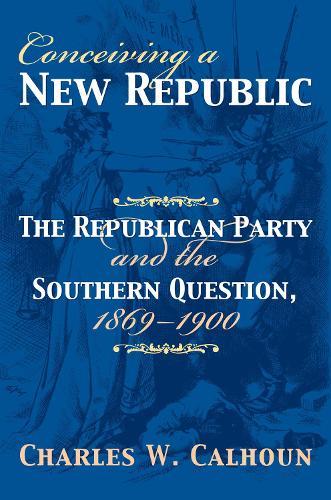
During the late nineteenth century, Republicans struggled to reinvent America in the wake of civil war - and were consumed by the question of how the South should fit within the reconstituted Union. But the unity that Republicans had shown during the war was far from evident in facing this new challenge. """"Conceiving a New Republic"""" examines the Republicans' ideological struggle, focusing on how party thought - particularly concerning the concept of republicanism - determined the contours of that effort and was in turn shaped by it. In relating how Republicans strove to fashion a new democratic polity in the face of fierce southern opposition, Charles Calhoun focuses on what they thought about their actions, particularly their beliefs about the meaning and nature of the American Republic. Calhoun revolutionizes our understanding of this era by showing that although it eventually failed in its lofty purpose, the party set out to reconstruct a nation that would abide by the promises of the Declaration of Independence. While earlier scholars have blamed Republicans for not being more steadfast advocates for blacks, Calhoun shows that southern Democrats so strongly resisted the breakdown of white supremacy that Republicans ultimately could not prevail. He assesses their actions in the election of 1876 and the ensuing electoral crisis less as an abandonment of black rights than as an effort to salvage as much of the republican experiment as possible. He also examines their struggle to revive the experiment with the Lodge Federal Elections bill of 1890 - the last serious attempt at civil rights legislation until the 1950s. Offering new insights into Presidents Grant, Hayes, Harrison, and McKinley, Calhoun shows that even before the latter's administration had begun, a confluence of forces had conspired to defeat the Republicans' attempt to create a new Republic. He spells out the reasons why Republicans, defeated by southern and Democratic intransigence, ultimately abandoned the effort to remake the Republic and found ways to accommodate themselves intellectually and morally to the failure of their earlier ideals. In showing how Republican leaders envisioned nothing less than an essential reordering of the Republic, """"Conceiving a New Republic"""" offers a bold reinterpretation of the Gilded Age that reflects a deep understanding of the period and its issues.
Full Product Details
Author: Charles W. Calhoun
Publisher: University Press of Kansas
Imprint: University Press of Kansas
Dimensions:
Width: 16.10cm
, Height: 3.20cm
, Length: 23.80cm
Weight: 0.700kg
ISBN: 9780700614622
ISBN 10: 0700614621
Pages: 360
Publication Date: 30 September 2006
Audience:
College/higher education
,
Professional and scholarly
,
Undergraduate
,
Postgraduate, Research & Scholarly
Format: Hardback
Publisher's Status: Active
Availability: In Print

This item will be ordered in for you from one of our suppliers. Upon receipt, we will promptly dispatch it out to you. For in store availability, please contact us.
Reviews
Calhoun sets out to do nothing less than trace the thought of the Republican party on the key Southern question over a three-decade period, and to do it in a new and conceptually brilliant way. . . . A groundbreaking interpretation of a period and a set of issues vital to both the American past and present, based on impeccable research and written in clear, careful, and persuasive prose. -- R. Hal Williams
A solidly researched and lucidly written work. --<i><b>American Historical Review</i></b>
A solidly researched and lucidly written work. -- American Historical Review
-A solidly researched and lucidly written work.---American Historical Review
By documenting the centrality of the Republican party's commitment to republican self-government, Calhoun not only casts light on that party's continuing commitment to black rights between 1869 and 1900. He also identifies the nub of the party's internal disputes over southern policy. This impressively perceptive book is an important contribution. --Michael Holt, author of The Rise and Fall of the Whig Party Calhoun sets out to do nothing less than trace the thought of the Republican party on the key Southern question over a three-decade period, and to do it in a new and conceptually brilliant way. . . . A groundbreaking interpretation of a period and a set of issues vital to both the American past and present, based on impeccable research and written in clear, careful, and persuasive prose. --R. Hal Williams, author of Years of Decision: American Politics in the 1890s A first-rate piece of political history that will cause historians to reexamine the significance of the election of 1888. This book is required reading for anyone interested in the Gilded Age and the history of elections and the presidency. --North Carolina Historical Review Impressively researched and thoughtfully argued. . . . A significant book, full of insights and providing an important new perspective on the period; it deserves a wide audience. --Indiana Magazine of History Calhoun presents an elegant, classic political history of what is often called 'Republicans and the Southern Question' from 1865 to the turn of the twentieth century. . . . Calhoun's book should become the standard account for historians and students who want a general view of post-Reconstruction Republican southern policy in the nineteenth century. --Journal of the Gilded Age and Progressive Era A solidly researched and lucidly written work. --American Historical Review
A solidly researched and lucidly written work. <i><b>American Historical Review</i></b>
Author Information
Charles W. Calhoun is professor of history at East Carolina University. His books include The Gilded Age and, most recently, Benjamin Harrison.