Overview
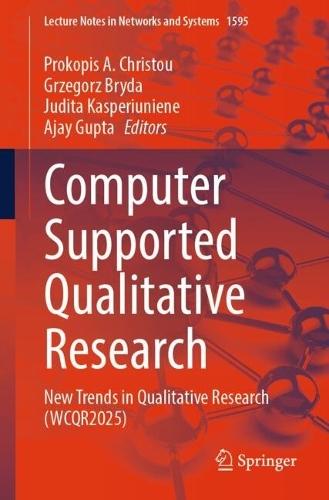
This book presents a selection of articles accepted for presentation and discussion at the World Conference on Qualitative Research (WCQR), held in 2025 at Jagiellonian University in Kraków, Poland, and online. WCQR focused on five main application fields: education, health, social sciences, engineering/technology, and business. This book, Computer Supported Qualitative Research—New Trends in Qualitative Research, captures a current and contemporary moment of a significant methodological and technological transformation of our era, impacted by new forms of technology, particularly Artificial Intelligence. This book is a valuable resource for anyone interested in qualitative research, with a particular emphasis on computer-assisted qualitative data analysis software (CAQDAS). It offers both theoretical reflections and practical insights, aiming to be a resource that readers can return to as their own qualitative research journeys unfold.
Full Product Details
Author: Prokopis A. Christou ,
Grzegorz Bryda ,
Judita Kasperiuniene ,
Ajay Gupta
Publisher: Springer Nature Switzerland AG
Imprint: Springer Nature Switzerland AG
ISBN: 9783032029980
ISBN 10: 3032029988
Pages: 436
Publication Date: 16 January 2026
Audience:
Professional and scholarly
,
Professional & Vocational
Format: Paperback
Publisher's Status: Forthcoming
Availability: Not yet available

This item is yet to be released. You can pre-order this item and we will dispatch it to you upon its release.
Author Information
Prokopis A. Christou is an assistant professor at the Cyprus University of Technology. His research interests center on qualitative inquiry and how this is influenced by technological innovation, particularly Artificial Intelligence (AI). He is also concerned with the broader impact of AI on research and societal fields, such as education, psychology, and tourism. He is the author of three books, the editor of the book Artificial Intelligence in Social Research, and has published academic papers on the intersection of AI and qualitative research. Grzegorz Bryda is an assistant professor at Jagiellonian University and head of CAQDAS TM Lab, as well as director of CAQDAS TM Summer School, specializes in Cognitive Sociology, Qualitative Digital Sociology, Digital Humanities, and AI with focus on NLP and LLMs. He has a strong foundation in both quantitative and qualitative research, leading over 450 Focus Groups and conducting 300+ in-depth interviews, completing 80+ projects in market and social research. Now he incorporates AI technologies (NLP/LLMs), and Text Mining into Qualitative Data Analysis and Modeling. He worked as a senior consultant for IBM Predictive Solutions (former SPSS Polska) and held various roles at Jagiellonian University, including Rector’s Proxy for Quality Assurance. He designed evaluation methodologies and data analysis quality assurance system at Jagiellonian University. Currently, he provides methodological consulting, developing AI-enhanced analytical frameworks for institutions and organizations. Judita Kasperiuniene is an associate professor and head of the System Analysis Department at the Faculty of Informatics, Vytautas Magnus University, Lithuania. She is also a senior researcher at the Educational Research Institute, Education Academy, Vytautas Magnus University, Lithuania, where she leads the research group “Educational Innovation and Change.” Currently, Judita Kasperiuniene conducts interdisciplinary research on the application of generative AI in social research, with a particular emphasis on qualitative and mixed methods approaches. Her recent publications highlight how ChatGPT can function as a co analyst, consultant, and trainer in qualitative coding workflows, demonstrating its value in accelerating data immersion, generating initial coding structures, and distinguishing between human and non human elements in complex data environments. Dr. Ajay Gupta, a professor at VES Business School, India, is an Erasmus Mundus fellow from the University of Milan, Italy, and a senior ATLAS.ti trainer. With a Ph.D. in organizational psychology from TISS and a master’s from the Asian Institute of Management, Manila, he brings 30 years of experience from the Indian Air Force, banking, and management education. He has taught at TAPMI, Manipal, and IIM Mumbai, earning 9.72/10 faculty feedback. Dr. Gupta has led 40+ workshops globally and authored three books, including “Qualitative Methods and Data Analysis using ATLAS.ti: A Comprehensive Researchers’ Manual,” published by Springer.