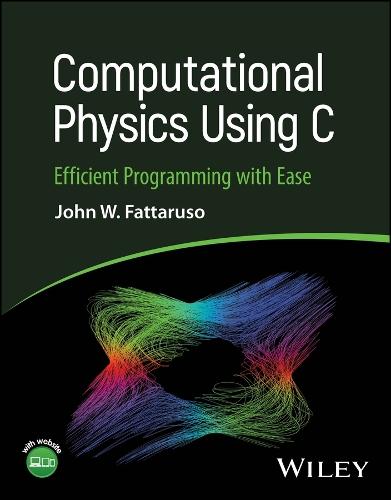
Computational Physics Using C: Efficient Programming with Ease

Author:   John W. Fattaruso (Southern Methodist University)
Publisher:   John Wiley & Sons Inc
ISBN:  

9781394318537


Pages:   448
Publication Date:   20 April 2026
Format:   Paperback
Availability:   Awaiting stock   Availability explained


Our Price $198.95 Quantity:  
Pre-Order

Share |

Computational Physics Using C: Efficient Programming with Ease


Overview

Explains C programming for solving computational physics problems Computational physics is transforming how scientists solve complex physical problems. Computational Physics Using C offers a unified approach to mastering both the numerical and programming skills essential for modern physics research. Designed to guide readers from fundamental concepts to advanced computational techniques, this textbook empowers students to effectively translate physical problems into numerical models and implement them using C. Each chapter builds progressively on prior material, beginning with the precision limits of numerical computation and advancing to nonlinear systems, Monte Carlo simulations, and the numerical integration of differential equations. The book contains detailed discussions of C language structures, pointers, and code optimization strategies, as well as programming exercises and downloadable code examples. Providing a clear roadmap for efficiently solving a wide range of real-world physics problems, Computational Physics Using C: Presents a systematic progression from fundamental numerical mathematics to advanced computational methods Integrates C programming instruction with core physics applications for seamless skill development Explains precision limits and numerical stability to ensure meaningful computational outcomes Demonstrates the use of gnuplot for effective visualization of numerical data Encourages algorithmic thinking to optimize code performance and hardware efficiency Supporting flexible course design through modular chapter organization, Computational Physics Using C: Efficient Programming with Ease is ideal for upper-level undergraduate and first-year graduate students in physics, engineering, and materials science. It is also a valuable reference for professionals engaged in computational research and analysis.

Full Product Details

Author:   John W. Fattaruso (Southern Methodist University)
Publisher:   John Wiley & Sons Inc
Imprint:   John Wiley & Sons Inc
Dimensions:   Width: 21.60cm , Height: 2.50cm , Length: 26.90cm
Weight:   0.839kg
ISBN:  

9781394318537


ISBN 10:   1394318537
Pages:   448
Publication Date:   20 April 2026
Audience:   Professional and scholarly ,  Professional & Vocational
Format:   Paperback
Publisher's Status:   Forthcoming
Availability:   Awaiting stock   Availability explained

Table of Contents

1 INTRODUCTION 1.1 What is Computational Physics? 1.2 Modularizing and Reusing Code 1.3 Introduction to Computational Efficiency 1.4 Taylor’s Theorem 2 PRECISION LIMITS OF NUMERICAL COMPUTATION 2.1 Computer Numerical Representation 2.2 Roundoff Errors 2.3 Loss of Precision Errors 2.4 Truncation Errors 3 C PROGRAMMING DETAILS 3.1 Structures and Pointers 3.1.1 Pointers 3.1.2 Custom Data Types 3.1.3 Dynamic Memory Allocation 3.1.4 Structures for Tables, Vectors, and Matrices 3.2 Modularizing Code and Encapsulating Data in C 3.3 Common Coding Traps 3.3.1 Type Conversions 3.3.2 Mixed-Type Expressions 3.3.3 Floating Point Comparisons 3.3.4 Floating Point Loop Indexing 3.3.5 The Fence Post Problem 3.3.6 Library Function Domains 4 VISUALIZATION OF NUMERICAL MODELS 4.1 Function Stepper Tool 4.2 Damped Harmonic Oscillator 4.3 The gnuplot Plotting Tool 4.4 The Helmholtz Coil 4.5 Rainbows 4.6 Diffraction Patterns 4.7 Collisions 4.8 Quantum Wave Packets 4.9 Field Vectors 4.10 Exercises 5 ROOTS OF NONLINEAR FUNCTIONS 5.1 Root Finding Algorithms 5.1.1 The Newton-Raphson Method 5.1.2 Secant Method 5.1.3 Regula Falsi Method 5.1.4 Bisection Method 5.2 The Root Solver Tool 5.3 Kepler’s Equation 5.4 The Catenary 5.5 Kirchoff’s Voltage Law 5.6 Gravitational Lagrange Points 5.7 Finding Multiple Roots with Stepping 5.8 Quantum Energy Levels of Bound Particles 5.9 Exercises 6 SYSTEMS OF LINEAR EQUATIONS 6.1 Gaussian Elimination 6.2 Pivoting 6.3 The Systems of Linear Equations Tool 6.4 Modes of Coupled Oscillators 6.5 Kirchoff’s Current Law 6.6 Determinate Structures 6.7 Indeterminate Structures 6.8 Exercises 7 SYSTEMS OF NONLINEAR EQUATIONS 7.1 Newton-Raphson Algorithm 7.2 The Systems of Nonlinear Equations Tool 7.3 Mechanics Problems 7.4 Statics Problems 7.5 Nonlinear Circuits 7.6 Numerical Estimates of the Jacobian Partial Derivatives 7.7 The Covalent Bond 7.8 Exercises 8 MONTE CARLO SIMULATION 8.1 Applications of Pseudorandom Numbers 8.2 Linear Congruential Method 8.3 The Pseudorandom Number Generator Tool 8.4 Random Walks 8.5 Radioactive Decay 8.6 Classical Scattering 8.7 Olbers’ Paradox 8.8 Ideal Gas Simulation 8.9 Integration of Gauss’ Law 8.10 Exercises 9 INTERPOLATION OF SPARSE DATA POINTS 9.1 Interpolation Algorithms 9.1.1 Newton Polynomial 9.1.2 Lagrange Polynomial 9.2 The Interpolation Tool 9.3 Interpolation of Sparse Experimental Data 9.4 Interpolation of Sparse Astronomical Data 9.5 Interpolation of Expensive Simulated Data 9.6 Inverse Interpolation 9.7 Interpolation of Troublesome Numerical Data 10 NUMERICAL INTEGRATION 10.1 Integration Algorithms 10.1.1 Trapezoidal Rule 10.1.2 Simpson’s Rule 10.2 The Integration Tool 10.3 Orbital Circumference 10.4 The Helmholtz Coil Revisited 10.5 Practical Solenoids 11 FUNCTION MINIMIZATION 11.1 Single Variable Functions 11.2 Multiple Variable Functions 11.3 Optimizing the Helmholtz Coil 11.4 Nonlinear Fitting 11.5 Exercises 12 EXPLICIT METHODS FOR ORDINARY DIFFERENTIAL EQUATIONS 12.1 Vector Fields 12.2 Explicit Algorithms for Differential Equation 12.2.1 Euler’s Method 12.2.2 Heun’s Method 12.2.3 Modified Euler Method 12.2.4 Runge-Kutta Methods 12.2.5 Adams-Bashforth-Moulton Method 12.3 Solving Higher Order Equations and Systems of Differential Equations 12.4 The Differential Equation Solver Tool 12.5 Large-Angle Pendulum 12.6 Ballistics 12.7 Forced and Damped Pendulum 12.8 Inverted Pendulum 12.9 Synchronized Oscillators 12.10 Double Pendulum 12.11 Chaotic Dynamics 12.12 n-Body Collisions 12.13 Classical Field Lines 12.14 Playground Swing 12.15 Deflecting Charges in Magnetic Fields 12.16 Solid State Physics 12.17 Quantum Scattering 12.18 Exercises 13 IMPLICIT METHODS FOR ORDINARY DIFFERENTIAL EQUATIONS 13.1 Explicit Algorithm Instability 13.1.1 Backward Euler Method 13.1.2 Trapezoidal Method 13.2 The Implicit Differential Equation Solver Tool 13.3 Waves 13.4 n-Body Gravitational Systems 13.5 Magnetic Confinement 13.6 The Ionosphere 13.7 Exercises Bibliography Index

Reviews

Author Information

John W. Fattaruso, PhD, is Adjunct Professor at Southern Methodist University, where he teaches in the Physics, Electrical Engineering, and Computer Science departments. His expertise spans computational physics, numerical analysis, and circuit design. A former Distinguished Member of the Technical Staff at Texas Instruments, he holds 32 U.S. patents and has published widely in IEEE journals and conferences.

Tab Content 6

Author Website:  

Countries Available

All regions
Latest Reading Guide

April RG 26_2


Shopping Cart
Your cart is empty
Shopping cart
Mailing List