Overview
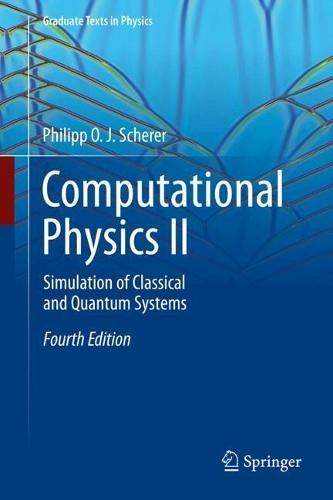
This book presents basic numerical methods and applies them to a large variety of physical models in multiple computer experiments. Authored by a distinguished expert in the field, it combines rigorous theoretical insights with a wealth of practical and easily accessible computational applications. This book serves as an ideal standalone text for computational physics courses at both the graduate and advanced undergraduate levels. It offers a detailed and cohesive exploration of the physics of classical and quantum systems, electrostatics, thermodynamics, statistical physics and nonlinear systems, integrating foundational principles with advanced simulation techniques. The significantly expanded and updated fourth edition comprises two volumes. Volume 2 deals with the simulation of classical and quantum systems, covering key areas such as rotational motion and molecular mechanics, thermodynamic systems, Brownian motion and diffusion, electrostatics, and nonlinear systems. It also features a detailed look at simple quantum systems and introduces variational quantum Monte Carlo for calculating ground state energies in quantum systems, including the helium atom and hydrogen molecule and time-dependent wave functions. New in this book are two new chapters on novel and unconventional simulation methods. The first focuses on physics-informed machine learning methods, applying artificial neural networks (ANNs) to solve and discover differential equations based on a given data set or Hamilton’s equations of motion while ensuring energy conservation. It presents the idea of a Boltzmann machine, which learns and reproduces a given probability distribution and is also useful to provide a trial function for quantum spin systems. Neural network quantum states (NNQS) are explained and optimized by the method of stochastic reconfiguration. The second explores the simulation of physical systems using real quantum systems, thus redefining the scope of computational physics. This includes examples of adiabatic quantum computing (AQS) and quantum annealing (QA) with application to quadratic unconstrained binary optimization (QUBO) and Boolean satisfiability problems (SAT). Additionally, this book introduces tensor networks and path integral methods as mathematical methods to reduce the exponentially growing configuration space to its most relevant parts and efficiently simulate quantum annealing (SQA) on a classical computer.
Full Product Details
Author: Philipp O. J. Scherer
Publisher: Springer Nature Switzerland AG
Imprint: Springer Nature Switzerland AG
Edition: Fourth Edition 2026
ISBN: 9783032078513
ISBN 10: 3032078512
Pages: 443
Publication Date: 18 February 2026
Audience:
Professional and scholarly
,
College/higher education
,
Professional & Vocational
,
Postgraduate, Research & Scholarly
Format: Hardback
Publisher's Status: Forthcoming
Availability: Not yet available

This item is yet to be released. You can pre-order this item and we will dispatch it to you upon its release.
Author Information
Prof. Scherer received his Ph.D. in experimental and theoretical physics in 1984. He habilitated in theoretical physics and has been a lecturer at the Technical University of Munich (TUM) since 1999. He joined the National Institute of Advanced Industrial Science and Technology (AIST) in Tsukuba, Japan, as a visiting scientist in 2001 and 2003. From 2006 to 2008, he has been temporary leader of the Institute for Theoretical Biomolecular Physics at TUM. Ever since, he has been an adjunct professor at the physics faculty of TUM. His area of research includes biomolecular physics and the computer simulation of molecular systems with classical and quantum methods. He published books on theoretical molecular physics and computational physics.