Overview
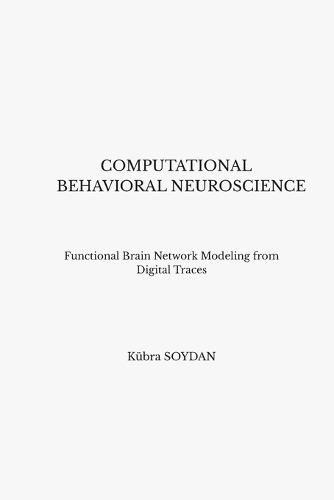
Every trace you leave while navigating your phone - the moment you pause on a video, the content you quickly scroll past, a post you like - carries strong clues about how your brain works. Computational Behavioral Neuroscience is a groundbreaking work that shows how these behavioral signals can be transformed into a ""functional brain map."" The book shows how neural measurements that were once only possible in laboratories using fMRI scanners can now be inferred through smartphones and cameras. So where does this technology take us? Spanning a range from personalized health applications to AI systems that understand our emotional states, the book explores both the opportunities and the ethical boundaries.It is an accessible yet in-depth resource for anyone interested in artificial intelligence, neuroscience, and digital culture.Computational Behavioral Neuroscience presents an interdisciplinary framework that bridges behavioral data and neural activity. While traditional neuroimaging techniques such as fMRI, EEG, and ECoG provide direct neural measurements, the book demonstrates how multimodal behavioral data collected from platforms like Instagram and YouTube - including scrolling, clicking, dwell time, and camera/microphone signals - can be used to construct a functional brain map.Using probabilistic mapping models, deep learning architectures, and pixel-based visual encoding methods, the book offers a mathematical framework for inferring individuals' cognitive and emotional states from digital behavior. It also provides an in-depth discussion of ethical boundaries, user autonomy, and algorithmic transparency.This work serves as a foundational reference for researchers, data scientists, and system designers working in computational neuroscience, behavioral AI, and human-computer interaction. Digital platforms do not merely observe user behavior; they also shape it. This book presents a comprehensive system architecture demonstrating how users' brain networks can be modeled based on digital traces such as clicks, scrolling speed, screen time, and facial expressions. Key topics include: Probabilistic mapping functions for estimating neural activity from behavioral data Sequential behavior modeling using LSTM- and Transformer-based architectures Pixel-level visual encoding and electromagnetic signal transformation Feedback loops and adaptive learning mechanisms Real-world applications: advertising, healthcare, e-commerce, and creative industries It also serves as a practical guide for professionals working in recommendation systems, user experience design, and AI ethics.
Full Product Details
Author: Kübra Soydan
Publisher: Independently Published
Imprint: Independently Published
Dimensions:
Width: 15.20cm
, Height: 0.50cm
, Length: 22.90cm
Weight: 0.145kg
ISBN: 9798257560552
Pages: 102
Publication Date: 15 April 2026
Audience:
General/trade
,
General
Format: Paperback
Publisher's Status: Active
Availability: Available To Order

We have confirmation that this item is in stock with the supplier. It will be ordered in for you and dispatched immediately.