Overview
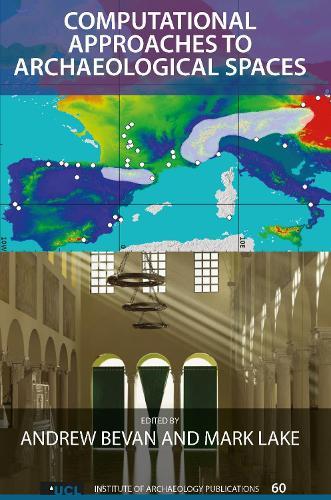
This volume of original chapters written by experts in the field offers a snapshot of how historical built spaces, past cultural landscapes, and archaeological distributions are currently being explored through computational social science. It focuses on the continuing importance of spatial and spatio-temporal pattern recognition in the archaeological record, considers more wholly model-based approaches that fix ideas and build theory, and addresses those applications where situated human experience and perception are a core interest. Reflecting the changes in computational technology over the past decade, the authors bring in examples from historic and prehistoric sites in Europe, Asia, and the Americas to demonstrate the variety of applications available to the contemporary researcher.
Full Product Details
Author: Andrew Bevan , Mark Lake
Publisher: Left Coast Press Inc
Imprint: Left Coast Press Inc
Weight: 0.453kg
ISBN: 9781611323474
ISBN 10: 1611323479
Pages: 338
Publication Date: 29 April 2022
Audience:
General/trade
,
General
Format: Paperback
Publisher's Status: Active
Availability: In Print 
This item will be ordered in for you from one of our suppliers. Upon receipt, we will promptly dispatch it out to you. For in store availability, please contact us.
Table of Contents
List of Illustrations Acknowledgments 1. Introduction,Andrew Bevan and Mark Lake 2. Intensities, Interactions and Uncertainties: Some New Approaches to Archaeological Distributions, Andrew Bevan, Enrico Crema, Xiuzhen Li and Alessio Palmisano 3. An Examination of Automated Archaeological Feature Recognition in Remotely Sensed Imagery, Kenneth Kvamme 4. An Introduction to Integrative Distance Analysis (IDA), Terence Clarke 5. Network Models and Archaeological Spaces, Ray Rivers, Carl Knappett, and Timothy Evans 6. Multilevel Selection and the Evolution of Food Sharing in Fragmented Environments: A Spatially Explicit Model and its Implications for Early Stone Age Archaeology, L.S. Premo 7. Stories of the Past or Science of the Future? Archaeology and Computational Social Science, Michael Barton 8. The Potential and Limits of Optimal Path Analysis, Irmela Herzog 9. Compute-Intensive GIS Visibility Analysis of the Settings of Prehistoric Stone Circles, Mark Lake and Damon Ortega 10. Reconsidering the Concept of Visualscape: Recent Advances in Three-Dimensional Visibility Analysis, Eleftheria Paliou 11. Formal and Informal Analysis of Rendered Space: The Basilica Portuense, Graeme Earl, Vito Porcelli, Constantinos Papadopoulos, Gareth Beale, Matthew Harrison, Hembo Pagi and Simon Keay 12. Reproducible Data Analysis and the Open Source Paradigm in Archaeology, Benjamin Ducke Index About the Editors/Contributors
Reviews
The papers in this edited volume, which grew out of a 2010 University College London international archaeology seminar, are organized around three broad themes: spatial analysis, spatial modeling, and spatial experience. Roughly one-third of the book is devoted to each topic. The first set of three papers represents inductive, exploratory approaches to archaeological spatial analysis. The second set comprises four chapters offering more deductive and model-driven approaches. These first seven chapters of the book are the most interesting and, arguably, the most useful to the majority of analysts. The final set of three articles concerns the analysis of viewsheds, visualscapes, and 3D architectural models.... Summing Up: Recommended. Graduate students/faculty/professionals. -CHOICE
“The papers in this edited volume, which grew out of a 2010 University College London international archaeology seminar, are organized around three broad themes: spatial analysis, spatial modeling, and spatial experience. Roughly one-third of the book is devoted to each topic. The first set of three papers represents inductive, exploratory approaches to archaeological spatial analysis. The second set comprises four chapters offering more deductive and model-driven approaches. These first seven chapters of the book are the most interesting and, arguably, the most useful to the majority of analysts. The final set of three articles concerns the analysis of viewsheds, visualscapes, and 3D architectural models.... Summing Up: Recommended. Graduate students/faculty/professionals.” —CHOICE
Author Information
Andrew Bevan is a lecturer at the Institute of Archaeology, University College London. He has active research interests in the social construction of value across widely ranging time periods and cultural contexts, with a particular focus on early societies in the Middle East and Mediterranean. He is author or ""Stone Vessels and Values in the Bronze Age Mediterranean"" (Cambridge, 2007). Mark Lake is Senior Lecturer at the Institute of Archaeology, University College London, and coordinator of the graduate program in GIS and Spatial Analysis in Archaeology there. A specialist in GIS and computer simulation, he studies patterning in prehistoric field systems and models the origins of culture. He is author of several simulation programs, coeditor of ""Geographical Information Systems in Archaeology"" and of ""Simulating Change,"" and author of numerous research articles.
Tab Content 6
Author Website:
Countries Available
All regions
|