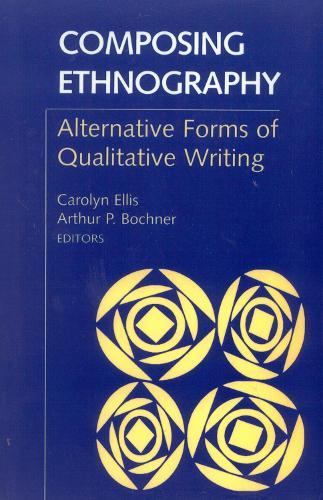
Full Product Details
Author: Carolyn Ellis ,
Arthur P. Bochner
Publisher: AltaMira Press
Imprint: AltaMira Press
Volume: 1
Dimensions:
Width: 15.40cm
, Height: 2.30cm
, Length: 23.00cm
Weight: 0.594kg
ISBN: 9780761991649
ISBN 10: 0761991646
Pages: 400
Publication Date: 27 August 1996
Audience:
College/higher education
,
Professional and scholarly
,
Undergraduate
,
Postgraduate, Research & Scholarly
Format: Paperback
Publisher's Status: Active
Availability: In Print

This item will be ordered in for you from one of our suppliers. Upon receipt, we will promptly dispatch it out to you. For in store availability, please contact us.
Reviews
Ellis and Bochner establish the need, importance and centrality of new forms of qualitative writing for interpretive ethnography ... [establishing] autoethnographies, sociopoetics, and reflexive texts as central points of reference for innovative ethnographic practice in the next century. There is much to be learned from these important exemplars. -- Norman K. Denzin, Univ. of Illinois at Urbana-Champaign I highly recommend this book...Each of their authors provides a well-crafted example of social science writing that is evocative, embodied, artistic, and often deeply emotional. -- Barbara Tedlock, (SUNY Buffalo) The articles... illustrate the kinds of writing that many of us in more traditional disciplines would like to see more widely used... Most importantly... these authors acknowledge the development of a new form of consciousness that was spiritual and political. -- Alfredo Gaitan Forum: Qualitative Social Research Each [article] is meant to engage readers personally, allowing them to gain critical insight into their own lives through understanding of the writer's lives. The editors recognize that works like these are at the fringes of academic norms. By presenting them as innovative alternatives they push readers to examine their own beliefs about what research, ethnography, and academic writing should be. Quarterly Journal Of Speech
I highly recommend this book....Each of their authors provides a well-crafted example of social science writing that is evocative, embodied, artistic, and often deeply emotional.--Barbara Tedlock
Ellis and Bochner establish the need, importance and centrality of new forms of qualitative writing for interpretive ethnography ... [establishing] autoethnographies, sociopoetics, and reflexive texts as central points of reference for innovative ethnographic practice in the next century. There is much to be learned from these important exemplars. -- Norman K. Denzin, Univ. of Illinois at Urbana-Champaign I highly recommend this book...Each of their authors provides a well-crafted example of social science writing that is evocative, embodied, artistic, and often deeply emotional. -- Barbara Tedlock, (SUNY Buffalo), SUNY Buffalo The articles... illustrate the kinds of writing that many of us in more traditional disciplines would like to see more widely used... Most importantly... these authors acknowledge the development of a new form of consciousness that was spiritual and political. -- Alfredo Gaitan Forum: Qualitative Social Research Each [article] is meant to engage readers personally, allowing them to gain critical insight into their own lives through understanding of the writer's lives. The editors recognize that works like these are at the fringes of academic norms. By presenting them as innovative alternatives they push readers to examine their own beliefs about what research, ethnography, and academic writing should be. Quarterly Journal Of Speech
Ellis and Bochner establish the need, importance and centrality of new forms of qualitative writing for interpretive ethnography ... [establishing] autoethnographies, sociopoetics, and reflexive texts as central points of reference for innovative ethnographic practice in the next century. There is much to be learned from these important exemplars. -- Norman K. Denzin, University of Illinois at Urbana-Champaign I highly recommend this book...Each of their authors provides a well-crafted example of social science writing that is evocative, embodied, artistic, and often deeply emotional. -- Barbara Tedlock, (SUNY Buffalo), SUNY Buffalo The articles... illustrate the kinds of writing that many of us in more traditional disciplines would like to see more widely used... Most importantly... these authors acknowledge the development of a new form of consciousness that was spiritual and political. -- Alfredo Gaitan Forum: Qualitative Social Research Each [article] is meant to engage readers personally, allowing them to gain critical insight into their own lives through understanding of the writer's lives. The editors recognize that works like these are at the fringes of academic norms. By presenting them as innovative alternatives they push readers to examine their own beliefs about what research, ethnography, and academic writing should be. Quarterly Journal Of Speech
Author Information
Carolyn Ellis: University of South Florida Arthur P. Bochner: University of South Florida