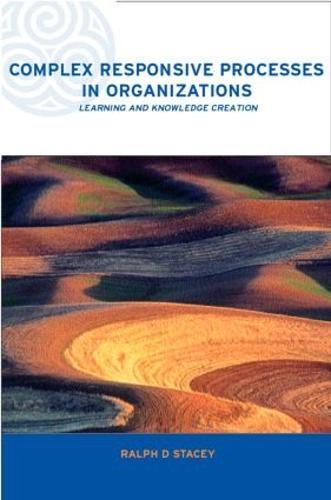
Complex Responsive Processes in Organizations: Learning and Knowledge Creation

Author:   Ralph Stacey (University of Hertfordshire, UK)
Publisher:   Taylor & Francis Ltd
ISBN:  

9780415249188


Pages:   270
Publication Date:   15 February 2001
Format:   Hardback
Availability:   In Print   Availability explained
This item will be ordered in for you from one of our suppliers. Upon receipt, we will promptly dispatch it out to you. For in store availability, please contact us.

Our Price $378.00 Quantity:  
Add to Cart

Share |

Complex Responsive Processes in Organizations: Learning and Knowledge Creation


Overview

Over the past decade, practicing managers and organizational theorists have been drawing attention to the centrality of information and knowledge in economic and social processes, the so-called 'knowledge economy'. This is reflected in the popularity of notions of learning, sense-making, knowledge creation, knowledge management and intellectual capital in organizations. More recently, attention has been drawn to emotional intelligence as an important management skill in these processes and knowledge creation. Complex Responsive Processes in Organizations argues that most of the literature on these matters, and the ways in which most practitioners now talk about them, reflect systems thinking and that its information processing view of knowledge creation is no longer tenable. The purpose of this book is to develop a different perspective, that of Complex Responsive Processes of relating, which draws on the complexity sciences as a source domain for analogies with human action. This alternative perspective places self-organizing interaction, with its intrinsic capacity to produce emergent coherence, at the centre of the knowledge creating process in organizations. Learning and knowledge creation are seen as qualitative processes of power relating that are emotional as well as intellectual, creative as well as destructive, enabling as well as constraining. The result is a radical questioning of the belief that organizational knowledge is essentially codified and centralised. Instead, organizational knowledge is understood to be in the relationships between people in an organization and has to do with the qualities of those relationships.

Full Product Details

Author:   Ralph Stacey (University of Hertfordshire, UK)
Publisher:   Taylor & Francis Ltd
Imprint:   Routledge
Dimensions:   Width: 15.60cm , Height: 1.60cm , Length: 23.40cm
Weight:   0.660kg
ISBN:  

9780415249188


ISBN 10:   041524918
Pages:   270
Publication Date:   15 February 2001
Audience:   College/higher education ,  Professional and scholarly ,  Tertiary & Higher Education ,  Professional & Vocational
Format:   Hardback
Publisher's Status:   Active
Availability:   In Print   Availability explained
This item will be ordered in for you from one of our suppliers. Upon receipt, we will promptly dispatch it out to you. For in store availability, please contact us.

Table of Contents

Reviews

Author Information

Ralph Stacey is Professor of Management and Director of the Complexity and Management Centre at the University of Hertfordshire, and a member of the Institute of Group Analysis. He is also consultant to managers at many levels accross a range of organizations and the author of a number of books and articles on strategy and complexity theory in management.

Tab Content 6

Author Website:  

Countries Available

All regions
Latest Reading Guide

NOV RG 20252


Shopping Cart
Your cart is empty
Shopping cart
Mailing List