Overview
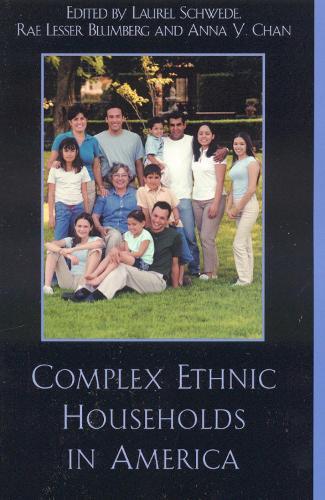
What commonalities link Navajos in their vast Arizona reservation and rural whites in upstate New York? More than you'd suspect when both live in complex households that include people other than nuclear kin. This groundbreaking interdisciplinary book on complex households in six U.S. ethnic groups-the other four are the Inupiat of Alaska, urban African Americans, Korean immigrants in New York City, and Latino immigrants in central Virginia-uniquely combines rich ethnographic descriptions with theory-linked overviews and Census 2000 data. It explores interactions of household structure, ethnicity, and gender, while illuminating factors affecting the formation and dissolution of complex households, which are becoming increasingly important as ethnic diversity increases throughout the U.S.
Full Product Details
Author: Laurel Schwede ,
Rae Lesser Blumberg ,
Anna Y. Chan ,
Amy Craver
Publisher: Bloomsbury Publishing Plc
Imprint: Rowman & Littlefield
Dimensions:
Width: 17.40cm
, Height: 1.90cm
, Length: 22.50cm
Weight: 0.431kg
ISBN: 9780742546370
ISBN 10: 0742546373
Pages: 304
Publication Date: 02 February 2006
Audience:
College/higher education
,
Undergraduate
Format: Paperback
Publisher's Status: Out of Print
Availability: Out of stock

Reviews
This is a gem of a book. It not only makes a significant contribution to scholarship, but is enjoyable to read. With its unusual combination of ethnography, demography, and theoretical insights, the book would be useful in a variety of courses?includingethnic studies, anthropology, demography, and especially, the sociology of the family. Further, it contains an important message for social scientists, policy makers, and others who take it for granted that census bureau classifications of household andfamily structure and relationships are hard, objective data, valid for the entire population... Contemporary Sociology This book is both important and topical. Highly recommended. CHOICE This important book opens the door to a rarely studied social world:complex households among six American ethnic groups. Its unique combination of fascinating ethnographies linked to census data on national and local family patterns introduces us to people who live in households very different from Ozzie and Harriet, and illuminates the rich complexity of multifaceted families at the intersections of ethnicity, gender, and domicile. This innovative text will be useful for a wide range of fields: sociology, demography, anthropology, ethnic studies, family studies, gender studies, and research methods. -- Sharon Hays, University of Southern California This book is an important contribution to the fields of ethnic, gender, and family studies. [It] is a beautiful demonstration of an inherent problem in social research. ..the clash between the researcher's conceptualizations and the subjects' worldviews...[It] will teach the reader much more than just complex household formation. It is also a colorful and effective lesson on field research and techniques... A solid piece of work that teaches a lot about household formation at the beginning of the 21st century. Journal Of Official Statistics The book is a must-read for multicultural educators and scholars who work with and desire to gain in-depth understanding of the particular ethnic populations in and outside the studied communities. This book would also be particularly helpful to social scientists who are interested in combining census and ethnographic data in a meaningful cultural analysis of ethnic communities. International Journal of Multicultural Education Households containing non-nuclear members are becoming increasingly common, and if current trends hold, represent a significant shift in household and family relations in twenty-first century America. This important book gives an in-depth view of how these complex households vary across ethnic groups, illustrating the mosaic of patterns that is changing American society. -- Randall Collins, Dorothy Swaine, University of Pennsylvania This is a gem of a book. It not only makes a significant contribution to scholarship, but is enjoyable to read. With its unusual combination of ethnography, demography, and theoretical insights, the book would be useful in a variety of courses-including ethnic studies, anthropology, demography, and especially, the sociology of the family. Further, it contains an important message for social scientists, policy makers, and others who take it for granted that census bureau classifications of household and family structure and relationships are hard, objective data, valid for the entire population. Contemporary Sociology Unique... this volume should command the attention of family researchers, particularly those of a qualitative nature, for its unique concentration on comparison. American Journal of Sociology, November 2008
This important book opens the door to a rarely studied social world: complex households among six American ethnic groups. Its unique combination of fascinating ethnographies linked to census data on national and local family patterns introduces us to people who live in households very different from Ozzie and Harriet, and illuminates the rich complexity of multifaceted families at the intersections of ethnicity, gender, and domicile. This innovative text will be useful for a wide range of fields: sociology, demography, anthropology, ethnic studies, family studies, gender studies, and research methods.--Sharon Hays
Author Information
Laurel Schwede is a research social scientist in the Statistical Research Division at the U.S. Census Bureau. Rae Lesser Blumberg is the William R. Kenan, Jr. professor of sociology at the University of Virginia. Anna Y. Chan is a research social scientist in the Statistical Research Division at the U.S. Census Bureau.