Overview
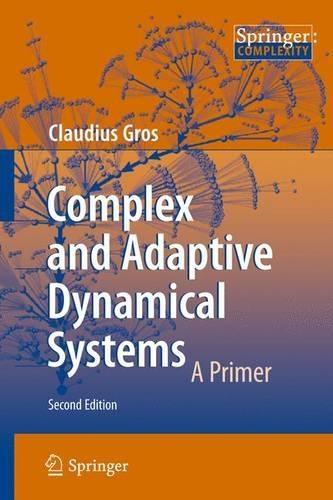
Discover a wide range of findings in quantitative complex system science that help us make sense of our complex world. Written at an introductory level, the book provides an accessible entry into this fascinating and vitally important subject.
Full Product Details
Author: Claudius Gros
Publisher: Springer-Verlag Berlin and Heidelberg GmbH & Co. KG
Imprint: Springer-Verlag Berlin and Heidelberg GmbH & Co. K
Edition: 2nd ed. 2011
Dimensions:
Width: 15.50cm
, Height: 2.30cm
, Length: 23.50cm
Weight: 0.577kg
ISBN: 9783642047053
ISBN 10: 364204705
Pages: 340
Publication Date: March 2010
Audience:
College/higher education
,
Undergraduate
Format: Paperback
Publisher's Status: Active
Availability: In Print

This item will be ordered in for you from one of our suppliers. Upon receipt, we will promptly dispatch it out to you. For in store availability, please contact us.
Reviews
From the reviews: This is a very interesting introductory book written for a broad audience of graduate students in natural sciences and engineering. It can be equally well used both for teaching and self-education. ... very well structured and every topic is illustrated by simple and motivating examples. This is a true guidebook to the world of complex nonlinear phenomena. ... Every chapter is followed by theoretical and computational exercises (with detailed solutions presented at the end of the book) and a list of references for further reading. (Ilya Pavlyukevich, Zentralblatt MATH, Vol. 1146, 2008) Claudius Gros's Complex and Adaptive Dynamical Systems: A Primer is a welcome addition to the literature. ... A particular strength of the book is its emphasis on analytical techniques for studying complex systems. ... Gros's book is for a fairly advanced and mathematically sophisticated audience ... in the field. ... Complex and Adaptive Dynamical Systems could be a fine option for well-prepared students looking for a focused introduction to complex systems ... . (David P. Feldman, Physics Today, July, 2009) From the reviews of the second edition: This is the second edition of a nicely written and generously illustrated text introducing the reader to a wide variety of topics related to dynamics of complex dynamical systems. ... The book can be used both for self-education and as a reading for a course on complex systems; the choice of material is quite flexible due to the reduced dependence among the chapters ... . The text should attract attention of graduate students and scientists working in natural sciences, engineering and neuroscience. (Yuri V. Rogovchenko, Zentralblatt MATH, Vol. 1232, 2012)
From the reviews: This is a very interesting introductory book written for a broad audience of graduate students in natural sciences and engineering. It can be equally well used both for teaching and self-education. ! very well structured and every topic is illustrated by simple and motivating examples. This is a true guidebook to the world of complex nonlinear phenomena. ! Every chapter is followed by theoretical and computational exercises (with detailed solutions presented at the end of the book) and a list of references for further reading. (Ilya Pavlyukevich, Zentralblatt MATH, Vol. 1146, 2008) Claudius Gros's Complex and Adaptive Dynamical Systems: A Primer is a welcome addition to the literature. ! A particular strength of the book is its emphasis on analytical techniques for studying complex systems. ! Gros's book is for a fairly advanced and mathematically sophisticated audience ! in the field. ! Complex and Adaptive Dynamical Systems could be a fine option for well-prepared students looking for a focused introduction to complex systems ! . (David P. Feldman, Physics Today, July, 2009)
Author Information
Prof. Claudius Gros holds a chair in theoretical physics at the Johann Wolfgang von Goethe University in Frankfurt am Main, Germany. After completing a PhD in theoretical condensed-matter physics in 1988 at the ETH in Zurich, Switzerland, Prof. Gros went as Chester-Davies fellow to Indiana University, US, before returning to Germany. His present research interests include Cognitive System Theory and Solid State Physics, with emphasis on high-temperature superconductors.