Overview
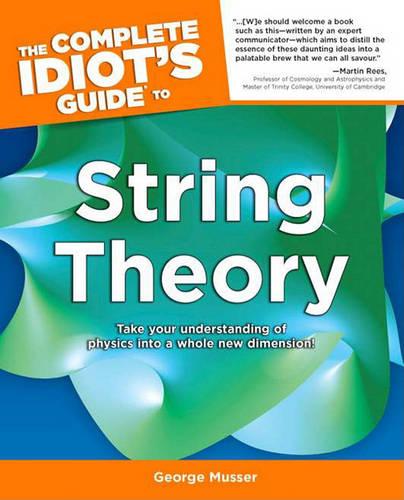
Everything is connected... We're living in the midst of a scientific revolution that's captured the general public's attention and imagination. The aim of this new revolution is to develop a ""theory of everything""--a set of laws of physics that will explain all that can be explained, ranging from the tiniest subatomic particle to the universe as a whole. Here, readers will learn the ideas behind the theories, and their effects upon our world, our civilization, and ourselves.
Full Product Details
Author: George Musser
Publisher: Alpha Books
Imprint: Alpha Books
Dimensions:
Width: 18.60cm
, Height: 2.00cm
, Length: 23.50cm
Weight: 0.540kg
ISBN: 9781592577026
ISBN 10: 1592577024
Pages: 359
Publication Date: 01 July 2008
Audience:
General/trade
,
General
Format: Paperback
Publisher's Status: Out of Stock Indefinitely
Availability: In Print

Limited stock is available. It will be ordered for you and shipped pending supplier's limited stock.
Reviews
aDespite the crazy title, this is an excellent popular account of string theory. As the astronomer Martin Rees writes in the foreword, aFor aliens, string theory may be a doddle. But for most of us humans, they are a Himalayan challenge.a So, this book is to be welcomed, not only for explaining the physics in an easily assimilated way, but also for articulating why superstrings and the rest of fundamental physics matter at all. This is something that physicists themselves rarely do. Best of all, Musser, a staff editor and writer at Scientific American, tackles the controversial aspects of string theory, which have been the subject of much journalistic nonsense lately, and gets it all just about right.a<br> a Physics World, December 2008 <br> aa] is actually a thoroughly worthwhile read, doing as good a job as you could hope for in reducing the Gordian complexity of string theory into something that intelligent readers feel that they understand.a<br> a Physics Education, November 2008
Despite the crazy title, this is an excellent popular account of string theory. As the astronomer Martin Rees writes in the foreword, For aliens, string theory may be a doddle. But for most of us humans, they are a Himalayan challenge.' So, this book is to be welcomed, not only for explaining the physics in an easily assimilated way, but also for articulating why superstrings and the rest of fundamental physics matter at all. This is something that physicists themselves rarely do. Best of all, Musser, a staff editor and writer at Scientific American, tackles the controversial aspects of string theory, which have been the subject of much journalistic nonsense lately, and gets it all just about right. Physics World, December 2008 is actually a thoroughly worthwhile read, doing as good a job as you could hope for in reducing the Gordian complexity of string theory into something that intelligent readers feel that they understand. Physics Education, November 2008
?Despite the crazy title, this is an excellent popular account of string theory. As the astronomer Martin Rees writes in the foreword, ?For aliens, string theory may be a doddle. But for most of us humans, they are a Himalayan challenge.? So, this book is to be welcomed, not only for explaining the physics in an easily assimilated way, but also for articulating why superstrings and the rest of fundamental physics matter at all. This is something that physicists themselves rarely do. Best of all, Musser, a staff editor and writer at Scientific American, tackles the controversial aspects of string theory, which have been the subject of much journalistic nonsense lately, and gets it all just about right.?<br> ? Physics World, December 2008 <br> is actually a thoroughly worthwhile read, doing as good a job as you could hope for in reducing the Gordian complexity of string theory into something that intelligent readers feel that they understand.?<br> ? Physics Education, November 2008
Author Information
George Musser is a staff editor and writer for Scientific American magazine. He was awarded the 2010 Jonathan Eberhart Planetary Sciences Journalism Award by the American Astronomical Society. He was the originator and one of the lead editors for the magazine's special issue ""A Matter of Time"" (Sept. 2002), which won a National Magazine Award for editorial excellence, and he coordinated the single-topic issue ""Crossroads for Planet Earth"" (Sept. 2005), which won a Global Media Award from the Population Institute and was a National Magazine Award finalist.