Overview
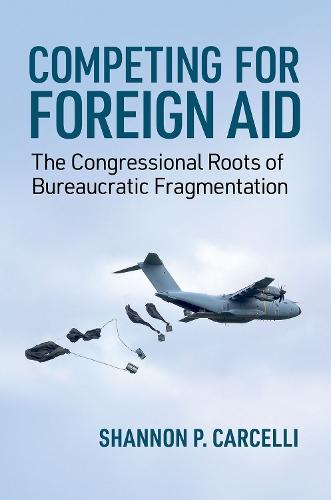
Every year, the United States authorizes dozens of bureaucracies to craft and implement foreign policy. This fragmentation of authority can result in chaos and infighting when agencies fail to communicate or outright undermine each other. Conventional wisdom considers the president to be the primary actor in US foreign policy, overlooking the extent of this bureaucratic turmoil. Why does the US government create a foreign policy apparatus that is so fragmented as to undermine its own leadership?In Competing for Foreign Aid, Shannon P. Carcelli argues that bureaucratic fragmentation is an unintended byproduct of the foreign policy-making process. To unpack the black box of foreign policy, Carcelli traces Congress's role in policy incoherence, infighting, and fragmentation in the realm of foreign aid policy. Rather than a centrally driven plan, she explains that foreign policy is better understood as an uneasy compromise between domestic interests that do not always align with ideological or economic preferences. Her theory proposes two factors that lead to fragmentation: congressional interest and disunity. Interestingly, as Carcelli shows, Congress is often the least capable of legislating effectively in the areas where its members care most about policy effectiveness. This is because congressional interest in foreign policy incentivizes micromanagement, territorial disputes, and favoritism. Combining qualitative process-tracing with a quantitative analysis of legislative voting, Competing for Foreign Aid provides a deep dive into Congress's role in shaping--and often misshaping--the foreign aid bureaucracy.
Full Product Details
Author: Shannon P. Carcelli (Assistant Professor, Assistant Professor, University of Maryland, College Park)
Publisher: Oxford University Press Inc
Imprint: Oxford University Press Inc
Dimensions:
Width: 16.60cm
, Height: 1.80cm
, Length: 23.90cm
Weight: 0.422kg
ISBN: 9780197799253
ISBN 10: 0197799256
Pages: 192
Publication Date: 09 October 2025
Audience:
Professional and scholarly
,
Professional & Vocational
Format: Hardback
Publisher's Status: Active
Availability: To order

Stock availability from the supplier is unknown. We will order it for you and ship this item to you once it is received by us.
Author Information
Shannon P. Carcelli is Assistant Professor at the University of Maryland, College Park. She studies the role of legislative and bureaucratic institutions in foreign policy, especially in the United States. She holds a PhD in political science from the University of California San Diego and a BA from Carleton College, in addition to three years of experience in the field of international development. During the 2018-2019 academic year, she served as a post-doctoral fellow at Princeton University's Niehaus Center for Globalization and Governance. During fall of 2023, she was a Visiting Scholar at the George Washington University Institute for Security and Conflict Studies (ISCS).