Overview
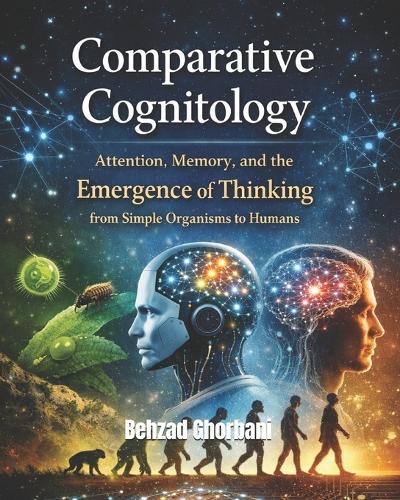
Comparative Cognitology: Attention, Memory, and the Emergence of Thinking from Simple Organisms to Humans, develops a comparative account of cognition grounded in dynamical organisation rather than in species-specific abilities or human-centred definitions. Instead of beginning with language, reasoning, or self-awareness, cognition is examined from its simplest biological forms, where behaviour emerges through interaction between internal state and environment. By tracing continuity from simple organisms to humans, the book argues that attention, memory, learning, imagination, and thinking arise through gradual extension of shared mechanisms rather than through abrupt evolutionary transitions. Cognitive complexity is therefore treated as a matter of scale, stability, and temporal depth within a common organisational structure. The central proposal is that cognition can be understood as the stabilisation of internal dynamics under perturbation. Organisms continuously adjust their internal state in response to environmental input, and stable patterns emerge through repeated interaction and feedback. Attention functions as a selection process that constrains which signals influence behaviour; memory reshapes future dynamics by preserving traces of past interaction; learning reduces error through iterative adjustment; and thinking emerges when attention stabilises internally generated trajectories prior to action. Across biological levels, the same principles operate, differing only in persistence and degree of integration. A key contribution of the work is the introduction of a comparative framework in which shared variables remain invariant across organisms. Internal state, attentional weighting, memory structure, and the degree of internalisation provide analytical axes through which cognition can be studied without reliance on anthropocentric assumptions. Consciousness is approached not as a discrete property but as an emergent condition of global integration, arising when distributed processes achieve sufficient coherence to produce unified behaviour. This perspective replaces binary distinctions between conscious and non-conscious systems with a continuous view based on degrees of integration and stability. The book also explores the role of rhythm, temporal organisation, and bilateral mirroring in stabilising cognitive dynamics, proposing that recursive interaction and feedback are fundamental to the structure of mind. Human cognition is presented as an expansion of earlier biological mechanisms, characterised by extended internal simulation and long temporal horizons rather than by discontinuity with simpler systems. Creativity, problem solving, and planning are interpreted as consequences of controlled instability and exploration within learned behavioural landscapes. In its concluding chapters, the work proposes Comparative Cognitology as a methodological orientation for future research. By focusing on measurable organisational variables rather than disciplinary boundaries, the framework extends naturally to artificial and collective systems, suggesting a unified approach to studying cognition wherever organised adaptive dynamics arise. The book emphasises that cognition research remains inherently open, since cognitive systems themselves are recursive and adaptive. Understanding progresses through refinement and comparison rather than final theoretical closure, positioning the science of mind as an evolving inquiry into the dynamics of organised behaviour and experience.
Full Product Details
Author: Behzad Ghorbani
Publisher: Independently Published
Imprint: Independently Published
Dimensions:
Width: 20.30cm
, Height: 1.10cm
, Length: 25.40cm
Weight: 0.413kg
ISBN: 9798248077427
Pages: 204
Publication Date: 12 February 2026
Audience:
General/trade
,
General
Format: Paperback
Publisher's Status: Active
Availability: Available To Order

We have confirmation that this item is in stock with the supplier. It will be ordered in for you and dispatched immediately.