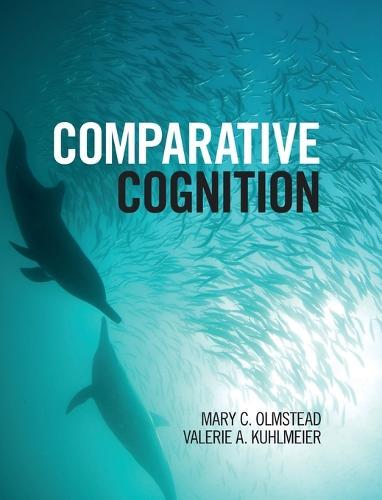
Full Product Details
Author: Mary C. Olmstead (Queen's University, Ontario) ,
Valerie A. Kuhlmeier (Queen's University, Ontario)
Publisher: Cambridge University Press
Imprint: Cambridge University Press
Dimensions:
Width: 19.30cm
, Height: 2.50cm
, Length: 25.20cm
Weight: 1.190kg
ISBN: 9781107011168
ISBN 10: 1107011167
Pages: 481
Publication Date: 15 January 2015
Audience:
College/higher education
,
Professional and scholarly
,
Tertiary & Higher Education
,
Professional & Vocational
Format: Hardback
Publisher's Status: Active
Availability: Manufactured on demand

We will order this item for you from a manufactured on demand supplier.
Reviews
'Comparative Cognition provides a clear and comprehensive review and an engaging synthesis of the key topics in this rapidly developing field. Like the other classic textbooks on animal cognition this book integrates knowledge of experimental psychology and evolutionary biology, reflecting the roots of this discipline in comparative psychology and ethology. It also contains a number of novel features, with its enhanced emphasis on both evolutionary function and the underlying neural mechanisms. These include feature boxes that describe key concepts in more detail, and researcher profiles that capture the contribution of some of the major figureheads in the field. A particular highlight is the series of questions at the end of each chapter, which encourage students to think more deeply about the issues raised, and to design experiments to test the competing hypotheses.' Nicola S. Clayton, University of Cambridge ''What is it like to be a bat?' Thomas Nagel once posed this question as a thought experiment and in doing so neatly illustrated the fact that we will never be able to experience the world from another animal's perspective. Despite the daunting task, however, Comparative Cognition attempts to do just that. The authors bring decades of research and teaching experience in compiling this valuable volume. The book contains 13 chapters and covers the breadth of comparative cognition in an introductory format that is likely to suit third-year undergraduate university students. Each chapter has a chapter plan, summary points, and ends with a series of discussion topics and further reading. Key terms are highlighted in bold, and defined in a glossary at the end of the volume to help with tricky terminology that is typical of a multidisciplinary field. Learning and teaching is further enhanced with an online tool set including PowerPoint slides ... It is perhaps the first textbook that assimilates knowledge from the rapidly developing, cross-disciplinary field of comparative cognition. As such it will be a valuable addition to bookshelf of both undergraduates and lecturers.' Culum Brown, The Quarterly Review of Biology
'Comparative Cognition provides a clear and comprehensive review and an engaging synthesis of the key topics in this rapidly developing field. Like the other classic textbooks on animal cognition this book integrates knowledge of experimental psychology and evolutionary biology, reflecting the roots of this discipline in comparative psychology and ethology. It also contains a number of novel features, with its enhanced emphasis on both evolutionary function and the underlying neural mechanisms. These include feature boxes that describe key concepts in more detail, and researcher profiles that capture the contribution of some of the major figureheads in the field. A particular highlight is the series of questions at the end of each chapter, which encourage students to think more deeply about the issues raised, and to design experiments to test the competing hypotheses.' Nicola S. Clayton, University of Cambridge
'Comparative Cognition provides a clear and comprehensive review and an engaging synthesis of the key topics in this rapidly developing field. Like the other classic textbooks on animal cognition this book integrates knowledge of experimental psychology and evolutionary biology, reflecting the roots of this discipline in comparative psychology and ethology. It also contains a number of novel features, with its enhanced emphasis on both evolutionary function and the underlying neural mechanisms. These include feature boxes that describe key concepts in more detail, and researcher profiles that capture the contribution of some of the major figureheads in the field. A particular highlight is the series of questions at the end of each chapter, which encourage students to think more deeply about the issues raised, and to design experiments to test the competing hypotheses.' Nicola S. Clayton, University of Cambridge 'This book is recommended for library purchases in the life and evolutionary sciences, animal minds, cognitive neurosciences, and the philosophy of mind. I would also like to note that the many detailed neuro-anatomical and evolution-related drawings are alone worth the price of this volume. They are some of the clearest and thought-out technical drawings I have ever seen and will engage the eye at length.' Paul Tibbetts, The Quarterly Review of Biology Comparative Cognition provides a clear and comprehensive review and an engaging synthesis of the key topics in this rapidly developing field. Like the other classic textbooks on animal cognition this book integrates knowledge of experimental psychology and evolutionary biology, reflecting the roots of this discipline in comparative psychology and ethology. It also contains a number of novel features, with its enhanced emphasis on both evolutionary function and the underlying neural mechanisms. These include feature boxes that describe key concepts in more detail, and researcher profiles that capture the contribution of some of the major figureheads in the field. A particular highlight is the series of questions at the end of each chapter, which encourage students to think more deeply about the issues raised, and to design experiments to test the competing hypotheses. Nicola S. Clayton, University of Cambridge 'This book is recommended for library purchases in the life and evolutionary sciences, animal minds, cognitive neurosciences, and the philosophy of mind. I would also like to note that the many detailed neuro-anatomical and evolution-related drawings are alone worth the price of this volume. They are some of the clearest and thought-out technical drawings I have ever seen and will engage the eye at length.' Paul Tibbetts, The Quarterly Review of Biology
Advance praise: 'Comparative Cognition provides a clear and comprehensive review and an engaging synthesis of the key topics in this rapidly developing field. Like the other classic textbooks on animal cognition this book integrates knowledge of experimental psychology and evolutionary biology, reflecting the roots of this discipline in comparative psychology and ethology. It also contains a number of novel features, with its enhanced emphasis on both evolutionary function and the underlying neural mechanisms. These include feature boxes that describe key concepts in more detail, and researcher profiles that capture the contribution of some of the major figureheads in the field. A particular highlight is the series of questions at the end of each chapter, which encourage students to think more deeply about the issues raised, and to design experiments to test the competing hypotheses.' Nicola S. Clayton, University of Cambridge
Author Information
Mary C. Olmstead is Professor of Psychology and Neuroscience at Queen's University, Ontario. Her research is directed towards understanding the neural and psychological interface between motivation and cognition, or how rewarding stimuli influence learning. Valerie A. Kuhlmeier is Associate Professor of Psychology and Canada Research Chair in Cognitive Development at Queen's University, Ontario. Her research programme explores cognition from a developmental and evolutionary perspective.