Overview
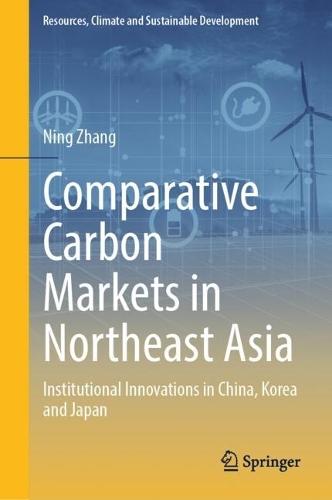
This book offers a comprehensive framework for comparing Northeast Asia’s market-based climate and energy policies, integrating carbon market theories, empirical data from China, South Korea, Japan, and practical policy cases. It bridges theory and regional practice, analyzing how the three nations—at distinct development stages—design tools to balance emission cuts, energy security, and economic growth. It covers core mechanisms: China’s national ETS (the world’s largest, covering 8 billion tons of emissions) and energy use rights trading; South Korea’s K-ETS (Asia’s first mandatory carbon market) with “auction + free allocation” and price stabilization tools (floor price, market reserve); Japan’s GX-ETS featuring central-local dual-track and voluntary-to-mandatory transition. Applying a four-dimensional framework (policy design, economic efficiency, innovation incentives, environmental effectiveness), it quantifies differences in quota allocation, carbon price volatility, green innovation, and emission reduction effects. Special focus is on heavy industries (steel, cement, aluminum), comparing technological routes (China’s electric arc furnace steel, South Korea’s hydrogen metallurgy, Japan’s CCUS) and carbon cost pass-through. This book is a key resource for advanced students in environmental economics/climate policy, and researchers, policymakers, and industry leaders in Northeast Asia’s climate governance. Its empirical data (quota tables, carbon price trends, industrial metrics) and policy roadmaps add value, especially for new analysts. Key features: - Links global climate theories to Northeast Asia’s policy innovations. - Specialized chapters on heavy industry decarbonization. - Actionable roadmap for regional carbon market linkage (China-South Korea allowance mutual recognition, China-Japan offset alignment). - Data from official sources (China’s MEE, South Korea’s MOE, Japan’s METI). Readers gain theoretical insights into regional policy differences and practical tools for policy design, industrial decarbonization, and regional climate cooperation.
Full Product Details
Author: Ning Zhang
Publisher: Springer Verlag, Singapore
Imprint: Springer Verlag, Singapore
ISBN: 9789819578313
ISBN 10: 9819578310
Pages: 299
Publication Date: 01 May 2026
Audience:
Professional and scholarly
,
Professional & Vocational
Format: Hardback
Publisher's Status: Forthcoming
Availability: Not yet available

This item is yet to be released. You can pre-order this item and we will dispatch it to you upon its release.
Author Information
Prof. Ning Zhang, Professor at Yonsei University's School of Economics, also served as Distinguished Professor at Shandong University and Senior Fellow at Cambridge University. He is also a 5-time Clarivate Highly Cited Researcher (2020-2024), he ranks among Stanford's Top 2% Scientists 2020–2025). His 150+ publications in Science, Nature, PNAS and Journal of Development Economics focus on climate change and environmental economics.