|
|
|||
|
||||
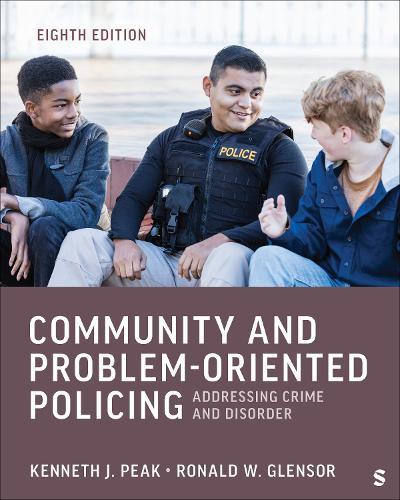
OverviewCommunity and Problem-Oriented Policing: Addressing Crime and Disorder addresses the evolving field of policing by emphasizing community-focused strategies to combat crime and disorder. Featuring new and emerging strategies and technologies, the Eighth Edition equips students with critical thinking skills, practical knowledge, and hands-on tools to tackle real-world challenges in the field. Full Product DetailsAuthor: Kenneth J. Peak , Ronald W. GlensorPublisher: Sage Publications Inc Ebooks Imprint: SAGE Publications Inc Edition: Revised edition ISBN: 9781071912331ISBN 10: 107191233 Publication Date: 14 April 2026 Audience: College/higher education , Undergraduate Format: Paperback Publisher's Status: Active Availability: In Print This item will be ordered in for you from one of our suppliers. Upon receipt, we will promptly dispatch it out to you. For in store availability, please contact us. Table of ContentsPreface Acknowledgements About the Authors Part 1: Historical Foundations and the Evolution of Policing Chapter 1: Policing Today: The Long Arc from Reactive to Proactive Introduction British Foundations and Early Policing Principles Policing Comes to America: The Political Era The Professional Era (Reform Movement) The Community Problem-Solving Era The Technology and Globalization Era Case Study Summary Key Terms and Concepts Discussion Questions Part II: Policing in a Complex Society Chapter 2: Police-Community Partnerships: Trust and Collaboration Introduction The Meaning of “Community,” And Why It Matters Embracing A New Professionalism Signs of a Healthy Community Effects of The Economy on Police and Community Civilian Oversight: A Partnership in Accountability Community Justice: Redefining Courts and Corrections Case Study Summary Key Terms and Concepts Discussion Questions Chapter 3: Policing a Diverse and Evolving Society Introduction Who We Are: A Diverse and Changing Nation Immigrants To the Land of Opportunity Police And Marginalized Groups: Conflict and Challenges Racial Profiling and Bias-Based Policing Transparency And Trust Building: Opportunities and Challenges Early Intervention Systems: Identifying Problem Employees Case Study Summary Key Terms and Concepts Discussion Questions Chapter 4: Homeland Security: Extreme Challenges for Law Enforcement Introduction Needed: A Consolidated and Skilled Effort The Many Faces of Terrorism Law Enforcement’s Evolving Role Other Strategies in The Toolbox The Role of Local Police The Role of Community- And Problem-Oriented Policing Case Study Summary Key Terms and Concepts Discussion Questions Part III: Problem-Solving Models, Programs, Practices Chapter 5: Problem-Solving: Targeted Interventions Introduction Problem-Solving: Rationalization And Application Sara: The Problem-Solving Process Challenges And Advancements in Problem-Solving Tailoring Strategies to Neighborhoods Case Study Summary Key Terms and Concepts Discussion Questions Chapter 6: Crime Prevention: Programs and Practices Introduction In The Beginning: Public Awareness Problem-Oriented Policing, Community, and Crime Prevention: A Symbiotic Relationship Crime Prevention Through Environmental Design Situational Crime Prevention The Officer’s Role in Crime Prevention Conducting a Publicity Campaign Displacement of Crime and Diffusion of Benefit Crime Prevention: What Works and What Doesn’t Case Study Summary Key Terms and Concepts Discussion Questions Chapter 7: Tools for Problem-solving: Using Information and Intelligence Technologies Introduction First Things First: IT Comes to Policing IT Tools In the Hands of Officers Crime Analysis: Revisiting S.A.R.A. Crime Mapping Real-Time Crime Centers Crime Strategies That Work: Tools for Smarter Policing Applying Social Media: Lessons from the Boston Marathon Bombing Case Study Summary Key Terms and Concepts Discussion Questions Part IV: Needed: Organizational Foundation for Problem Solving Chapter 8: Transforming the Culture: Toward Constitutional and Legitimate Policing Introduction First Things First: What Is Meant by Police “Culture”? Revisiting The “New Professional” Two Essentials for This Environment: Constitutional Policing and Proedural Justice Leadership As a Driver for Police Culture Recruitment And Retention for Community Policing Roles of Key Leaders Case Study Summary Key Terms and Concepts Discussion Questions Chapter 9: Planning and Implementation: Keys to Success Introduction Organizational Transformation Strategic Planning: Achieving Organizational Vision Core Elements of Strategic Planning The New Economic and Global Reality in Policing Agency-Wide Implementation Force-Field Analysis A Tool for Measuring CPOP Implementation: CP-SAT Case Study Summary Key Terms and Concepts Discussion Questions Chapter 10: Training for Problem-Solving: Learning by Doing Introduction Learning Theories and Methods for Training Police The Learning Organization Training Police as “Guardians” Constitutional Policing and Procedural Justice Mentoring Across Generations Training Methods for Today’s Officers Engaging the Community in Training and Education High Tech Training: From Gaming to AI Case Study Summary Key Terms and Concepts Discussion Questions Chapter 11: Evaluating Response Outcomes: Do Officers’ Efforts Measure Up? Introduction Assessments and Impact Evaluations Knowledge and Skills Program Evaluators Should Posses Key Measurements An Evidenced-Based Matrix That Translates Research into Practice Establishing Cause: Tests for Causal Interference Evaluating Officers′ Problem-Solving Efforts Not to be Overlooked: Community Surveys Case Study Summary Key Terms and Concepts Discussion Questions Part V: Addressing Today’s Crime and Disorder Chapter 12: Problem-Solving in Practice: “What Works” with Drugs, Youth Gang and Violence, and Neighborhood Disorder Introduction The War on Drugs: New Challenges and Strategic Responses What Works: Law Enforcement and Legislative Efforts Youth Crime and Delinquency q Neighborhood Disorder Abandoned Buildings ""Flash Mob Thefts"": The Newest Retail Crime Challenge Case Study Summary Key Terms and Concepts Discussion Questions Chapter 13: Addressing Justice-Involved Individuals and Victims: Mental Illness, Domestic Violence, Cyber Criminals, and Human Trafficking Introduction Assisting Individuals with Mental Illness Domestic Violence: Integrated Interventions Cybercrime and Online Victimization Human Traffickings Case Study Summary Key Terms and Concepts Discussion Questions Chapter 14: The Future is Here! – What Now? Introduction Policing 2030: The Next Horizon Drivers And Factors Influencing the Future of Policing “Information Overload” – A Real Challenge A Glimpse of What’s Here, What’s on The Horizon Cybercrime And Community Policing Applying Science to Policing Need For Strong Police Leadership Futures Thinking vs. Strategic Planning Case Study Summary Key Terms and Concepts Discussion Questions Appendix: Model Academic Curriculum for Problem Solving GlossaryReviewsThis textbook provides a deep dive into contemporary community policing. The authors examine police-community relations from a lens focused on where improvements can and should be made. Students will be challenged with the critical thinking exercises as they grow their understanding of effective policing in today′s communities. -- Charles Husted, Yavapai College -- Charles Husted * Review * This textbook provides a deep dive into contemporary community policing. The authors examine police-community relations from a lens focused on where improvements can and should be made. Students will be challenged with the critical thinking exercises as they grow their understanding of effective policing in today′s communities. -- Charles Husted * Review * Author InformationKenneth J. Peak, Ph.D., is a professor emeritus and former chairman of the criminal justice department at the University of Nevada, Reno, where he was named “Teacher of the Year” by the UNR Honor Society and also served as acting director of public safety. He has authored or coauthored more than 40 books on community policing, introductory policing, justice administration, introduction to criminal justice, women in law enforcement, and police supervision and management; two historical books (on bootlegging and temperance); and more than 60 journal articles and additional book chapters on a wide range of justice-related subjects. He has served as chairman of the Police Section, Academy of Criminal Justice Sciences and a past president of the Western Association of Criminal Justice. Prior to coming to UNR, Dr. Peak held positions as a municipal police officer, nine-county criminal justice planner; and director of a four-state Technical Assistance Institute. He also served twice as a chief of university police and as an assistant professor at Wichita State University (five years). He received two gubernatorial appointments to statewide criminal justice committees while in Kansas and holds a doctorate from the University of Kansas. Ronald W. Glensor, Ph.D., is an assistant chief (retired) of the Reno, Nevada, Police Department (RPD). He has accumulated more than 36 years of police experience and commanded the department’s patrol, administration, and detective divisions. In addition to being actively involved in RPD’s implementation of community oriented policing and problem solving since 1987, he has provided such training to thousands of officers, elected officials, and community members representing jurisdictions throughout the United States as well as Canada, Australia, and the United Kingdom. He is also a judge for the Herman Goldstein International Problem Oriented Policing Awards held annually throughout the nation. Dr. Glensor was the 1997 recipient of the prestigious Gary P. Hayes Award, conferred by the Police Executive Research Forum, recognizing his contributions and leadership in the policing field. Internationally, he is a frequent featured speaker on a variety of policing issues. He served a six-month fellowship as problem oriented policing coordinator with the Police Executive Research Forum in Washington, D.C., and received an Atlantic Fellowship in public policy, studying repeat victimization at the Home Office in London. He is coauthor of Police Supervision and Management in an Era of Community Policing (third edition) and was coeditor of Policing Communities: Understanding Crime and Solving Problems; Dr. Glensor has also published in several journals and trade magazines, is an adjunct professor at the University of Nevada, Reno, and instructs at area police academies and criminal justice programs. He holds both a doctorate in political science and a master’s of public administration from the University of Nevada, Reno. Tab Content 6Author Website:Countries AvailableAll regions |
||||