|
|
|||
|
||||
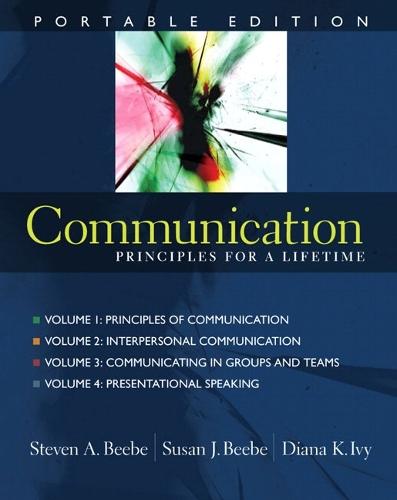
OverviewThis alternative version of Communication: Principles for a Lifetime is a four volume set (sold together or separately) with fully integrated practice tests and contextually placed icons connected to our interactive online MyCommunicationLab resources. This Portable Edition offers unparalleled flexibility, choice, and support for the learning experience. Written by experienced and highly regarded authors and teachers, Communication: Principles for a Lifetime, Portable Edition provides readers with all the theory and skills necessary — in a manner that will help them to apply what they learn throughout their lives. Understanding that the challenge is learning the myriad of skills, principles, and theories without being overwhelmed, Beebe, Beebe, and Ivy anchor all discussion around five key principles of communication throughout their book: Be aware of your communication with yourself and others. Effectively use and interpret verbal messages. Effectively use and interpret nonverbal messages. Listen and respond thoughtfully to others. Appropriately adapt messages to others. Providing both comprehensive and cutting-edge content about communication organized around these five themes, Beebe, Beebe, and Ivy cover all of the topics expected in a manner that will help the reader organize the extensive range of material. Full Product DetailsAuthor: Steven A. Beebe , Susan J. Beebe , Diana K. IvyPublisher: Pearson Education (US) Imprint: Pearson Edition: Portable ed Dimensions: Width: 18.80cm , Height: 3.00cm , Length: 23.10cm Weight: 1.225kg ISBN: 9780205609826ISBN 10: 0205609821 Publication Date: 28 December 2011 Audience: College/higher education , Tertiary & Higher Education Format: Paperback Publisher's Status: Out of Print Availability: Awaiting stock Table of ContentsVolume 1: Principles of Communication 1.1 Foundations of Human Communication * Communication Defined * Communication Competence * Why Study Communication * Communication Models * Communication Characteristics * Communicating with Others: Three Situations 1.2 Self-Awareness and Communication * Self-Awareness: How Well Do You Know Yourself? * Self-Esteem: What Is Your Value? * The Perception Process * Communication and the Enhancement of Perceptual Accuracy 1.3 Understanding Verbal Messages * Why Focus on Language? * The Nature of Language * The Power of Words * Confronting Bias in Language 1.4 Understanding Nonverbal Messages * Why Focus on Nonverbal Communication * The Nature of Nonverbal Communication * Codes of Nonverbal Communication * How to Interpret Nonverbal Cues More Accurately 1.5 Listening and Responding * How We Listen * Listening Styles * Adapting to Your Listening Style * Listening Barriers * Improving Your Listening Skills * Responding Skills * Responding with Empathy 1.6 Adapting to Others: Bridging Culture and Gender Differences * Ethically Adapt Your Communication to Others * Gender and Communication * Barriers to Bridging Differences and Adapting to Others * Adapting to Others Who Are Different from You Volume 2: Interpersonal Communication 2.1 Understanding Interpersonal Communication * What Is Interpersonal Communication * Initiating Relationships * Maintaining Relationships 2.2 Enhancing Relationships * The Importance of Friendship * The Importance of Family * The Importance of Colleagues * Stages of Relationship Development * Managing Interpersonal Conflict Appendix A: Interviewing Appendix B: Technology and Interpersonal Communication Volume 3: Communicating in Groups and Teams 3.1 Understanding Group and Team Performance * Groups and Teams Defined * Understanding Types of Groups and Teams * Understanding Group and Team Dynamics * Understanding Phases of Group and Team Development 3.2 Enhancing Group and Team Performance * What Effective Group Members Do * When Not to Work in Groups and Teams * Structuring Group and Team Problem Solving * Enhancing Group and Team Leadership * Enhancing Group and Team Meetings Appendix C: Technology and Group Performance Volume 4: Presentational Speaking 4.1 Developing Your Presentation * An Overview of the Presentational Speaking Process * Understanding Speaker Anxiety * Managing Speaker Anxiety * Selecting and Narrowing Your Topic * Identifying Your Purpose * Developing Your Central Idea * Generating Main Ideas * Gathering Supporting Material * Acknowledgement of Supporting Material 4.2 Organizing and Outlining Your Presentation * Organizing Your Main Ideas * Organizing Your Supporting Material * Organizing Your Presentation for the Ears of Others * Introducing and Concluding Your Presentation * Outlining Your Presentation 4.3 Delivering Your Presentation * Methods of Delivery * Effective Verbal Delivery * Effective Nonverbal Delivery * Effective Presentation Aids * Some Final Tips for Rehearsing and Delivering Your Presentation 4.4 Speaking to Inform * Types of Informative Presentations * Strategies for Organizing Your Informative Presentation * Strategies for Making Your Informative Presentation Clear * Strategies for Making Your Informative Presentation Interesting * Strategies for Making Your Informative Presentation Memorable 4.5 Speaking to Persuade * Persuasion Defined * Motivating Your Audience: The Psychology of Persuasion * Selecting and Narrowing Your Persuasive Topic * Identifying Your Persuasive Topic * Identifying Your Persuasive Purpose * Developing Your Central Idea as a Persuasive Proposition * Supporting Your Presentation with Credibility, Logic, and Emotion * Organizing Your Persuasive Message * How to Adapt Ideas to People and People to Ideas Appendix D: Technology and Presentational Communication Appendix E: Sample Speeches for Discussion and EvaluationReviewsAuthor InformationTab Content 6Author Website:Countries AvailableAll regions |
||||