|
|
|||
|
||||
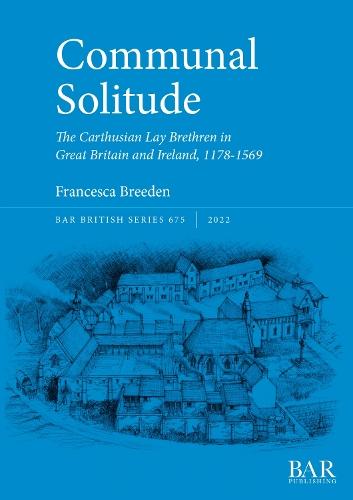
OverviewThe Carthusians were a small monastic order founded in France in the late 11th century. Their dedication to the hermit lifestyle required a unique living situation that included individual housing for each monk, and a group of lay brothers who carried out the day-to-day tasks and interacted with the local community. This volume examines the Carthusian Order in Great Britain and Ireland from an archaeological standpoint and highlights the role of the lay brother in the everyday life of the charterhouse. Using the case studies of Witham Charterhouse and Hinton Priory in Somerset, the layouts of the lay brothers' complexes are explored through geophysical survey and comparison with Carthusian material culture assemblages from other British charterhouses. This method of investigation provides a singular view of the lay brother in medieval society and for the first time proposes a layout of an English Carthusian lower house. Full Product DetailsAuthor: Francesca BreedenPublisher: BAR Publishing Imprint: BAR Publishing Weight: 0.427kg ISBN: 9781407359755ISBN 10: 1407359754 Pages: 107 Publication Date: 31 August 2022 Audience: Professional and scholarly , Professional & Vocational Format: Paperback Publisher's Status: Active Availability: Available To Order We have confirmation that this item is in stock with the supplier. It will be ordered in for you and dispatched immediately. Table of ContentsList of Tables List of Abbreviations Abstract 1. Introduction 1.1 Data Set and Chronology 1.2 A Brief History of the Carthusian Order 1.3 Primary Written Sources 1.4 Previous Archaeological Research 2. The Carthusians in Great Britain 2.1 Hugh of Lincoln and the first English foundation: 1178-1221 2.2 Expansion and Royal Benefaction: 1222-1500 2.3 The Carthusians during the Reformation: 1518-1569 2.4 The Aftermath of the Dissolution and the Re-use of Carthusian Buildings 2.5 Conclusions 3. Church, Cloister, and Cell: The Inner Charterhouse Complex 3.1 Overview of the Charterhouse Complex 3.2 Previous Excavations and Resistivity Surveys 3.2.1 Witham Charterhouse 3.2.2 Hinton Priory and Friary 3.3 The Carthusian Church: Use, Expansion and Decoration 3.4 The Cloister 3.5 The Cell 3.6 Conclusions 4. Daily Life in the Charterhouse 4.1 The Daily Schedule 4.2 Prayer and Spiritual Exercises 4.3 Manual Works 4.4 Meals 4.5 Silence 4.6 Death and Memory 4.7 Conclusions 5. The Wider Landscape of the Carthusian Precinct 5.1 Siting of the Charterhouse 5.2 Water Management 5.3 Topographic Analysis: Using LiDAR to assess landscape changes 5.4 The Influence of the Carthusians on the Local Landscape 5.5 Carthusian Estates 5.6 Conclusions 6. Material Culture of the Charterhouse 6.1 A Comparative Study of Monastic Material Culture recovered from English Charterhouses 6.1.1 Ceramic Cooking and Dining Vessels 6.1.2 Writing and Book Manufacture Implements 6.1.3 Dress Accessories 6.1.4 Summary 6.2 Material Culture of the Lay Brethren 6.2.1 Mount Grace Priory 6.2.2 The London Charterhouse 6.2.3 Coventry Charterhouse 6.2.4 Documentary Evidence 6.2.5 Summary 6.3 Conclusions 7. The Lower House: An Archaeological Investigation at the sites of Hinton and Witham Friary 7.1 A Divided House 7.2 Case Study 1 - Witham Friary 7.3 Case Study 2 - Hinton Friary 7.4 Geophysical Survey 7.4.1 Witham Friary Earth Resistance Survey 7.4.2 Hinton Friary Earth Resistance Survey 7.4.3 Hinton Friary Magnetometer Survey 7.5 Synthesis of Data 7.6 Conclusions 8. Conclusions 8.1 Can the Lay Brother be identified as archaeologically distinct? 8.2 Layouts and Landscapes: Arrangement and Organisation 8.3 Interactions with the Secular World 8.4 The Role of the Lay Brother 8.5 Scope and Recommendations for Further Research BibliographyReviews'The book is a significant contribution to the general field of monastic studies and makes a particular contribution to the study of the Carthusians. The research will certainly be of considerable interest to scholars working on medieval orders elsewhere in Europe.' Deirdre O'Sullivan, University of Leicester 'The approach to the subject is fresh and comprehensive making it a valuable addition to the topic of the archaeology of medieval monasticism in Great Britain and Ireland. I was very impressed by this volume which proved to be an enjoyable and informative read.' Dr J. Patrick Greene, Standing Committee for Archaeology of the Royal Irish Academy and Heritage Council of Ireland Author InformationFrancesca Breeden completed her PhD in Archaeology at the University of Sheffield in 2018. Since then, she has remained working at the University, supporting doctoral students in the department of Mechanical Engineering to complete their own PhDs. She continues to participate in excavations whenever possible. Tab Content 6Author Website:Countries AvailableAll regions |
||||