Full Product Details
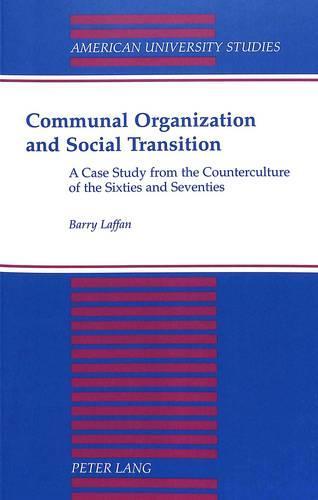
Author: Barry Laffan
Publisher: Peter Lang Publishing Inc
Imprint: Peter Lang Publishing Inc
Edition: New edition
Volume: 46
Weight: 0.450kg
ISBN: 9780820411934
ISBN 10: 0820411930
Pages: 288
Publication Date: 01 October 1997
Audience:
Professional and scholarly
,
Professional & Vocational
Format: Paperback
Publisher's Status: Active
Availability: Available To Order

We have confirmation that this item is in stock with the supplier. It will be ordered in for you and dispatched immediately.
Reviews
This is an extraordinary, absolutely unique book about the counterculture of the late 1960s through the 1970s. Here, laid out in meticulous and abundant detail, is an historical account of the genesis of the hippie communes of Vermont and adjacent rural areas. In addition to being a great chronicler of the counterculture, Barry Laffan, now deceased, was a superb master of participant observation who lived with the communards and experienced their everyday joys and sorrows firsthand. The communards were convinced that they could upend America by removing themselves from the world of capitalist strivings. Again and again however, their sublime intentions ended in disasters... And yet Laffan does not shrink from proposing that the counterculture on balance helped to bring about permanent and beneficial changes for a more open and democratic society. Readers will find enough objective data in Laffan's treatise to make up their own minds. (Marvin Harris, Department of Anthropology, University of Florida) This is the definitive study of not only one commune, but also of the conflicting values, ideologies, and status differences the countercultural communitarians everywhere confronted and tried to resolve. From its beginning to its end, Laffan chronicles the social life of youthful idealists who hoped to live the better life. (Arthur J. Vidich, Senior Lecturer and Professor Emeritus of Sociology and Anthropology, New School For Social Research) Barry Laffan has given new life to anthropology's 'participant observation'. Instead of looking at people from the outside, he participated with high commitment in the commune culture in order to understand their ideas,feelings, and actions from the inside. At the same time, he managed to achieve an admirably rigorous degree of objectivity in his observations. These events, twenty-five years later, might seem like ancient history, except that Barry Laffan has shown us how to see their connections with the present-day culture of advanced industrial society. An extraordinarily valuable piece of work. (Herbert Passin, Professor Emeritus, Columbia University) 'Communal Organization and Social Transition' is one of the finest ethnographies I have ever read. Like all works in this genre its attention to fine detail gives the reader a sense of 'being there': of participating in the euphoria that brought Jackson's Meadows to life, and of being part of those events that precipitated the commune's decline and demise... Not only does this work follow the internal evolution of Jackson's Meadows itself, but it painstakingly situates Jackson's Meadows in the complex nexus of those local communal experiments as it evolved in those wonderful decades of utopian hope and romantic excess... As a historical document it depicts from the bottom up the revolutionary spirit of the sixties and seventies as it was lived in the everyday lives of those caught up in the momentous social and cultural shifts wracking American society during those decades. What strikes me most about this aspect of the book is its painful honesty - its principled refusal to be seduced by nostalgia or diverted from its mission by retrospective revisionism. This is 'history from the bottom up' at its finest: honest, unapologetic, and filled with intellectual integrity and passion that is emblematic of the excellence we in the social sciences seek to achieve. (David L. Harvey, Professor of Sociology, University of Nevada, Reno)