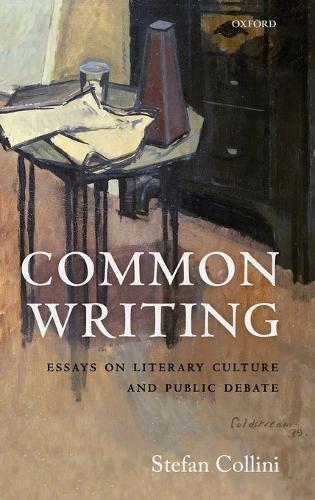
Full Product Details
Author: Stefan Collini (Professor Emeritus of Intellectual History and English Literature, Professor Emeritus of Intellectual History and English Literature, University of Cambridge)
Publisher: Oxford University Press
Imprint: Oxford University Press
Dimensions:
Width: 17.10cm
, Height: 2.60cm
, Length: 23.60cm
Weight: 0.668kg
ISBN: 9780198758969
ISBN 10: 0198758960
Pages: 366
Publication Date: 17 March 2016
Audience:
College/higher education
,
Undergraduate
,
Postgraduate, Research & Scholarly
Format: Hardback
Publisher's Status: Active
Availability: To order

Stock availability from the supplier is unknown. We will order it for you and ship this item to you once it is received by us.
Reviews
Collini offers a series of companionable, entertaining and often insightful considerations of his subjects. He has a gift for evoking a powerful sense of a particular writer's work and personality; his attention to their use of language is usually careful, sensitive and revealing; and he shows a willingness to argue against himself that lends his judgements extra subtlety, interest and weight. Prospect elegant and arch series of essays on modern English intellectual life Oxford Today
His [Collini's] task here, which he performs with admirable aplomb, is to eulogize the passing order ... [an] absorbing book David Hawkes, Times Literary Supplement One of the strengths of Common Writing is the success with which Collini is able to show why his discipline matters. Rafe McGregor, Review 31 Collini offers a series of companionable, entertaining and often insightful considerations of his subjects. He has a gift for evoking a powerful sense of a particular writer's work and personality; his attention to their use of language is usually careful, sensitive and revealing; and he shows a willingness to argue against himself that lends his judgements extra subtlety, interest and weight. Prospect elegant and arch series of essays on modern English intellectual life Oxford Today
Collini provides intelligent discussions of the lives and works of a range of individuals - writers, literary critics, historians, and other intellectuals - whose work has appealed to an audience beyond the strictly scholarly or academically inclined ... The range of the book is welcome, in particular because it offers thoughtful commentary on figures who may be less familiar, such as R. M. Titmuss, Herbert Butterfield, Timothy Garton Ash, and specialists in other fields ... Recommended. * CHOICE * at his best he [Collini] transforms our understanding of an author and the world in which he - and it is almost always he - works ... it would be worth handing these volumes on to students to give them a keener sense of how to write, for both these authors are brilliant stylists as well as important thinkers; indeed, they make the point ... that to write well is to think well. If they convey nothing more than that - and, read attentively, they will convey far more - these books will have served a most useful purpose. * William Whyte, Twentieth Century British History * elegant and arch series of essays on modern English intellectual life * Oxford Today * Collini offers a series of companionable, entertaining and often insightful considerations of his subjects. He has a gift for evoking a powerful sense of a particular writer's work and personality; his attention to their use of language is usually careful, sensitive and revealing; and he shows a willingness to argue against himself that lends his judgements extra subtlety, interest and weight. * Prospect * One of the strengths of Common Writing is the success with which Collini is able to show why his discipline matters. * Rafe McGregor, Review 31 * His [Collini's] task here, which he performs with admirable aplomb, is to eulogize the passing order ... [an] absorbing book * David Hawkes, Times Literary Supplement * eloquently acerbic prose * Robert Irwin, Books of the Year 2016, Times Literary Supplement *
Author Information
Stefan Collini was Professor of Intellectual History and English Literature at Cambridge until 2014. Educated at Cambridge and Yale, he taught at the University of Sussex for 12 years before moving to Cambridge in 1986. He is a frequent contributor to The London Review of Books, The Times Literary Supplement, The Guardian, The Nation, and other periodicals. He is a Fellow of the British Academy and of the Royal Historical Society.