|
|
|||
|
||||
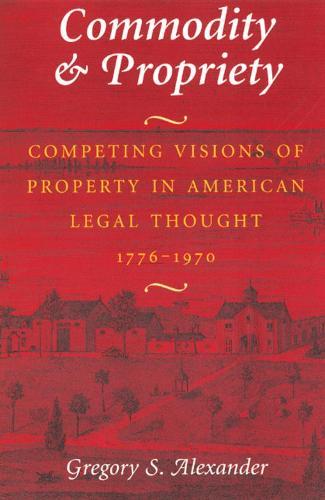
OverviewMost people understand property as something that is owned, a means of creating individual wealth. But in Commodity and Propriety, the first full-length history of the meaning of property, Gregory Alexander uncovers in American legal writing a competing vision of property that has existed alongside the traditional conception. Property, Alexander argues, has also been understood as proprietary, a mechanism for creating and maintaining a properly ordered society. This view of property has even operated in periods—such as the second half of the nineteenth century—when market forces seemed to dominate social and legal relationships. In demonstrating how the understanding of property as a private basis for the public good has competed with the better-known market-oriented conception, Alexander radically rewrites the history of property, with significant implications for current political debates and recent Supreme Court decisions. Full Product DetailsAuthor: Gregory S. AlexanderPublisher: The University of Chicago Press Imprint: University of Chicago Press Dimensions: Width: 1.60cm , Height: 0.40cm , Length: 2.30cm Weight: 0.879kg ISBN: 9780226013534ISBN 10: 0226013537 Pages: 496 Publication Date: 03 February 1998 Audience: College/higher education , Professional and scholarly , Undergraduate , Postgraduate, Research & Scholarly Format: Hardback Publisher's Status: Out of Stock Indefinitely Availability: Awaiting stock Table of Contents"Acknowledgments Introduction Pt. 1: The Civic Republican Culture, 1776-1800 Prologue: Legal Writing in the Civic Republican Era 1: Thomas Jefferson and the Civic Conception of Property 2: Time, History, and Property in the Republican Vision 3: Descent and Dissent from the Civic Meaning of Property Pt. 2: The Commercial Republican Culture, 1800-1860 Prologue: Legal Writing in the Commercial Republican Era 4: ""Liberality"" vs. ""Technicality"": Statutory Revision of Land Law in the Jacksonian Age 5: James Kent and the Ambivalent Romance of Commerce 6: Antebellum Statutory Law Reform Revisited: The Married Women's Property Laws 7: Ambiguous Entrepreneurialism: The Rise and Fall of Vested Rights in the Antebellum Era 8: Commodifying Humans: Property in the Antebellum Legal Discourse of Slavery Pt. 3: The Industrial Culture, 1870-1917 Prologue: Legal Writing in the Age of Enterprise 9: The Dilemma of Property in Public Law during the Age of Enterprise: Power and Democracy 10: The Dilemma of Property in the Private Sphere: Alienability and Paternalism Pt. 4: The Late Modern Culture, 1917-1970 Prologue: Legal Writing in the Twentieth Century - The Demise of Legal Autonomy 11: Socializing Property: The Influence of Progressive-Realist Legal Thought 12: Property in the Welfare State: Postwar Legal Thought, 1945-1970 Epilogue Notes Index"ReviewsAuthor InformationGregory S. Alexander is the A. Robert Noll Professor of Law at Cornell Law School. He is the author or coauthor of several books, including Global Debate over Constitutional Property: The Competing Visions of Property in American Legal Thought, also published by the University of Chicago Press. Tab Content 6Author Website:Countries AvailableAll regions |
||||