Overview
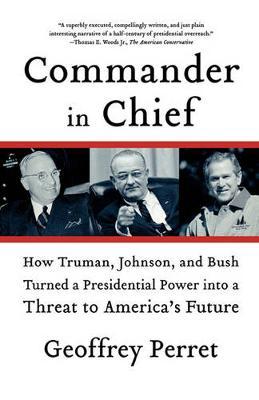
How Korea, Vietnam, and Iraq Made The Commander In Chief and Foretell the Future of America This is a story of ever-expanding presidential powers in an age of unwinnable wars. Harry Truman and Korea, Lyndon Johnson and Vietnam, George W. Bush and Iraq: three presidents, three ever broader interpretations of the commander in chief clause of the Constitution, three unwinnable wars, and three presidential secrets. Award-winning presidential biographer and military historian Geoffrey Perret places these men and events in the larger context of the post-World War II world to establish their collective legacy: a presidency so powerful it undermines the checks and balances built into the Constitution, thereby creating a permanent threat to the Constitution itself. In choosing to fight in Korea, Vietnam, and Iraq, Truman, Johnson, and Bush alike took counsel of their fears, ignored the advice of the professional military and major allies, and were influenced by facts kept from public view. Convinced that an ever-more powerful commander in chief was the key to victory, they misread the moment. Since World War II wars have become tests of stamina rather than strength, and more likely than not they sow the seeds of future wars. Yet recent American presidents have chosen to place their country in the forefront of fighting them. In the course of doing so, however, they gave away the secret of American power--for all its might, the United States can be defeated by chaos and anarchy.
Full Product Details
Author: Geoffrey Perret
Publisher: Farrar, Straus and Giroux
Imprint: Farrar, Straus and Giroux
Dimensions:
Width: 14.70cm
, Height: 2.90cm
, Length: 21.90cm
Weight: 0.603kg
ISBN: 9780374531270
ISBN 10: 0374531277
Pages: 448
Publication Date: 22 January 2008
Audience:
General/trade
,
General
Format: Paperback
Publisher's Status: Active
Availability: Out of print, replaced by POD

We will order this item for you from a manufatured on demand supplier.
Reviews
Praise for Jack: A portrait of Kennedy that is thoroughly grounded in fact, free of partisan bias and believable. -- The New York Times Book Review Perret captures the paradox at Kennedy's core: He was an idealist and a visionary who couldn't or wouldn't control his most adolescent urges. -- The Atlanta Journal-Constitution Praise for Jack: A portrait of Kennedy that is thoroughly grounded in fact, free of partisan bias and believable. -- The New York Times Book Review Perret captures the paradox at Kennedy' s core: He was an idealist and a visionary who couldn' t or wouldn' t control his most adolescent urges. -- The Atlanta Journal-Constitution A military historian examines how post-WWII presidents have drained American power by waging three unwinnable wars.Asked about the importance and consequences of the French Revolution, former Chinese Premier Chou En-lai responded, It's too soon to tell. No such timidity from Perret (Lincoln's War, 2004, etc.), who looks at the last 60 years and concludes that Iraq will break American power, that war between nation states is virtually over, that within a decade, fears about global warming will dwarf the War on Terror, that India, China and the EU will challenge a failing America to leave regional matters to the people who live there. We've reached this pass, Perret insists, because three American presidents, aided and abetted by fawning, half-bright advisors, a pliant Congress and a deceived public, have run away with their powers and recklessly inserted the nation into armed conflicts in Korea, Vietnam and Iraq. Furthermore, Perret argues, Truman, with his little-guy compl A military historian examines how post-WWII presidents have drained American power by waging three unwinnable wars.Asked about the importance and consequences of the French Revolution, former Chinese Premier Chou En-lai responded, It's too soon to tell. No such timidity from Perret (Lincoln's War, 2004, etc.), who looks at the last 60 years and concludes that Iraq will break American power, that war between nation states is virtually over, that within a decade, fears about global warming will dwarf the War on Terror, that India, China and the EU will challenge a failing America to leave regional matters to the people who live there. We've reached this pass, Perret insists, because three American presidents, aided and abetted by fawning, half-bright advisors, a pliant Congress and a deceived public, have run away with their powers and recklessly inserted the nation into armed conflicts in Korea, Vietnam and Iraq. Furthermore, Perret argues, Truman, with his little-guy complex, perhaps complicated by mood-enhancing drugs, Johnson and his inferiority complex with regard to predecessor JFK, and G.W. Bush with his Daddy complex, appear to have used war, no matter the consequences to the nation, to work out their own pathologies. Surely it's too soon to tell whether America's last three difficult wars will produce the remarkable turning point Perret sees, and certainly Presidents Gone Wild is too glib an explanation for our involvement. But while it's easy to reject the author's judgment, it's impossible to resist his storytelling. He writes in the in-the-room brand of history, full of anecdotes, trivia and acidic portraits of presidential courtiers. Indeed, the chief delight here is the serial takedown of such sacred Washington cows as Clark Clifford ( a little too smooth, a little too pleased with himself ) and Paul Wolfowitz ( a graying vulgarian ).A fast-moving, sharply told history that arrives at controversial conclusions. --Kirkus Reviews-> A military historian examines how post-WWII presidents have drained American power by waging three unwinnable wars.Asked about the importance and consequences of the French Revolution, former Chinese Premier Chou En-lai responded, It's too soon to tell. No such timidity from Perret (Lincoln's War, 2004, etc.), who looks at the last 60 years and concludes that Iraq will break American power, that war between nation states is virtually over, that within a decade, fears about global warming will dwarf the War on Terror, that India, China and the EU will challenge a failing America to leave regional matters to the people who live there. We've reached this pass, Perret insists, because three American presidents, aided and abetted by fawning, half-bright advisors, a pliant Congress and a deceived public, have run away with their powers and recklessly inserted the nation into armed conflicts in Korea, Vietnam and Iraq. Furthermore, Perret argues, Truman, with his little-guy complex, perhaps complicated by mood-enhancing drugs, Johnson and his inferiority complex with regard to predecessor JFK, and G.W. Bush with his Daddy complex, appear to have used war, no matter the consequences to the nation, to work out their own pathologies. Surely it's too soon to tell whether America's last three difficult wars will produce the remarkable turning point Perret sees, and certainly Presidents Gone Wild is too glib an explanation for our involvement. But while it's easy to reject the author's judgment, it's impossible to resist his storytelling. He writes in the in-the-room brand of history, full of anecdotes, trivia and acidic portraits of presidential courtiers. Indeed, the chief delight here is the serial takedown of such sacred Washington cows as Clark Clifford ( a little too smooth, a little too pleased with himself ) and Paul Wolfowitz ( a graying vulgarian ).A fast-moving, sharply told history that arrives at controversial conclusions. Kirkus Reviews A military historian examines how post-WWII presidents have drained American power by waging three unwinnable wars.Asked about the importance and consequences of the French Revolution, former Chinese Premier Chou En-lai responded, It's too soon to tell. No such timidity from Perret (Lincoln's War, 2004, etc.), who looks at the last 60 years and concludes that Iraq will break American power, that war between nation states is virtually over, that within a decade, fears about global warming will dwarf the War on Terror, that India, China and the EU will challenge a failing America to leave regional matters to the people who live there. We've reached this pass, Perret insists, because three American presidents, aided and abetted by fawning, half-bright advisors, a pliant Congress and a deceived public, have run away with their powers and recklessly inserted the nation into armed conflicts in Korea, Vietnam and Iraq. Furthermore, Perret argues, Truman, with his little-guy complex, perhaps complicated by mood-enhancing drugs, Johnson and his inferiority complex with regard to predecessor JFK, and G.W. Bush with his Daddy complex, appear to have used war, no matter the consequences to the nation, to work out their own pathologies. Surely it's too soon to tell whether America's last three difficult wars will produce the remarkable turning point Perret sees, and certainly Presidents Gone Wild is too glib an explanation for our involvement. But while it's easy to reject the author's judgment, it's impossible to resist his storytelling. He writes in the in-the-room brand of history, full of anecdotes, trivia and acidic portraits of presidential courtiers. Indeed, the chief delight here is the serial takedown of such sacred Washington cows as Clark Clifford ( a little too smooth, a little too pleased with himself ) and Paul Wolfowitz ( a graying vulgarian ).A fast-moving, sharply told history that arrives at controversial conclusions. --Kirkus Reviews
A military historian examines how post-WWII presidents have drained American power by waging three unwinnable wars.Asked about the importance and consequences of the French Revolution, former Chinese Premier Chou En-lai responded, It's too soon to tell. No such timidity from Perret (Lincoln's War, 2004, etc.), who looks at the last 60 years and concludes that Iraq will break American power, that war between nation states is virtually over, that within a decade, fears about global warming will dwarf the War on Terror, that India, China and the EU will challenge a failing America to leave regional matters to the people who live there. We've reached this pass, Perret insists, because three American presidents, aided and abetted by fawning, half-bright advisors, a pliant Congress and a deceived public, have run away with their powers and recklessly inserted the nation into armed conflicts in Korea, Vietnam and Iraq. Furthermore, Perret argues, Truman, with his little-guy complex, perhaps complicated by mood-enhancing drugs, Johnson and his inferiority complex with regard to predecessor JFK, and G.W. Bush with his Daddy complex, appear to have used war, no matter the consequences to the nation, to work out their own pathologies. Surely it's too soon to tell whether America's last three difficult wars will produce the remarkable turning point Perret sees, and certainly Presidents Gone Wild is too glib an explanation for our involvement. But while it's easy to reject the author's judgment, it's impossible to resist his storytelling. He writes in the in-the-room brand of history, full of anecdotes, trivia and acidic portraits of presidentialcourtiers. Indeed, the chief delight here is the serial takedown of such sacred Washington cows as Clark Clifford ( a little too smooth, a little too pleased with himself ) and Paul Wolfowitz ( a graying vulgarian ).A fast-moving, sharply told history that arrives at controversial conclusions. --Kirkus Reviews
Author Information
Geoffrey Perret is the award-winning author of twelve previous books, including Ulysses S. Grant, Eisenhower, and Lincoln's War. He has been a consultant for PBS, C-Span, and the History Channel.