Overview
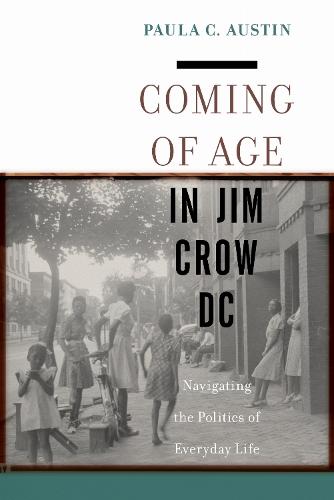
The fullest account to date of African American young people in a segregated city Coming of Age in Jim Crow DC offers a complex narrative of the everyday lives of black young people in a racially, spatially, economically, and politically restricted Washington, DC, during the 1930s. In contrast to the ways in which young people have been portrayed by researchers, policy makers, law enforcement, and the media, Paula C. Austin draws on previously unstudied archival material to present black poor and working class young people as thinkers, theorists, critics, and commentators as they reckon with the boundaries imposed on them in a Jim Crow city that was also the American emblem of equality. The narratives at the center of this book provide a different understanding of black urban life in the early twentieth century, showing that ordinary people were expert at navigating around the limitations imposed by the District of Columbia's racially segregated politics. Coming of Age in Jim Crow DC is a fresh take on the New Negro movement, and a vital contribution to the history of race in America.
Full Product Details
Author: Paula C. Austin
Publisher: New York University Press
Imprint: New York University Press
Weight: 0.445kg
ISBN: 9781479894994
ISBN 10: 1479894990
Pages: 208
Publication Date: 10 December 2019
Audience:
Professional and scholarly
,
Professional & Vocational
Format: Hardback
Publisher's Status: Active
Availability: Manufactured on demand

We will order this item for you from a manufactured on demand supplier.
Reviews
"""A superlative analysis [...] Austin restores the humanity of poor and working-class black youth, who lived through the Jim Crow era in Washington, D.C., by reading against the grain. She locates the ideas, thoughts, and intellectual frameworks of youths such as seventeen-year-old Louise Freely, who wrote twelve poems that were simply discarded by the social science investigators who deemed her thoughts unimportant to their larger sociological analysis of black youths in the district at the time. Coming of Age in Jim Crow DC might be easily used in several courses in the humanities and social sciences."" * The Journal of Southern History * ""An excellent roadmap for the elusive quest to illuminate the everyday lives of black children in the nation’s capital [...] Her methodological insights will be of great value to scholars of the African-American experience."" * The Journal of Interdisciplinary History * ""Coming of Age is an invaluable addition to Washington, DC social and cultural studies, which are a constant dialogue among history, symbol, access, inclusion—a clash between lofty promises and failed ideals."" * Washington History * ""Austin makes a vital contribution to the history of race, youth, and urban studies by creatively mining the original interviews gathered by early social scientists E. Franklin Frazier and William Henry Jones and their assistants. Her book both reveals new dimensions of African American history and offers a generative method for interpreting the raw data of early twentieth century social science. An excellent, insightful, and engaging book."" -- Corinne T. Field, University of Virginia. ""Paula C. Austin’s book provides fascinating insight into a much overlooked and understudied topic: the personal thoughts, social psychology and, most important, social analysis of black young adults during a formative period in American urban history. With this book’s treatment of young people as theorists, thinkers, critics, and commentators, Austin provides an important contribution to histories of cities and of African Americans during the interwar period, the age of the New Negro Renaissance, in which black people emerged as formative artists, intellectuals, and activists."" -- Brian Purnell, Geoffrey Canada Associate Professor of Africana Studies and History, Bowdoin College"
An excellent roadmap for the elusive quest to illuminate the everyday lives of black children in the nation's capital [...] Her methodological insights will be of great value to scholars of the African-American experience. * The Journal of Interdisciplinary History * A superlative analysis ... Austin restores the humanity of poor and working-class black youth, who lived through the Jim Crow era in Washington, D.C., by reading against the grain. She locates the ideas, thoughts, and intellectual frameworks of youths such as seventeen-year-old Louise Freely, who wrote twelve poems that were simply discarded by the social science investigators who deemed her thoughts unimportant to their larger sociological analysis of black youths in the district at the time. Coming of Age in Jim Crow DC might be easily used in several courses in the humanities and social sciences. * The Journal of Southern History * Austin makes a vital contribution to the history of race, youth, and urban studies by creatively mining the original interviews gathered by early social scientists E. Franklin Frazier and William Henry Jones and their assistants. Her book both reveals new dimensions of African American history and offers a generative method for interpreting the raw data of early twentieth century social science. An excellent, insightful, and engaging book. -- Corinne T. Field, University of Virginia. Paula C. Austin's book provides fascinating insight into a much overlooked and understudied topic: the personal thoughts, social psychology and, most important, social analysis of black young adults during a formative period in American urban history. With this book's treatment of young people as theorists, thinkers, critics, and commentators, Austin provides an important contribution to histories of cities and of African Americans during the interwar period, the age of the New Negro Renaissance, in which black people emerged as formative artists, intellectuals, and activists. -- Brian Purnell, Geoffrey Canada Associate Professor of Africana Studies and History, Bowdoin College
A superlative analysis [...] Austin restores the humanity of poor and working-class black youth, who lived through the Jim Crow era in Washington, D.C., by reading against the grain. She locates the ideas, thoughts, and intellectual frameworks of youths such as seventeen-year-old Louise Freely, who wrote twelve poems that were simply discarded by the social science investigators who deemed her thoughts unimportant to their larger sociological analysis of black youths in the district at the time. Coming of Age in Jim Crow DC might be easily used in several courses in the humanities and social sciences. * The Journal of Southern History * An excellent roadmap for the elusive quest to illuminate the everyday lives of black children in the nation’s capital [...] Her methodological insights will be of great value to scholars of the African-American experience. * The Journal of Interdisciplinary History * Coming of Age is an invaluable addition to Washington, DC social and cultural studies, which are a constant dialogue among history, symbol, access, inclusion—a clash between lofty promises and failed ideals. * Washington History * Austin makes a vital contribution to the history of race, youth, and urban studies by creatively mining the original interviews gathered by early social scientists E. Franklin Frazier and William Henry Jones and their assistants. Her book both reveals new dimensions of African American history and offers a generative method for interpreting the raw data of early twentieth century social science. An excellent, insightful, and engaging book. -- Corinne T. Field, University of Virginia. Paula C. Austin’s book provides fascinating insight into a much overlooked and understudied topic: the personal thoughts, social psychology and, most important, social analysis of black young adults during a formative period in American urban history. With this book’s treatment of young people as theorists, thinkers, critics, and commentators, Austin provides an important contribution to histories of cities and of African Americans during the interwar period, the age of the New Negro Renaissance, in which black people emerged as formative artists, intellectuals, and activists. -- Brian Purnell, Geoffrey Canada Associate Professor of Africana Studies and History, Bowdoin College
Austin makes a vital contribution to the history of race, youth, and urban studies by creatively mining the original interviews gathered by early social scientists E. Franklin Frazier and William Henry Jones and their assistants. Her book both reveals new dimensions of African American history and offers a generative method for interpreting the raw data of early twentieth century social science. An excellent, insightful, and engaging book. --Corinne T. Field, University of Virginia. Paula C. Austin's book provides fascinating insight into a much overlooked and understudied topic: the personal thoughts, social psychology and, most important, social analysis of black young adults during a formative period in American urban history. With this book's treatment of young people as theorists, thinkers, critics, and commentators, Austin provides an important contribution to histories of cities and of African Americans during the interwar period, the age of the New Negro Renaissance, in which black people emerged as formative artists, intellectuals, and activists. --Brian Purnell, Geoffrey Canada Associate Professor of Africana Studies and History, Bowdoin College
Author Information
Paula C. Austin is Assistant Professor of History and African American Studies at Boston University. She writes and teaches about Black visual culture, African American and civil rights history, and facilitates faculty professional development on diversity, equity, and inclusion.