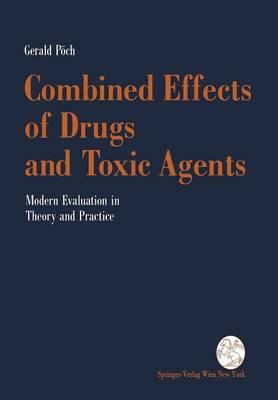
Combined Effects of Drugs and Toxic Agents: Modern Evaluation in Theory and Practice

Author:   Gerald Pöch
Publisher:   Springer Verlag GmbH
ISBN:  

9783211824344


Pages:   167
Publication Date:   16 March 1993
Format:   Paperback
Availability:   Out of stock   Availability explained
The supplier is temporarily out of stock of this item. It will be ordered for you on backorder and shipped when it becomes available.

Our Price $184.67 Quantity:  
Add to Cart

Share |

Combined Effects of Drugs and Toxic Agents: Modern Evaluation in Theory and Practice


Overview

Scientists struggling with the pharmaco-and toxicodynamic interactions of drugs and chemicals will find this a valuable reference to the relevant theoretical background of a complex field as well as a guide to practical, analytical procedures for the evaluation of experimental data. A mechanistically-based analysis of observed combination effects is backed up by numerous examples as well as computer-assisted plotting and curve fitting, using popular graphical software systems. Readers can proceed directly to the evaluation of their own dose-response experiments with respect to independent actions and additive interactions, where appropriate. The meanings of terms and acronyms are illucidated by a comprehensive glossary.

Full Product Details

Author:   Gerald Pöch
Publisher:   Springer Verlag GmbH
Imprint:   Springer Verlag GmbH
Dimensions:   Width: 17.00cm , Height: 1.00cm , Length: 24.40cm
Weight:   0.322kg
ISBN:  

9783211824344


ISBN 10:   3211824340
Pages:   167
Publication Date:   16 March 1993
Audience:   Professional and scholarly ,  Professional & Vocational
Format:   Paperback
Publisher's Status:   Active
Availability:   Out of stock   Availability explained
The supplier is temporarily out of stock of this item. It will be ordered for you on backorder and shipped when it becomes available.

Table of Contents

1 Principle considerations of drug actions and interactions.- 1.1 Introduction.- 1.2 Dose-response curves.- 1.2.1 The parameters of dose-response curves.- 1.2.2 Models and curve-fitting.- 1.2.3 Comparison of curves.- 1.3 Time course of effects.- 1.4 Phenomena and mechanisms: interactions between drugs - antagonism and synergism.- 1.4.1 Simple interactions.- 1.4.2 Complex interactions.- Phenomena.- Mechanisms of interaction.- 2 Concepts and models of interactions - additivity and independence.- 2.1 Concept and phenomenon of additivity.- 2.1.1 Historical perspective.- 2.1.2 The isobologram.- 2.1.3 Dose-response curves.- 2.1.4 Mechanism underlying additivity.- 2.1.5 Additive dose-response curves.- 2.1.6 Comparison of effect-additive with dose-additive combinations.- 2.2 Site-directed analysis.- 2.3 Concept of independence.- 2.3.1 Calculation of independent effects.- 2.3.2 Independent dose-response curves.- 2.4 Relationship between additivity and independence.- 2.4.1 Dose-additive and independent combinations.- 2.4.2 Effect-additive and independent combinations.- 2.5 Summary and conclusions.- 2.6 Tips and hints.- 3 Synergism/potentiation and antagonism - phenomena and mechanisms.- 3.1 The current dilemma.- 3.1.1 The effect approach .- 3.1.2 The dose approach (evaluation of isobolograms).- 3.2 Towards a uniform characterization of synergism/potentiation and antagonism.- 3.3 Potentiation (synergism).- 3.3.1 Net effects.- 3.3.2 Total effects.- 3.4 Antagonism.- 3.4.1 The effect approach .- 3.4.2 The dose approach (evaluation of isobolograms).- 3.5 Comparison of complex with simple interactions.- 3.6 Quantitative expression of combined effects.- 3.6.1 The combination index (CI).- 3.6.2 Comparison of CI and combined-effect graph.- 3.7 Suggestions for quantitation of combined effects.- 3.8 Tips and hints.- 4 Evaluation by dose-response curves.- 4.1 New methodological approach: fixed-dose studies.- 4.1.1 Construction of experimental and theoretical dose-response curves.- 4.1.2 Statistical comparison of observed and expected response 58 Chi-square goodness-of-fit test 58 * F-test.- 4.1.3 Expression of results and examples.- 4.2 Fixed dose-ratio combinations.- 4.2.1 Dose-additive interactions.- 4.2.2 Independent actions.- 4.2.3 Multiple combinations.- 4.3 Tips and hints.- 5 Evaluation by time-course studies.- 5.1 Time course of independent actions.- 5.2 Dose-additive time course.- 5.3 Statistical comparison of observed and expected time course.- 5.4 Time-course studies with log response scale.- 5.5 Comparison of time-course studies and dose-response studies.- 5.6 Conclusions.- 6 Single-dose and other studies.- 6.1 Single-dose studies.- 6.1.1 Comparison with effect-additive.- 6.1.2 Comparison with independence.- 6.1.3 Comparison with additivity.- 6.1.4 Tips and hints.- 6.2 Other studies.- 7 Combined-effect graph and other graphs.- 7.1 The construction of the combined-effect graph.- 7.1.1 Percent of maximum response.- 7.1.2 Percent of control response.- 7.2 Comparison of observed with independent effects.- 7.3 Yonetani-Theorell plot for enzyme inhibitors.- 7.4 Tips and hints.- 8 Applications of the new approach and observations.- 8.1 Biochemistry and physiology/pathophysiology.- 8.1.1 Dual inhibition of enzyme activity.- 8.1.2 Physiology.- 8.1.3 Pathophysiology.- 8.2 Experimental pharmacology.- 8.2.1 Dose-response studies: site of action.- 8.2.2 Extent of enhancement.- 8.2.3 Unspecifically acting agents in combination.- 8.3 Clinical pharmacology - drug combinations.- 8.3.1 Dose-response studies.- 8.3.2 Drug mixtures: dose-response studies.- 8.3.3 Drug mixtures: time-course studies.- 8.3.4 Single-dose studies.- 8.4 Chemotherapy of infections and tumors.- 8.4.1 Therapy of infections.- 8.4.2 Tumortherapy.- 8.5 Experimental and environmental toxicology.- 8.5.1 Examples of toxic interactions.- 8.6 Epidemiology - risks.- 8.7 Herbicides.- 8.8 Conclusions and discussion.- 8.8.1 Methods.- 8.8.2 Comparison with model interactions.- 9 A new and critical view of isobolograms.- 9.1 Inappropriate conclusions.- 9.2 Pitfalls.- 10 Comparison of the new with the conventional approach.- 10.1 Experimental dose-response curves and isobolograms.- 10.1.1 Concurring interpretation.- 10.1.2 Different and controversial interpretation.- Envelope of additivity in isobolograms.- Nonconsideration and incorrect calculation of independence.- 10.2 Evaluation of combined effects in the future.- Epilog.- Appendix A - Glossary of terms and abbreviations.- Appendix B - Guide to practical work: exercise examples.- References.

Reviews

Author Information

Tab Content 6

Author Website:  

Countries Available

All regions
Latest Reading Guide

NOV RG 20252


Shopping Cart
Your cart is empty
Shopping cart
Mailing List