Awards
- Winner of <DIV>A <I>Choice</I> Outstanding Academic Title, 2017</DIV> 2017
Overview
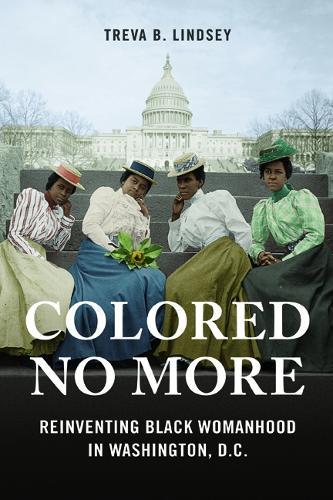
Home to established African American institutions and communities, Washington, D.C., offered women in the New Negro movement a unique setting for the fight against racial and gender oppression. Colored No More traces how African American women of the late-nineteenth and early twentieth century made significant strides toward making the nation's capital a more equal and dynamic urban center. Treva B. Lindsey presents New Negro womanhood as a multidimensional space that included race women, blues women, mothers, white collar professionals, beauticians, fortune tellers, sex workers, same-gender couples, artists, activists, and innovators. Drawing from these differing but interconnected African American women's spaces, Lindsey excavates a multifaceted urban and cultural history of struggle toward a vision of equality that could emerge and sustain itself. Upward mobility to equal citizenship for African American women encompassed challenging racial, gender, class, and sexuality status quos. Lindsey maps the intersection of these challenges and their place at the core of New Negro womanhood.
Full Product Details
Author: Treva B. Lindsey
Publisher: University of Illinois Press
Imprint: University of Illinois Press
Dimensions:
Width: 15.20cm
, Height: 1.50cm
, Length: 22.90cm
Weight: 0.227kg
ISBN: 9780252082511
ISBN 10: 0252082516
Pages: 204
Publication Date: 29 March 2017
Audience:
Professional and scholarly
,
Professional & Vocational
Format: Paperback
Publisher's Status: Active
Availability: Out of stock

The supplier is temporarily out of stock of this item. It will be ordered for you on backorder and shipped when it becomes available.
Reviews
A timely and important book that centers black women in the New Negro era--a long overdue addition to the history and historiography. --Danielle L. McGuire, author of At the Dark End of the Street: Black Women, Rape, and Resistance--A New History of the Civil Rights Movement from Rosa Parks to the Rise of Black Power An insightful book theoretically framed around ideas of 'Colored' and New Negro Womanhood. Lindsey demonstrates how Black women in Washington, D.C., labored and managed under the strains of Jim and Jane Crow, navigating structural disadvantages and persistent sexist exclusion in the nation's capital. Lindsey makes abundantly clear that the diverse efforts of Black Washingtonian women, from political organizing to cultural productions, pushed the boundaries of culturally accepted norms and laid a foundation for latter liberationist movements led by Black women within their communities both locally and nationally. --Randal Maurice Jelks, author of Benjamin Elijah Mays, Schoolmaster of the Movement: A Biography Treva Lindsey, in Colored No More, is as bold as the women about whom she writes. Fresh research, illuminated by feminist theory, reveals how 'New Negro Womanhood' became a framework through which African American women developed modern identities. The politics of respectability confront the politics of pleasure in this outstanding study. --Martha S. Jones, author of All Bound Up Together: The Woman Question in African American Public Culture, 1830-1900
A timely and important book that centers black women in the New Negro era--a long overdue addition to the history and historiography. --Danielle L. McGuire, author of <i>At the Dark End of the Street: Black Women, Rape, and Resistance--A New History of the Civil Rights Movement from Rosa Parks to the Rise of Black Power</i>
A timely and important book that centers black women in the New Negro era--a long overdue addition to the history and historiography. --Danielle L. McGuire, author of At the Dark End of the Street: Black Women, Rape, and Resistance--A New History of the Civil Rights Movement from Rosa Parks to the Rise of Black Power An insightful book theoretically framed around ideas of 'Colored' and New Negro Womanhood. Lindsey demonstrates how Black women in Washington, D.C., labored and managed under the strains of Jim and Jane Crow, navigating structural disadvantages and persistent sexist exclusion in the nation's capital. Lindsey makes abundantly clear that the diverse efforts of Black Washingtonian women, from political organizing to cultural productions, pushed the boundaries of culturally accepted norms and laid a foundation for latter liberationist movements led by Black women within their communities both locally and nationally. --Randal Maurice Jelks, author of Benjamin Elijah Mays, Schoolmaster of the Movement: A Biography Treva Lindsey, in Colored No More, is as bold as the women about whom she writes. Fresh research, illuminated by feminist theory, reveals how 'New Negro Womanhood' became a framework through which African American women developed modern identities. The politics of respectability confront the politics of pleasure in this outstanding study. --Martha S. Jones, author of All Bound Up Together: The Woman Question in African American Public Culture, 1830-1900 Lindsey's brilliantly researched book adds to black culture by mapping out the intersections of various identities of African-American women who shaped black life on a local and national scale. --Vibe
Treva Lindsey, in Colored No More, is as bold as the women about whom she writes. Fresh research, illuminated by feminist theory, reveals how 'New Negro Womanhood' became a framework through which African American women developed modern identities. The politics of respectability confront the politics of pleasure in this outstanding study. --Martha S. Jones, author of All Bound Up Together: The Woman Question in African American Public Culture, 1830-1900 An insightful book theoretically framed around ideas of 'Colored' and New Negro Womanhood. Lindsey demonstrates how Black women in Washington, D.C., labored and managed under the strains of Jim and Jane Crow, navigating structural disadvantages and persistent sexist exclusion in the nation's capital. Lindsey makes abundantly clear that the diverse efforts of Black Washingtonian women, from political organizing to cultural productions, pushed the boundaries of culturally accepted norms and laid a foundation for latter liberationist movements led by Black women within their communities both locally and nationally. --Randal Maurice Jelks, author of Benjamin Elijah Mays, Schoolmaster of the Movement: A Biography A timely and important book that centers black women in the New Negro era--a long overdue addition to the history and historiography. --Danielle L. McGuire, author of At the Dark End of the Street: Black Women, Rape, and Resistance--A New History of the Civil Rights Movement from Rosa Parks to the Rise of Black Power
Author Information
Treva B. Lindsey is an associate professor of women's, gender, and sexuality studies at The Ohio State University.