Overview
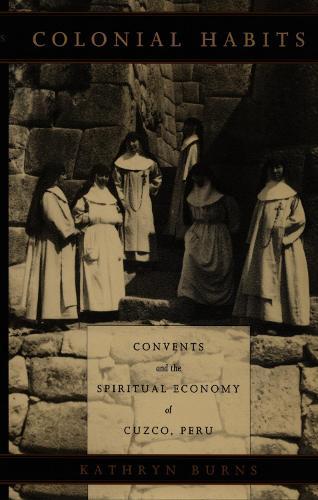
In ""Colonial Habits"" Kathryn Burns transforms our view of nuns as marginal recluses to one of central actors on the colonial stage. Beginning with the 1558 founding of South America's first convent, Burns shows how nuns in Cuzco, Peru played an active part in reproducing an Andean colonial order in which economic and spiritual interests were inextricably fused. Based on unprecedented archival research, ""Colonial Habits"" demonstrates how nuns became leading guarantors of their city's social order by making loans, managing property, containing ""unruly"" women and raising girls. The study also reveals, however, their active part in subjugating Incas and creating a Creole elite. Coining the phrase ""spiritual economy"" to analyze the intricate investments and relationships that enabled Cuzco's convents to thrive, Burns explains how, by the late 1700s, this economy had faltered badly, making convents the emblems of decay and a focal point for intense criticism of a failing colonial regime. The book concludes with the nuns' postcolonial retreat from their previous roles, marginalized in the construction of a new republican order. ""Colonial Habits"" should engage those interested in early modern economics, women in religion, Latin American studies and the history of gender, class and race.
Full Product Details
Author: Kathryn Burns
Publisher: Duke University Press
Imprint: Duke University Press
Weight: 0.653kg
ISBN: 9780822322597
ISBN 10: 0822322595
Pages: 320
Publication Date: 29 March 1999
Audience:
Professional and scholarly
,
Professional & Vocational
Format: Hardback
Publisher's Status: Active
Availability: In Print

This item will be ordered in for you from one of our suppliers. Upon receipt, we will promptly dispatch it out to you. For in store availability, please contact us.
Reviews
It is fascinating to revisit the history of Cuzco through the gates of the convent. Burns' clear, succinct prose, her gift for narrative, her eye for detail, and her engagement of larger issues of power, gender, and race make this an attractive book for a wide variety of readers. ([RR, PP, edited slightly] Brooke Larson, SUNY Stony Brook)
It is fascinating to revisit the history of Cuzco through the gates of the convent. Burns' clear, succinct prose, her gift for narrative, her eye for detail, and her engagement of larger issues of power, gender, and race make this an attractive book for a wide variety of readers. -Brooke Larson, SUNY Stony Brook Burns's important and highly readable work takes a fresh look at the key economic, social, and cultural relationships that created and sustained a densely woven urban-centered colonial society in the Andes. Among its new findings: at the heart of the economy of colonial Cuzco, a credit institution run by women favored the conquered indigenous elite with long-term finance at concessionary interest rates. -John Coatsworth, Harvard University [A] thoughtful and well-written study... [and] an important contribution to the understanding of Andean and Latin American history. -- Kenneth Mills American Historical Review [I]maginatively conceived and expertly executed. Dr. Burns writes a graceful and lucid prose that enlightens and delights. This is a book for specialists, for general readers curious about its subject matter, and for anyone who loves insightful and engaging works of history. -- John C. Moore Report of the Chairman of the Committee on the John Gilmary Shea Prize, The Catholic Historical R [I]maginatively researched, logically organized, and intelligently constructed... [T]his is a wonderful study. Colonial Habits makes an elegant and a major contribution to the history of women and gender in colonial and nineteenth-century Spanish America. Its accessibility will make it a natural assignment for undergraduates; its content will make it a standard for experts. -- Ann Twinam Journal of Women's History [M]eticulously researched and exquisitely written. Burns is one of the best prose writers working in the field today, and her story unfolds effortlessly and harmoniously... With her excellent book Kathyrn Burns, has thrown the evolution of Peru's Andean region into new relief, and produced a leading work within this emerging field. -- Ellen Gunnarsdottir Latin American Studies Burns provides an important means of addressing the role of Colonial Cuzco's convents, in a well-written and engaging narrative that incorporates archival documents from both administrative and religious archives. Vivid accounts of individual lives are well integrated with discussion of how Cuzco's nuns mediated the sacred/secular divide to advance or simply preserve their corporate interests. -- R. Alan Covey Comparative Study of Society and History Burns's fine study reveals the nuns as a critical factor in the subjugation of the Incas, the creation of a creole Peruvian elite, and in the annual provision of finance for the whole regional economy. -- Iain S. Maclean Religious Studies Review Carefully researched [and] well-written, ... Colonial Habits makes important contributions to the historiography of colonial Spanish America, and deserves a wide readership. -- Kenneth J. Andrien The Journal of Interdisciplinary History Except as saints and sinners, women have been marginalized in the study of colonial Peru. Kathryn Burns, however, in Colonial Habits, reconstructs the world of Cuzco by placing women at the center. The realignment is original and instructive, and, by focusing on convents, the author chooses virtually the only institution where women exercised real authority and gained some independence... [H]er book is a product of perseverance as well as of scholarship. Times Literary Supplement In a well-researched and carefully considered study, Kathryn Burns makes a serious case for the important role cloistered nuns played as the center of economic and spiritual life in colonial Cuzco from the sixteenth to nineteenth centuries, a role that remains influential to this day... Colonial Habits is a highly readable work that introduces valuable historical data and provides a fascinating analysis of the economy and spiritual interests in colonial Cuzco. -- Sister Maria Consuelo Sparks Colonial Latin American Historical Review In this fascinating and well-researched reconstruction of convent life, Burns lays the axe to several widespread assumptions... It is frequently said that to understand colonial religious life one must understand colonial society. But Colonial Habits suggests that the reverse is equally true-to undersand colonial society fully one must enter the inner world of its convents and monasteries. -- Jeffrey L. Klaiber Church History Kathryn Burns's book provides original insights into several of the most significant and contested areas of colonial history, particularly those concerning race, religion, family history, and economic development. Scholars of colonial Latin America will find much of interest in this fascinating, multi-faceted book. -- Elizabeth Anne Kuznesof The Americas Richly textured, this work is well anchored in archival research and fulfills the ambition of its author to create a new historical locus for the institutions as well as for the women who created and managed them. -- Asuncion Lavrin The Catholic Historical Review
""It is fascinating to revisit the history of Cuzco through the gates of the convent. Burns' clear, succinct prose, her gift for narrative, her eye for detail, and her engagement of larger issues of power, gender, and race make this an attractive book for a wide variety of readers."" ([RR, PP, edited slightly] Brooke Larson, SUNY Stony Brook)
Author Information
Kathryn Burns is Associate Professor of History at the University of North Carolina,Chapel Hill.