Overview
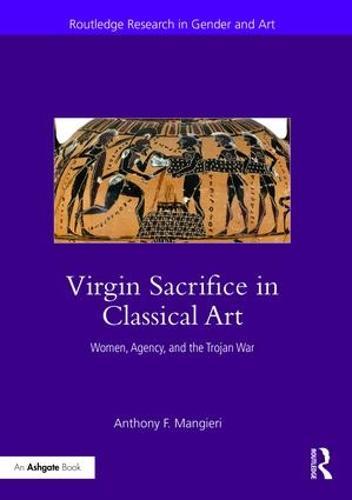
The Trojan War begins and ends with the sacrifice of a virgin princess. The gruesome killing of a woman must have captivated ancient people because the myth of the sacrificial virgin resonates powerfully in the arts of ancient Greece and Rome. Most scholars agree that the Greeks and Romans did not practice human sacrifice, so why then do the myths of virgin sacrifice appear persistently in art and literature for over a millennium? Virgin Sacrifice in Classical Art: Women, Agency, and the Trojan War seeks to answer this question. This book tells the stories of the sacrificial maidens in order to help the reader discover the meanings bound up in these myths for historical people. In exploring the representations of Iphigeneia and Polyxena in Greek, Etruscan, and Roman art, this book offers a broader cultural history that reveals what people in the ancient world were seeking in these stories. The result is an interdisciplinary study that offers new interpretations on the meaning of the sacrificial virgin as a cultural and ideological construction. This is the first book-length study of virgin sacrifice in ancient art and the first to provide an interpretive framework within which to understand its imagery.
Full Product Details
Author: Anthony F. Mangieri ,
ELORDI
Publisher: Taylor & Francis Ltd
Imprint: Routledge
Weight: 0.635kg
ISBN: 9780415301350
ISBN 10: 0415301351
Pages: 246
Publication Date: 03 October 2017
Audience:
College/higher education
,
Tertiary & Higher Education
,
Undergraduate
Format: Hardback
Publisher's Status: Active
Availability: In Print

This item will be ordered in for you from one of our suppliers. Upon receipt, we will promptly dispatch it out to you. For in store availability, please contact us.
Reviews
This refreshing, multi-faceted approach to analyzing visual representations of a most intriguing topic is a powerful argument for using myth, depicted both in art and literature, as a means for understanding how women and men in the classical Mediterranean world saw themselves and each other. - Keely Elizabeth Heuer, State University of New York at New Paltz
This refreshing, multi-faceted approach to analyzing visual representations of a most intriguing topic is a powerful argument for using myth, depicted both in art and literature, as a means for understanding how women and men in the classical Mediterranean world saw themselves and each other. - Keely Elizabeth Heuer, State University of New York at New Paltz
Author Information
Anthony F. Mangieri is Associate Professor of Art History and Coordinator of the Women, Gender, and Sexuality Studies program at Salve Regina University in Newport, Rhode Island, USA. He holds a Ph.D. in Greek and Roman art from Emory University. Mangieri has lectured widely and published articles on Greek art.