|
|
|||
|
||||
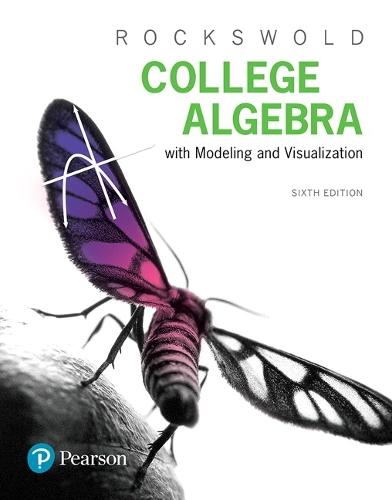
OverviewFor courses in College Algebra. Showing why math matters Gary Rockswold doesn’t just mention real-world examples; he teaches mathematical concepts through those applications. For example, if we look at Facebook usage over time, what might that tell us about linear growth and predictions? In this way, students learn the concepts in the context of the world they know, which leads to better understanding and retention. From there, the author shows a connection between application, modeling, and visualisation. Rockswold is known for presenting the concept of a function as a unifying theme, with an emphasis on the rule of four (verbal, graphical, numerical, and symbolic representations). The 6th Edition emphasises conceptual understanding with new in-chapter features and assignment options, while at the same time providing tools to empower instructors to make their classroom more active through collaboration and group work. Full Product DetailsAuthor: Gary RockswoldPublisher: Pearson Education (US) Imprint: Pearson Edition: 6th edition Dimensions: Width: 22.40cm , Height: 3.30cm , Length: 27.70cm Weight: 1.790kg ISBN: 9780134418049ISBN 10: 0134418042 Pages: 896 Publication Date: 12 March 2018 Audience: College/higher education , Tertiary & Higher Education Format: Hardback Publisher's Status: Active Availability: Available To Order We have confirmation that this item is in stock with the supplier. It will be ordered in for you and dispatched immediately. Table of Contents1. Introduction to Functions and Graphs 1.1 Numbers, Data, and Problem Solving 1.2 Visualizing and Graphing Data Checking Basic Concepts for Sections 1.1 and 1.2 1.3 Functions and Their Representations 1.4 Types of Functions and Their Rates of Change Checking Basic Concepts for Sections 1.3 and 1.4 Chapter 1 Summary Chapter 1 Review Exercises Chapter 1 Extended and Discovery Exercises 2. Linear Functions and Equations 2.1 Equations of Lines 2.2 Linear Equations Checking Basic Concepts for Sections 2.1 and 2.2 2.3 Linear Inequalities 2.4 More Modeling with Functions Checking Basic Concepts for Sections 2.3 and 2.4 2.5 Absolute Value Equations and Inequalities Checking Basic Concepts for Section 2.5 Chapter 2 Summary Chapter 2 Review Exercises Chapter 2 Extended and Discovery Exercises Chapters 1-2 Cumulative Review Exercises 3. Quadratic Functions and Equations 3.1 Quadratic Functions and Models 3.2 Quadratic Equations and Problem Solving Checking Basic Concepts for Sections 3.1 and 3.2 3.3 Complex Numbers 3.4 Quadratic Inequalities Checking Basic Concepts for Sections 3.3 and 3.4 3.5 Transformations of Graphs Checking Basic Concepts for Section 3.5 Chapter 3 Summary Chapter 3 Review Exercises Chapter 3 Extended and Discovery Exercises 4. More Nonlinear Functions and Equations 4.1 More Nonlinear Functions and Their Graphs 4.2 Polynomial Functions and Models Checking Basic Concepts for Sections 4.1 and 4.2 4.3 Division of Polynomials 4.4 Real Zeros of Polynomial Functions Checking Basic Concepts for Sections 4.3 and 4.4 4.5 The Fundamental Theorem of Algebra 4.6 Rational Functions and Models Checking Basic Concepts for Sections 4.5 and 4.6 4.7 More Equations and Inequalities 4.8 Radical Equations and Power Functions Checking Basic Concepts for Sections 4.7 and 4.8 Chapter 4 Summary Chapter 4 Review Exercises Chapter 4 Extended and Discovery Exercises Chapters 1-4 Cumulative Review Exercises 5. Exponential and Logarithmic Functions 5.1 Combining Functions 5.2 Inverse Functions and Their Representations Checking Basic Concepts for Sections 5.1 and 5.2 5.3 Exponential Functions and Models 5.4 Logarithmic Functions and Models Checking Basic Concepts for Sections 5.3 and 5.4 5.5 Properties of Logarithms 5.6 Exponential and Logarithmic Equations Checking Basic Concepts for Sections 5.5 and 5.6 5.7 Constructing Nonlinear Models Checking Basic Concepts for Section 5.7 Chapter 5 Summary Chapter 5 Review Exercises Chapter 5 Extended and Discovery Exercises 6. Systems of Equations and Inequalities 6.1 Functions and Systems of Equations in Two Variables 6.2 Systems of Inequalities in Two Variables Checking Basic Concepts for Sections 6.1 and 6.2 6.3 Systems of Linear Equations in Three Variables 6.4 Solutions to Linear Systems Using Matrices Checking Basic Concepts for Sections 6.3 and 6.4 6.5 Properties and Applications of Matrices 6.6 Inverses of Matrices Checking Basic Concepts for Sections 6.5 and 6.6 6.7 Determinants Checking Basic Concepts for Section 6.7 Chapter 6 Summary Chapter 6 Review Exercises Chapter 6 Extended and Discovery Exercises Chapters 1-6 Cumulative Review Exercises 7. Conic Sections 7.1 Parabolas 7.2 Ellipses Checking Basic Concepts for Sections 7.1 and 7.2 7.3 Hyperbolas Checking Basic Concepts for Section 7.3 Chapter 7 Summary Chapter 7 Review Exercises Chapter 7 Extended and Discovery Exercises 8. Further Topics in Algebra 8.1 Sequences 8.2 Series Checking Basic Concepts for Sections 8.1 and 8.2 8.3 Counting 8.4 The Binomial Theorem Checking Basic Concepts for Sections 8.3 and 8.4 8.5 Mathematical Induction 8.6 Probability Checking Basic Concepts for Sections 8.5 and 8.6 Chapter 8 Summary Chapter 8 Review Exercises Chapter 8 Extended and Discovery Exercises Chapters 1-8 Cumulative Review Exercises R. Reference: Basic Concepts from Algebra and Geometry R.1 Formulas from Geometry R.2 Integer Exponents R.3 Polynomial Expressions R.4 Factoring Polynomials R.5 Rational Expressions R.6 Radical Notation and Rational Exponents R.7 Radical Expressions Appendix A: Collaborative Activities Appendix B: A Library of Functions Appendix C: Partial Fractions Appendix D: Percent Change and Exponential Functions Bibliography Answers to Selected Exercises Photo Credits Index of Applications IndexReviewsAuthor InformationGary Rockswold has taught mathematics, computer science, and physical science at a wide variety of levels, including high school, undergraduate, and graduate students for over 30 years. He received his bachelor’s degree from St. Olaf College and his Ph.D. in applied mathematics from Iowa State University. He has been a principal investigator of parallel computing at the Minnesota Supercomputer Institute and is an emeritus professor of mathematics at Minnesota State University, Mankato. He is an author and has published numerous mathematics textbooks for Pearson Education at both the developmental and collegiate levels. His motivation for writing is to make mathematics more inclusive for a greater number of students by presenting mathematics in a contextual, meaningful way. Tab Content 6Author Website:Countries AvailableAll regions |
||||