Overview
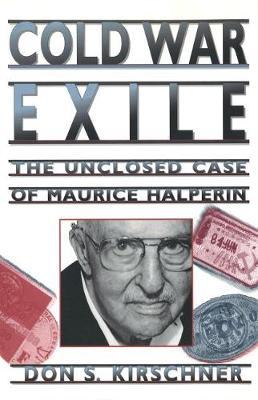
In 1953 Maurice Halperin was called before the Senate Internal Security Subcommittee to defend himself on charges of espionage. He was accused of having supplied Soviet sources with classified material from the Office of Strategic Services while he was an employee during World War II. The Cold War was in full force. McCarthyism was at its peak. Caught up in the rapids of history, Maurice Halperin's life spun out of control. Denying the charges but knowing he could never fully clear his name, Halperin fled to Mexico and then, to avoid extradition, to Moscow. Among the friends he made there were British spy Donald MacLean and Cuban revolutionary leader Che Guevara. Disenchanted with socialism in the Soviet Union, he accepted Guevara's invitation to come to Havana in 1962. There he worked for Castro's government for five years before political tension forced him to leave for Vancouver, Canada, where he now resides. Was Halperin a spy or a scapegoat? Was he a victim of Red- baiting or a onetime Communist espionage agent who eventually lost faith in Communism? Halperin's accuser was Elizabeth Bentley, a confessed Soviet courier who accused more than one hundred Americans of spying. Yet Bentley had no proof, and Halperin continues to maintain his innocence. One of them was lying. As Kirschner unravels the engrossing facts of the case--utilizing FBI files and dozens of interviews, including extensive interviews with Halperin himself--the reader becomes the investigator in a riveting real-life spy mystery. Along the way Kirschner offers new material on the OSS and further disturbing information about J. Edgar Hoover's use of his considerable power. Maurice Halperin has lived a life like few Americans in our century. A left-wing American exile, he experienced two socialist worlds from the inside. In recounting the unclosed case of Maurice Halperin, Cold War Exile is both a gripping account of that remarkable life and a significant contribution to our understanding of a fascinating and controversial era in American political history.
Full Product Details
Author: Don S. Kirschner
Publisher: University of Missouri Press
Imprint: University of Missouri Press
Dimensions:
Width: 15.20cm
, Height: 3.00cm
, Length: 22.90cm
Weight: 0.726kg
ISBN: 9780826209894
ISBN 10: 0826209890
Pages: 344
Publication Date: 01 May 1995
Audience:
College/higher education
,
Professional and scholarly
,
Undergraduate
,
Postgraduate, Research & Scholarly
Format: Hardback
Publisher's Status: Active
Availability: Out of stock

The supplier is temporarily out of stock of this item. It will be ordered for you on backorder and shipped when it becomes available.
Reviews
An unusual biography cum investigation of an academic caught up in a Cold War controversy. Kirschner (History/Simon Fraser Univ., British Columbia; The Paradox of Professionalism, not reviewed) initially aimed to help his older colleague Halperin (1906 - 1995) write his memoirs. But this story of a McCarthy-era political refugee grew, and the author not only incorporates Halperin's memories but applies his own skeptical sleuthing. Though lucidly written, the book's biographical depth may slow readers mainly curious about whether Halperin did spy for Soviets during WW II. Kirschner sketches Halperin's youth in Boston, the son of Yiddish-speaking immigrants, his undergraduate years at Harvard, and teaching stint at the University of Oklahoma, where he became a scholar of Latin America and an issue-oriented fellow traveler. Halperin was recruited in 1941 as a researcher on Latin America for the federal agency that preceded the OSS and CIA. He went to Boston University in 1949, but in 1953 the Senate Internal Security Subcommittee subpoenaed him, citing testimony by a Soviet courier that he had spied for the Soviets during the war. Halperin took the Fifth Amendment but also denied committing espionage. The author offers intriguing accounts of Halperin's self-imposed exile: five years in Mexico within the community of American expatriate radicals; a three-year stint in the Soviet Union, which soured him on the promise of Communism; a subsequent move to Cuba, where he also concluded that socialism had failed; and his final relocation to Canada - ironically, to a campus seething with socialist slogans. In a final chapter, Kirschner conducts a near-exhaustive lineup of evidence on both sides; he concludes that Halperin was more of an ideologue than he let on and that it seems improbable that his accuser perjured herself. A minor tale of the Cold War, but well told. (Kirkus Reviews)
Author Information
Don S. Kirschner is the author of The Paradox of Professionalism and City and Country. He is Professor of History at Simon Fraser University in British Columbia.