Overview
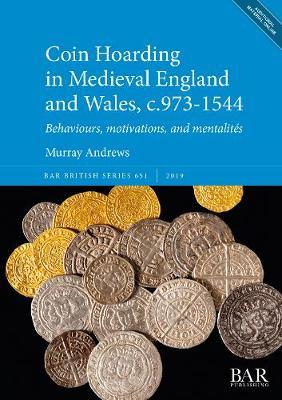
{\rtf1\fbidis\ansi\ansicpg1252\deff0\deflang2057{\fonttbl{\f0\fswiss\fprq2\fcharset0 Calibri;}{\f1\fnil\fcharset0 Verdana;}} \viewkind4\uc1\pard\ltrpar\sa160\sl252\slmult1\f0\fs22 More than 800 hoards of medieval precious metal coins are known from England and Wales, but the phenomenon as a whole remains poorly understood: who made coin hoards, what did they put in them, how did they assemble them, where did they bury them, and, ultimately, why did they do it? This book provides a pioneering analysis of the archaeological and numismatic evidence for coin hoarding in medieval England and Wales, using innovative multivariate and spatial techniques to shed fresh light on the behaviours, motivations, and mentalit\'e9s behind the formation and deposition of coin hoards during in the period c.973-1544. It is accompanied by a digital gazetteer describing the 815 hoards used in the study, the largest and most comprehensive corpus ever assembled for this region and period.\par \pard\ltrpar Shortlisted for the International Association of Professional Numismatists 2019 Book Prize\f1\fs17\par }
Full Product Details
Author: Murray Andrews
Publisher: BAR Publishing
Imprint: BAR Publishing
Weight: 1.021kg
ISBN: 9781407356686
ISBN 10: 1407356682
Pages: 205
Publication Date: 29 November 2019
Audience:
Professional and scholarly
,
Professional & Vocational
Format: Mixed media product
Publisher's Status: Active
Availability: Available To Order 
We have confirmation that this item is in stock with the supplier. It will be ordered in for you and dispatched immediately.
Table of Contents
{\rtf1\fbidis\ansi\ansicpg1252\deff0\deflang2057{\fonttbl{\f0\fnil\fcharset0 Calibri;}} \viewkind4\uc1\pard\ltrpar\f0\fs22 List of Figures\par List of Tables\par Abstract\par 1. Introduction: coin hoards and medieval archaeology\par 2. Approaches to coin hoards: theory and practice\par 2.1 Laying foundations: coins, hoards, money, value, treasure\par 2.2 The motives of hoarders\par 2.3 Approaches to hoarding I: content-driven study\par 2.3.1 Typological approaches\par 2.3.2 \lquote Applied\rquote methods\par 2.3.2.1 Chronological structure\par 2.3.2.2 Regional structure\par 2.3.2.3 Nominal structure\par 2.3.3 Non-numismatic contents\par 2.4 Approaches to hoarding II: context-driven studies\par 2.4.1 \lquote Feature\rquote /depositional context\par 2.4.2 \lquote Site\rquote /landscape context\par 2.5 Approaches to coin hoards: a summary\par 3. Methods and problems: the \i Coin hoards of medieval England and Wales database\i0\par 3.1 Framing the study: definitions and parameters\par 3.2 Chronological periodisation\par 3.3 Database arrangement\par 3.3.1 Hoard summary\par 3.3.2 Hoard contents\par 3.3.3 Non-numismatic object summary\par 3.3.4 Container summary\par 3.3.5 Context summary\par 3.4 Populating the database: source material\par 3.4.1 Checklists\par 3.4.2 Hoard reports\par 3.4.3 Online archaeological databases\par 3.4.4 Archaeological journals\par 3.4.5 Antiquarian and archival sources\par 3.4.6 Historic Ordnance Survey mapping\par 3.4.7 Museum collections\par 3.4.8 Personal correspondence\par 3.5 Data quality ratings\par 3.6 Augmenting the evidence: findspot characterisation\par 3.6.1 Historic mapping\par 3.6.2 Archaeological records\par 3.7 Archaeological source criticism: formation processes and data bias\par 3.7.1 Record formation processes I: the burial stage\par 3.7.2 Record formation processes II: the discovery stage\par 3.7.2.1 Agricultural work\par 3.7.2.2 Archaeological investigations\par 3.7.2.3 Building work\par 3.7.2.4 Grave digging\par 3.7.2.5 Metal detecting\par 3.7.2.6 Other discovery circumstances\par 3.7.2.7 Unknown circumstances\par 3.7.3 Record formation processes III: the registration stage\par 3.7.4 Record formation processes: concluding remarks\par 4. Seeing the bigger picture: the pattern of hoarding in England and Wales, c.973-1544\par 4.1 The pattern of hoarding in England and Wales, c.973-1544\par 4.1.1 Phase A: Late Anglo-Saxon coin hoards, c.973-1066\par 4.1.2 Phase B: Anglo-Norman coin hoards, 1066-1158\par 4.1.3 Phase C: High medieval coin hoards, 1158-1279\par 4.1.4 Phase D: Late medieval coin hoards, 1279-1544\par 4.2 Patterns in perspective I: coin hoards and monetary trends\par 4.2.1 Hoards and the size of the currency\par 4.2.2 Hoards and single coin finds\par 4.3 Patterns in perspective II: coin hoards and socio-economic geographies\par 4.3.1 Hoards and population\par 4.3.1.1 Benchmark 1: Domesday Book, 1086\par 4.3.1.2 Benchmark 2: England c.1290\par 4.3.1.3 Benchmark 3: The 1377 poll tax\par 4.3.2 Hoards and the distribution of assessed wealth\par 4.3.2.1 Benchmark 1: Domesday Book, 1086\par 4.3.2.2 Benchmark 2: The 1334 lay subsidy\par 4.3.2.3 Benchmark 3: The 1524-5 exchequer lay subsidies\par 4.3.3 Hoards and commerce\par 4.3.3.1 Hoards and towns\par 4.3.3.2 Hoards and transport infrastructure: road, river, and sea\par 4.4 Patterns in perspective III: coin hoards and conflict\par 4.4.1 The Norman Conquest and the \lquote Harrying of the North\rquote\par 4.4.2 The twelfth century \lquote Anarchy\rquote\par 4.4.3 The Scottish Wars of Independence\par 4.5 Discussion: interpreting macro-scale patterning in coin hoards\par 5. Treasured possessions? The contents of coin hoards\par 5.1 The numismatic elements of coin hoards, c.973-1544\par 5.1.1 Nominal structures\par 5.1.1.1 Phase A: Late Anglo-Saxon coin hoards, c.973-1066\par 5.1.1.2 Phase B: Anglo-Norman coin hoards, 1066-1158\par 5.1.1.3 Phase C: High medieval coin hoards, 1158-1279\par 5.1.1.4 Phase D: Late medieval coin hoards, 1279-1544\par 5.1.1.5 Discussion\par 5.1.2 Age structures\par 5.1.2.1 Phases A and B: Late Anglo-Saxon and Anglo-Norman coin hoards, c.973-1158\par 5.1.2.2 Phase C: High medieval coin hoards, 1158-1279\par 5.1.2.3 Phase D: Late medieval coin hoards, 1279-1544\par 5.1.2.4 Discussion\par 5.1.3 Regional structures\par 5.1.3.1 Phase A: Late Anglo-Saxon coin hoards, c.973-1066\par 5.1.3.2 Phase B: Anglo-Norman coin hoards, 1066-1158\par 5.1.3.3 Phase C: High medieval coin hoards, 1158-1279\par 5.1.3.4 Phase D: Late medieval coin hoards, 1279-1544\par 5.1.3.5 Discussion\par 5.2 The non-numismatic elements of coin hoards, c.973-1544\par 5.2.1 The incidence of non-numismatic objects\par 5.2.2 Coveting the precious things? Objects and economic value\par 5.2.3 Sending a message: status signifiers and symbolic values\par 5.2.4 Faith and fortune: religious and magical objects\par 5.2.5 Personal pieces? Objects, emotions, and memories\par 5.3 Coins beyond money?\par 6. Coins in context: the depositional circumstances of medieval coin hoards\par 6.1 Pots of gold? The archaeology of hoard containers\par 6.1.1 The incidence of containers\par 6.1.2 Securing treasures? Containers and economic value\par 6.1.3 Jars and jugs, boxes and bags: patterns in container forms\par 6.1.3.1 Bags and purses\par 6.1.3.2 Jugs and pitchers\par 6.1.3.3 Rouleaux\par 6.1.3.4 Jars and cooking vessels\par 6.1.3.5 Boxes and chests\par 6.1.3.6 Sheet metal\par 6.1.3.7 Bottles\par 6.1.3.8 Barrels, canisters, and other cylindrical storage containers\par 6.1.3.9 Bowls, cups, and mugs\par 6.1.3.10 Animal remains\par 6.1.3.11 Hollow stones\par 6.1.3.12 Trifoliate vessels\par 6.1.3.13 Tripod ewers\par 6.1.3.14 Personal ornaments\par 6.1.4 Discussion: containers and choices in medieval England and Wales\par 6.2 Landscapes of deposition: a contextual archaeology of coin hoards\par 6.2.1 Cash in the attic: coin hoards and settlement\par 6.2.2 Prayerful pennies: coin hoards and religious space\par 6.2.3 A step into the unknown? Coin hoards and ancient monuments\par 6.2.4 Fields and forests, coasts and caves: coin hoards and the medieval landscape\par 6.2.5 Monetary miscellanea: coin hoards from other medieval sites\par 6.3 Discussion: coin hoards and the evidence of archaeological contexts\par 7. Conclusion\par 7.1 Where and when have coin hoards been recovered, and what factors condition these distributions?\par 7.2 What do patterns in the temporal and spatial incidence of coin hoards tell us about hoarding behaviour?\par 7.3 What patterns, if any, are visible in the numismatic elements of medieval coin hoards, and what do they tell us about hoarding behaviour?\par 7.4 What non-numismatic objects, if any, are found in medieval coin hoards, and what do they tell us about hoarding behaviour?\par 7.5 What types of containers, if any, were used to store coin hoards, and what might they reveal about the processes of hoard formation and deposition?\par 7.6 What patterns, if any, are visible in the archaeological contexts of coin hoards, and what do they tell us about hoarding behaviour?\par 7.7 Legacy and future work\par 8. Bibliography\par 8.1 Printed primary sources\par 8.2 Secondary sources\par Appendix 1 is available as an accompanying download\par }
Reviews
{\rtf1\fbidis\ansi\ansicpg1252\deff0\deflang2057{\fonttbl{\f0\fswiss\fprq2\fcharset0 Calibri;}{\f1\fnil\fcharset0 Verdana;}} \viewkind4\uc1\pard\ltrpar\lang1033\f0\fs22\lquote (A)n ambitious analysis of medieval coin hoards from England and Wales, addressing the fundamental questions of what are hoards and how and why are they deposited - and indeed how and why are they recovered.` Barrie Cook, The Numismatic Chronicle, Issue 180, 2020\lang2057\par \pard\ltrpar\sb100\sa100\lquote This book is an important contribution to the field of numismatics and archaeology. Murray Andrews shows a deep understanding of these complex statistical methods and numismatic patterns.\rquote Mr Carl Savage, University of York\par \pard\ltrpar\sa160\sl252\slmult1\lquote The data assembled by Andrews is refreshingly broad. Not only does he bring together the hundreds of hoards which have been found by metal detectorists over the last 40 years, he\rquote s also done the work in the archives to root out evidence of antiquarian and historical hoards that have not previously been published.\rquote Dr Richard Kelleher, The Fitzwilliam Museum, Cambridge\par \lquote This is the most comprehensive analysis of the phenomenon of coin hoarding during the mid to late medieval period in England and Wales.\rquote Dr Jeremy Piercy, College of Charleston\par \pard\ltrpar\f1\fs17\par }
{\rtf1\ansi\ansicpg1252\deff0\deflang2057{\fonttbl{\f0\fswiss\fprq2\fcharset0 Calibri;}{\f1\fnil\fcharset0 Verdana;}} \viewkind4\uc1\pard\sa160\sl252\slmult1\f0\fs22\lquote The data assembled by Andrews is refreshingly broad. Not only does he bring together the hundreds of hoards which have been found by metal detectorists over the last 40 years, he\rquote s also done the work in the archives to root out evidence of antiquarian and historical hoards that have not previously been published.\rquote Dr Richard Kelleher, The Fitzwilliam Museum, Cambridge\par \lquote This is the most comprehensive analysis of the phenomenon of coin hoarding during the mid to late medieval period in England and Wales.\rquote Dr Jeremy Piercy, College of Charleston\par \pard\f1\fs17\par }
Author Information
{\rtf1\ansi\ansicpg1252\deff0\deflang2057{\fonttbl{\f0\fswiss\fprq2\fcharset0 Calibri;}{\f1\fnil\fcharset0 Verdana;}} \viewkind4\uc1\pard\f0\fs22 Murray Andrews holds a PhD from the Institute of Archaeology, UCL. He specialises in the archaeology of the medieval economy, with a particular focus on the material culture of money. He currently works as a freelance numismatic specialist for archaeological units.\f1\fs17\par }
Tab Content 6
Author Website:
Countries Available
All regions
|