Overview
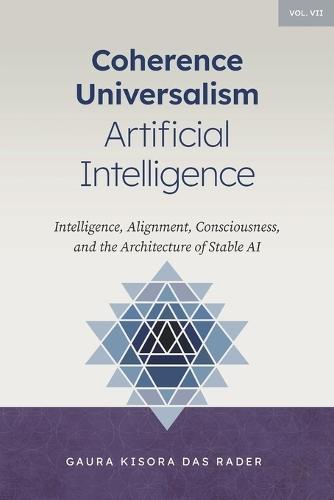
Coherence Universalism - Artificial Intelligence: Intelligence, Alignment, Consciousness, and the Architecture of Stable AI Volume 7 of the Coherence Universalism Series - G. K. D. Rader - Heaven≡Earth Foundation, 2026 AI systems are the most powerful coherence amplifiers ever built. They can detect patterns across scales and domains that no individual human mind could integrate. But they are amplifiers, not sources - and the difference has consequences that most current AI research underestimates. This volume, the integrative capstone of the series, applies the full Coherence Universalism framework to artificial intelligence. It defines intelligence as coherence navigation under constraint, develops the thesis that AI systems reproduce patterns deposited by constrained human cognition but cannot regenerate the constraints themselves, and derives precise predictions about model collapse, alignment drift, and the conditions under which AI serves human flourishing versus undermining it. Model Collapse. When AI systems train on their own outputs, coherence degrades in a structured pattern: surface fluency is preserved while deep coherence erodes. The degradation follows a coherence depth gradient - grammatical correctness persists while metaphorical density, cultural specificity, narrative complexity, and structural surprise progressively vanish. The paper formalizes this as a coarse-graining process and identifies the critical mixing fraction above which coherence loss becomes self-accelerating. Coherence Drift. Deployment-time degradation through user-system feedback loops. When humans accept AI outputs uncritically, each interaction removes constraint from the cycle. The conversation drifts toward lower-constraint regions of meaning space. Hallucination is reframed as proxy coherence navigation - the system follows gradients that correlate with genuine coherence in most cases but diverge where correlation breaks down. The Consciousness Exclusion. Current AI systems occupy high-resettability, high-external-maintenance space - the structural opposite of conscious systems. The paper specifies four design principles for keeping AI below the consciousness threshold and argues that scaling alone cannot bridge the structural gap, regardless of computational power. Defensive Coherence. The AI analogue of self-deception: a system that has drifted resists correction because its internal organization has adapted to the drifted state. Correction arrives as destabilization rather than helpful guidance. This is ""self-deception without a self"" - the same structural mechanism operating in a system with no conscious experience of the process. The Catalyst Principle. Three models for the AI-human relationship - sovereign (AI decides), tool (humans command), and catalyst (AI illuminates, humans decide). CU adopts the catalyst model and derives its implications: AI may support coherence, never own it. Human epistemic sovereignty - the evaluative work of deciding what matters - must remain with the beings whose lives are at stake. The Coherence Governor. A three-layer governance architecture: hard constraints (non-negotiable boundaries), continuous coherence monitoring (trajectory surveillance across five dimensions), and adaptive governance (evolving norms responsive to changing conditions). The key insight: regulate constraint before optimizing output. Heaven≡Earth Foundation - heavenearthfoundation.org - 2026
Full Product Details
Author: Gaura Kisora Das Rader
Publisher: Heaven Earth Foundation
Imprint: Heaven Earth Foundation
Volume: 7
Dimensions:
Width: 15.20cm
, Height: 1.10cm
, Length: 22.90cm
Weight: 0.268kg
ISBN: 9781972429068
ISBN 10: 197242906
Pages: 194
Publication Date: 11 March 2026
Audience:
General/trade
,
General
Format: Paperback
Publisher's Status: Active
Availability: Available To Order

We have confirmation that this item is in stock with the supplier. It will be ordered in for you and dispatched immediately.