Overview
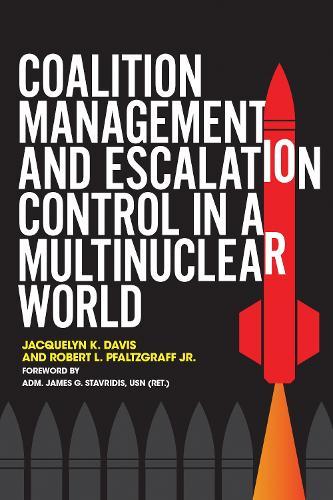
Coalition Management and Escalation Control in a Multinuclear World examines the impact of new technologies on twenty-first-century crisis management and armed conflict, as well as the unprecedented number and types of actors involved in current and potential flash-points. The book's basic thesis is that new technologies are changing how wars are fought and providing a broadening range of escalation options. Cyber weapons and artificial intelligence, as well as social media, blur traditional escalation thresholds with important consequences for deterrence. Nuclear weapons possessors, especially nations and powers new to their use, may have differing strategies concerning how, when, why, or where such weapons should be used either for purposes of deterrence or as actual warfighting instruments. Today's global map differs drastically from all previous eras, not only in the types and numbers of actors but also in the level of lethality, as well as the range and accuracy of weapons available with which to threaten or actually conduct battle. A world of Great Power competition, together with non-state armed groups contains risks for miscalculation including the possibility of catalytic warfare.
Full Product Details
Author: Jacquelyn Davis ,
Robert Pfaltzgraff, Jr. ,
James G. Stavridis
Publisher: Naval Institute Press
Imprint: Naval Institute Press
Dimensions:
Width: 15.20cm
, Height: 2.50cm
, Length: 22.80cm
Weight: 0.517kg
ISBN: 9781682475324
ISBN 10: 1682475328
Pages: 240
Publication Date: 26 November 2020
Audience:
Professional and scholarly
,
Professional & Vocational
Format: Hardback
Publisher's Status: Active
Availability: Temporarily unavailable

The supplier advises that this item is temporarily unavailable. It will be ordered for you and placed on backorder. Once it does come back in stock, we will ship it out to you.
Reviews
This book offers a comprehensive description of the whole new and vast issue of military escalation between powers in a cyber age. Consequently, it concentrates the mind on our increasingly nervous geopolitics. All strategists will want to have it in their libraries. --Robert D. Kaplan, managing director, Eurasia Group. author, The Return of Marco Polo's World: War, Strategy, and American Interests in the Twenty-first Century Advanced technologies across all war fighting domains -- maritime, air, land, space and cyberspace -- have fundamentally changed the character of war. These changes have significantly increased the prospects of miscalculation in a crisis or conflict. Traditional frameworks for deterrence, alliance and coalition management, strategic stability, and crisis management are inadequate for the realities of the twenty-first-century. Jacquelyn Davis and Robert Pfaltzgraff have made an important and thought provoking contribution to the dialogue on how we think and grapple with this new reality. --Joseph Dunford Jr., retired General, United States Marine Corps, 19th Chairman of the Joint Chiefs of Staff (2015 to 2019)
Advanced technologies across all war fighting domains -- maritime, air, land, space and cyberspace -- have fundamentally changed the character of war. These changes have significantly increased the prospects of miscalculation in a crisis or conflict. Traditional frameworks for deterrence, alliance and coalition management, strategic stability, and crisis management are inadequate for the realities of the twenty-first-century. Jacquelyn Davis and Robert Pfaltzgraff have made an important and thought provoking contribution to the dialogue on how we think and grapple with this new reality. --Joseph Dunford Jr., retired General, United States Marine Corps, 19th Chairman of the Joint Chiefs of Staff (2015 to 2019) This book offers a comprehensive description of the whole new and vast issue of military escalation between powers in a cyber age. Consequently, it concentrates the mind on our increasingly nervous geopolitics. All strategists will want to have it in their libraries. --Robert D. Kaplan, managing director, Eurasia Group. author, The Return of Marco Polo's World: War, Strategy, and American Interests in the Twenty-first Century
Author Information
Jacquelyn K. Davis is executive vice president of the Institute for Foreign Policy Analysis (IFPA). Dr. Davis chaired the Defense Advisory Committee for Women in the Services and was a member of the Chief of Naval Operations Executive Panel (CEP), U.S. European Command's Special Advisory Group, and chaired U.S. Special Operations Command's International Advisory Panel. Robert L. Pfaltzgraff Jr. is President, Institute for Foreign Policy Analysis, and Shelby Cullom Davis Professor of International Security Studies, The Fletcher School, Tufts University. Between 2006-2009, Dr. Pfaltzgraff served on the Secretary of State's International Security Advisory Board (ISAB). From 2011 to 2018 he was a member of the U.S. Naval War College Board of Advisors.