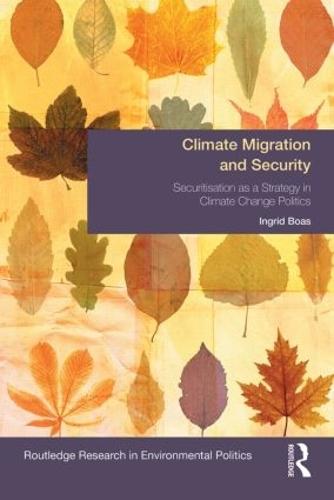
Full Product Details
Author: Ingrid Boas
Publisher: Taylor & Francis Ltd
Imprint: Routledge
Volume: 24
Dimensions:
Width: 15.20cm
, Height: 1.80cm
, Length: 22.90cm
Weight: 0.430kg
ISBN: 9781138811515
ISBN 10: 1138811513
Pages: 210
Publication Date: 22 May 2015
Audience:
College/higher education
,
Tertiary & Higher Education
,
Undergraduate
Format: Hardback
Publisher's Status: Active
Availability: In Print

This item will be ordered in for you from one of our suppliers. Upon receipt, we will promptly dispatch it out to you. For in store availability, please contact us.
Reviews
"""Few in Europe doubt that climate change represents a significant global challenge. But less obvious is the extent to which climate change has become both a subject and tool of global diplomacy in recent years. In this excellent and well-researched book, Ingrid Boas sheds light on how small island and European states - notably the UK - have constructed climate change as a security threat, and their unsuccessful efforts to persuade major emerging developing countries - notably India - that this threat is significant. Her analysis tells us much about the misunderstandings and mistrust that beset international diplomacy in the 21st century.""—Professor Richard Black, SOAS, University of London ""Threats of ‘climate wars’ and floods of ‘climate refugees’ have been central in the climate-change discourse for years, especially in the richer countries in the North. But does such ‘securitisation’ of climate policy really help? Who pushes discourses of ‘environmental security’, and who benefits? Ingrid Boas’ outstanding analysis reveals in great detail the complex politics around recent attempts at a ‘securitisation’ of climate politics. Her book is a must-read for scholars as well as policy-makers in this field, who will find in this remarkable study an important insight: ‘Scare stories’ are not the best means to convince an already skeptical audience.""—Frank Biermann, VU University Amsterdam and Lund University ""Few in Europe doubt that climate change represents a significant global challenge. But less obvious is the extent to which climate change has become both a subject and tool of global diplomacy in recent years. In this excellent and well-researched book, Ingrid Boas sheds light on how small island and European states - notably the UK - have constructed climate change as a security threat, and their unsuccessful efforts to persuade major emerging developing countries - notably India - that this threat is significant. Her analysis tells us much about the misunderstandings and mistrust that beset international diplomacy in the 21st century.""—Professor Richard Black, SOAS, University of London ""Threats of ‘climate wars’ and floods of ‘climate refugees’ have been central in the climate-change discourse for years, especially in the richer countries in the North. But does such ‘securitisation’ of climate policy really help? Who pushes discourses of ‘environmental security’, and who benefits? Ingrid Boas’ outstanding analysis reveals in great detail the complex politics around recent attempts at a ‘securitisation’ of climate politics. Her book is a must-read for scholars as well as policy-makers in this field, who will find in this remarkable study an important insight: ‘Scare stories’ are not the best means to convince an already skeptical audience.""—Frank Biermann, VU University Amsterdam and Lund University"
Few in Europe doubt that climate change represents a significant global challenge. But less obvious is the extent to which climate change has become both a subject and tool of global diplomacy in recent years. In this excellent and well-researched book, Ingrid Boas sheds light on how small island and European states - notably the UK - have constructed climate change as a security threat, and their unsuccessful efforts to persuade major emerging developing countries - notably India - that this threat is significant. Her analysis tells us much about the misunderstandings and mistrust that beset international diplomacy in the 21st century. -Professor Richard Black, SOAS, University of London Threats of 'climate wars' and floods of 'climate refugees' have been central in the climate-change discourse for years, especially in the richer countries in the North. But does such 'securitisation' of climate policy really help? Who pushes discourses of 'environmental security', and who benefits? Ingrid Boas' outstanding analysis reveals in great detail the complex politics around recent attempts at a 'securitisation' of climate politics. Her book is a must-read for scholars as well as policy-makers in this field, who will find in this remarkable study an important insight: 'Scare stories' are not the best means to convince an already skeptical audience. -Frank Biermann, VU University Amsterdam and Lund University
Author Information
Ingrid Boas is Assistant Professor in Climate Governance at the Environmental Policy Group at Wageningen University, the Netherlands. Her research particularly focusses on the topic of climate change-induced migration and climate security.