Overview
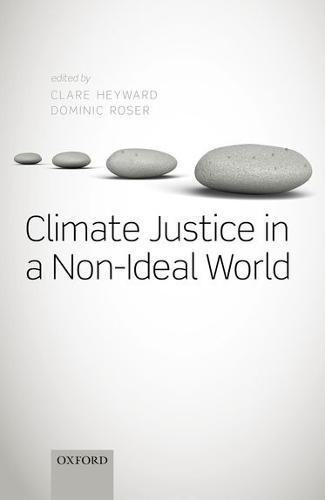
Climate change is a pressing international political issue, for which a practical but principled solution is urgently required. Climate Justice in a Non-Ideal World aims to make normative theorising on climate justice more relevant and applicable to political realities and public policy. The motivation behind this edited collection is that normative theorising has something to offer even in an imperfect world mired by partial compliance and unfavourable circumstances. In the last years, a lively debate has sprung up in political philosophy about non-ideal theory and there has also been an upsurge of interest in the various normative issues raised by climate change such as intergenerational justice, transnational harm, collective action, or risk assessment. However, there has been little systematic discussion of the links between climate justice and non-ideal theory even though the former would seem like a paradigm example of the relevance of the latter. The aim of this edited volume is to address this. In doing so, the volume presents original work from leading experts on climate ethics, including several who have participated in climate policy. The first part of the book discusses those facets of the debate on climate justice that become relevant due to the shortcomings of current global action on climate change. The second part makes specific suggestions for adjusting current policies and negotiating procedures in ways that are feasible in the relatively short term while still decreasing the distance between current climate policy and the ideal. The chapters in the third and final part reflect upon how philosophical work can be brought to bear on the debates in climate science, communication, and politics.
Full Product Details
Author: Clare Heyward (Leverhulme Early Career Research Fellow, University of Warwick) ,
Dominic Roser (Research Fellow in the Oxford Martin Programme on Human Rights for Future Generations, University of Oxford)
Publisher: Oxford University Press
Imprint: Oxford University Press
Dimensions:
Width: 16.40cm
, Height: 2.50cm
, Length: 24.00cm
Weight: 0.652kg
ISBN: 9780198744047
ISBN 10: 0198744048
Pages: 352
Publication Date: 23 June 2016
Audience:
College/higher education
,
Undergraduate
,
Postgraduate, Research & Scholarly
Format: Hardback
Publisher's Status: Active
Availability: To order

Stock availability from the supplier is unknown. We will order it for you and ship this item to you once it is received by us.
Reviews
Collectively, the chapters provide an effective treatment of normative issues in climate politics and policy, with a uniformly strong set of contributions that are coherently organized and well informed by the realities of climate politics as well as the methods of and debates within political theory and applied ethics, and so the book should be of interest and use to scholars both of justice and of environmental politics and governance. While the separate chapters only occasionally address one another directly, they speak to common themes and could thus prove suitable for use in graduate-level teaching, as well as provide a primer on current questions in and approaches to the scholarly field of climate justice, with the variety of normative theories and methods that Climate Justice in a Non-Ideal World seeks to apply to this important contemporary environmental problem. * Perspectives on Politics *
Author Information
Clare Heyward is a Leverhulme Early Career Researcher at the University of Warwick. Before joining the University of Warwick, she was James Martin Research Fellow on the Oxford Geoengineering Programme. Clare is interested in issues of global distributive justice and intergenerational justice, especially those connected to climate change. Dominic Roser is Research Fellow in the Oxford Martin Programme on Human Rights for Future Generations at the University of Oxford. With a background in philosophy and economics, his research is located in contemporary political philosophy. His work focuses on various aspects of the debate on climate ethics such as intergenerational justice, global justice, non-ideal theory, risk, human rights, and the normative foundations of climate economics. Together with Christian Seidel, he has co-authored an introduction to climate ethics and he has collaborated in various interdisciplinary and policy-relevant projects.