Overview
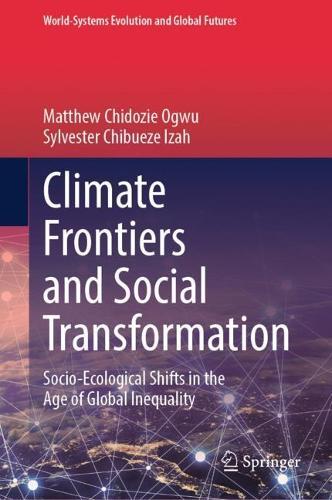
This book examines how climate change is reshaping not just the environment, but also global politics, economies, and societies. Through a systems-level analysis, it demonstrates the link between ecological crises and global capitalism, power struggles, and social movements. The book explains how climate change disproportionately affects the poorest and most vulnerable, particularly in the Global South. Employing world-systems theory and historical analysis, the book explores crucial issues such as fossil fuel dependence, global trade, urbanization, and resistance movements. The book also discusses the roles of Indigenous communities, youth activism, and grassroots efforts in striving for a fairer, more sustainable future. With its case studies and forward-looking insights, this book will appeal to anyone studying or working in the fields of climate justice, sustainability, or global change.
Full Product Details
Author: Matthew Chidozie Ogwu ,
Sylvester Chibueze Izah
Publisher: Springer Nature Switzerland AG
Imprint: Springer Nature Switzerland AG
ISBN: 9783032176387
ISBN 10: 3032176387
Pages: 426
Publication Date: 18 February 2026
Audience:
College/higher education
,
Postgraduate, Research & Scholarly
Format: Hardback
Publisher's Status: Active
Availability: Not yet available

This item is yet to be released. You can pre-order this item and we will dispatch it to you upon its release.
Author Information
Matthew Chidozie Ogwu is an Assistant Professor of Integrated Ecology and Sustainable Development at Appalachian State University, USA. He advances interdisciplinary research at the interface of ecology, sustainability, and society. His work examines how environmental change—particularly climate stressors, air pollution, food insecurity, resource management, and biodiversity loss—interacts with social and economic systems, supported by complementary expertise in microbial ecology and applied environmental assessment. He has participated in international collaborations, including EU-funded biodiversity projects, and brings a strong record of teaching, mentorship, and cross-sector engagement. Dr. Ogwu’s research and editorial work focus on developing evidence and frameworks to support climate justice, resilient communities, and policy innovation across the Global North and Global South. Sylvester Chibueze Izah is a Faculty Member at Bayelsa Medical University, Nigeria, where he also serves as Assistant Director of Academic Planning, Research, and Innovations. A licensed environmental health specialist, he focuses on sustainable human-environmental health interactions, including air, soil, and water quality, toxicology, sanitation, food science, waste management, and biodiversity. His interdisciplinary expertise and prolific scholarship make him a key voice in environmental health and sustainability research.