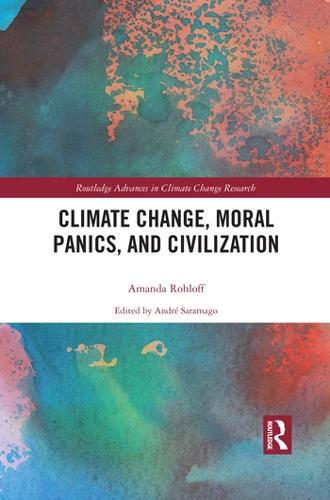
Full Product Details
Author: Amanda Rohloff (Lecturer, School of Social Sciences, Brunel University, UK.) ,
André Saramago
Publisher: Taylor & Francis Ltd
Imprint: Routledge
Weight: 0.303kg
ISBN: 9780367507701
ISBN 10: 0367507706
Pages: 200
Publication Date: 04 March 2020
Audience:
College/higher education
,
Tertiary & Higher Education
Format: Paperback
Publisher's Status: Active
Availability: In Print

This item will be ordered in for you from one of our suppliers. Upon receipt, we will promptly dispatch it out to you. For in store availability, please contact us.
Reviews
A must read for anyone who wants to make sense of the uncertainties of our times caused by climate change and fear of a bleak future. The analytical links established by the author between Elias' thought on civilising [and decivilising] processes and moral panic literature are very compelling. -- Aurelie Lacassagne, Associate Professor of Political Science, Laurentian University, Canada Amanda Rohloff's book makes a valuable contribution to the discussion of how the sociological perspective inspired by Norbert Elias can be extended to develop the historical sociology of moral panics, as well being a path-breaking intervention into the way we understand current debates around the vital question of climate change . -- Robert van Krieken, Professor of Sociology, University of Sydney, Australia Amanda Rohloff was a remarkable young thinker. She had the original idea that our contemporary concern with climate change has some of the characteristics of a moral panic -- but not in the usual sense of an overreaction, because the problem is very real. And she sets it in long-term and theoretical perspective, linking it to civilising and decivilising processes . -- Stephen Mennell, Professor Emeritus of Sociology, University College Dublin, Ireland Focusing on how climate change has come to be perceived as a major global threat, Amanda Rohloff has developed a challenging and sophisticated reformulation of the moral panic concept. A major contribution to ongoing debates about such panics, this highly original work is a fitting epitaph to an exceptionally promising and talented younger scholar . -- Julian Petley, Professor of Journalism, Brunel University London, United Kingdom This book constitutes a well-researched study on anthropogenic climate change as [a] social problem. Rohloff skilfully interweaves the moral panic sociological model with the figurational sociology of Norbert Elias. Providing original insights and suggestions for future research, she offers a rigorous approach for testing the moral panic concept and improving its reformulation . -- Morena Tartari, Lecturer of Sociology, University of Padova, Italy Climate change and moral panics are inherently political subjects. But amid heated debate, Amanda Rohloff keeps her cool and resists the temptation to indulge in moralising. Drawing on the theory of civilising processes, she provides a highly illuminating long-term and wide-ranging perspective in this exemplary work of sociology . -- Cas Wouters, Senior Lecturer of Sociology, Utrecht University, The Netherlands Bringing to bear both Elias's theory of civilising processes and Cohen's theory of moral panics on the problem of climate change, Rohloff has managed to shed real light on the greatest challenge facing global civilisation. This book is an accessible and constantly illuminating guide [to] the environmental politics of the biosphere that should be compulsory reading for anyone involved in climate change governance . -- Stephen Quilley, Associate Professor of Social and Environmental Innovation, University of Waterloo, Canada Amanda Rohloff 's book illustrates how the igniting of a sociological spark in an outstanding student began an impressive voyage of discovery. This innovative synthesis of Eliasian perspectives and moral panic theories greatly enhances our understanding of climate change politics and serves as a fitting tribute to a tragically foreshortened scholarly journey. -- David Pearson, Adjunct Reader, School of Social & Cultural Studies, Victoria University of Wellington, New Zealand
"""A must read for anyone who wants to make sense of the uncertainties of our times caused by climate change and fear of a bleak future. The analytical links established by the author between Elias’ thought on civilising [and decivilising] processes and moral panic literature are very compelling."" -- Aurélie Lacassagne, Associate Professor of Political Science, Laurentian University, Canada ""Amanda Rohloff’s book makes a valuable contribution to the discussion of how the sociological perspective inspired by Norbert Elias can be extended to develop the historical sociology of moral panics, as well being a path-breaking intervention into the way we understand current debates around the vital question of climate change"". -- Robert van Krieken, Professor of Sociology, University of Sydney, Australia ""Amanda Rohloff was a remarkable young thinker. She had the original idea that our contemporary concern with climate change has some of the characteristics of a moral panic -- but not in the usual sense of an overreaction, because the problem is very real. And she sets it in long-term and theoretical perspective, linking it to civilising and decivilising processes"". -- Stephen Mennell, Professor Emeritus of Sociology, University College Dublin, Ireland ""Focusing on how climate change has come to be perceived as a major global threat, Amanda Rohloff has developed a challenging and sophisticated reformulation of the moral panic concept. A major contribution to ongoing debates about such panics, this highly original work is a fitting epitaph to an exceptionally promising and talented younger scholar"". -- Julian Petley, Professor of Journalism, Brunel University London, United Kingdom ""This book constitutes a well-researched study on anthropogenic climate change as [a] social problem. Rohloff skilfully interweaves the moral panic sociological model with the figurational sociology of Norbert Elias. Providing original insights and suggestions for future research, she offers a rigorous approach for testing the moral panic concept and improving its reformulation"". -- Morena Tartari, Lecturer of Sociology, University of Padova, Italy ""Climate change and moral panics are inherently political subjects. But amid heated debate, Amanda Rohloff keeps her cool and resists the temptation to indulge in moralising. Drawing on the theory of civilising processes, she provides a highly illuminating long-term and wide-ranging perspective in this exemplary work of sociology"". -- Cas Wouters, Senior Lecturer of Sociology, Utrecht University, The Netherlands ""Bringing to bear both Elias’s theory of civilising processes and Cohen’s theory of moral panics on the problem of climate change, Rohloff has managed to shed real light on the greatest challenge facing global civilisation. This book is an accessible and constantly illuminating guide [to] the environmental politics of the biosphere that should be compulsory reading for anyone involved in climate change governance"". -- Stephen Quilley, Associate Professor of Social and Environmental Innovation, University of Waterloo, Canada ""Amanda Rohloff ’s book illustrates how the igniting of a sociological spark in an outstanding student began an impressive voyage of discovery. This innovative synthesis of Eliasian perspectives and moral panic theories greatly enhances our understanding of climate change politics and serves as a fitting tribute to a tragically foreshortened scholarly journey."" -- David Pearson, Adjunct Reader, School of Social & Cultural Studies, Victoria University of Wellington, New Zealand"
A must read for anyone who wants to make sense of the uncertainties of our times caused by climate change and fear of a bleak future. The analytical links established by the author between Elias' thought on civilising [and decivilising] processes and moral panic literature are very compelling. -- Aurelie Lacassagne, Associate Professor of Political Science, Laurentian University, Canada Amanda Rohloff's book makes a valuable contribution to the discussion of how the sociological perspective inspired by Norbert Elias can be extended to develop the historical sociology of moral panics, as well being a path-breaking intervention into the way we understand current debates around the vital question of climate change . -- Robert van Krieken, Professor of Sociology, University of Sydney, Australia Amanda Rohloff was a remarkable young thinker. She had the original idea that our contemporary concern with climate change has some of the characteristics of a moral panic -- but not in the usual sense of an overreaction, because the problem is very real. And she sets it in long-term and theoretical perspective, linking it to civilising and decivilising processes . -- Stephen Mennell, Professor Emeritus of Sociology, University College Dublin, Ireland Focusing on how climate change has come to be perceived as a major global threat, Amanda Rohloff has developed a challenging and sophisticated reformulation of the moral panic concept. A major contribution to ongoing debates about such panics, this highly original work is a fitting epitaph to an exceptionally promising and talented younger scholar . -- Julian Petley, Professor of Journalism, Brunel University London, United Kingdom This book constitutes a well-researched study on anthropogenic climate change as [a] social problem. Rohloff skilfully interweaves the moral panic sociological model with the figurational sociology of Norbert Elias. Providing original insights and suggestions for future research, she offers a rigorous approach for testing the moral panic concept and improving its reformulation . -- Morena Tartari, Lecturer of Sociology, University of Padova, Italy Climate change and moral panics are inherently political subjects. But amid heated debate, Amanda Rohloff keeps her cool and resists the temptation to indulge in moralising. Drawing on the theory of civilising processes, she provides a highly illuminating long-term and wide-ranging perspective in this exemplary work of sociology . -- Cas Wouters, Senior Lecturer of Sociology, Utrecht University, The Netherlands Bringing to bear both Elias's theory of civilising processes and Cohen's theory of moral panics on the problem of climate change, Rohloff has managed to shed real light on the greatest challenge facing global civilisation. This book is an accessible and constantly illuminating guide [to] the environmental politics of the biosphere that should be compulsory reading for anyone involved in climate change governance . -- Stephen Quilley, Associate Professor of Social and Environmental Innovation, University of Waterloo, Canada Amanda Rohloff 's book illustrates how the igniting of a sociological spark in an outstanding student began an impressive voyage of discovery. This innovative synthesis of Eliasian perspectives and moral panic theories greatly enhances our understanding of climate change politics and serves as a fitting tribute to a tragically foreshortened scholarly journey. -- David Pearson, Adjunct Reader, School of Social & Cultural Studies, Victoria University of Wellington, New Zealand
Author Information
Amanda Rohloff was a Wellcome Trust Postdoctoral Research Fellow in Sociology at the School of Social Sciences at Brunel University, UK. André Saramago is an Auxiliary Professor of International Relations at Lusíada University-North (Porto), Portugal.