Overview
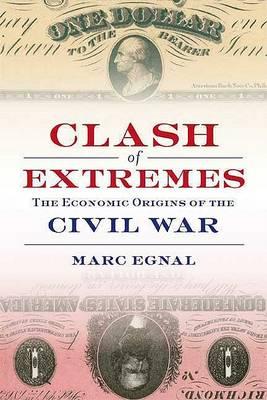
Marc Egnal's Clash of Extremes challenges the orthodoxy that the Civil War began for moral reasons. Egnal contends that more than any other concern, the evolution of the Northern and Southern economies explains the sectional clash. Drawing on a wealth of primary and secondary sources, Clash of Extremes shows that between 1820 and 1850, patterns of trade and production drew the sections together. For example, the Mississippi River provided a strong north-south axis while planters earned high profits on fertile soils. Those ties allowed sectional leaders to broker a series of compromises. After mid-century all that changed, as the rise of the Great Lakes economy reoriented Northern trade along east-west lines. Slave owners, wrestling with the first signs of soil exhaustion, found Washington more foe than friend. The underpinnings for compromise were gone, and escalating hostility was the result. While this study emphasizes economics, it gives careful consideration to the role of individuals, the rise of the antislavery movement, and social conflict. Ultimately, changes in the Great Lakes region and New England and in the southern part of the Deep South caused those regions to take the lead in the conflict. The result was truly a clash of extremes.
Full Product Details
Author: Professor of History Marc Egnal (York University)
Publisher: Hill & Wang Inc.,U.S.
Imprint: Hill & Wang Inc.,U.S.
Dimensions:
Width: 16.10cm
, Height: 3.70cm
, Length: 23.00cm
Weight: 0.667kg
ISBN: 9780809095360
ISBN 10: 080909536
Pages: 416
Publication Date: 06 January 2009
Audience:
General/trade
,
General
Format: Hardback
Publisher's Status: Out of Stock Indefinitely
Availability: In Print

Limited stock is available. It will be ordered for you and shipped pending supplier's limited stock.
Reviews
Challenging a great deal of modern scholarship, Clash of Extremes promises to be the most talked-about book in years on the origins of the Civil War. --Daniel W. Crofts, The College of New Jersey Egnal's scholarship and detailed analysis of the data makes it hard to argue with the notion that the war, at least initially, was driven in large measure by economic factors . . . Essential reading for anyone with a serious interest in the American Civil War. --Herbert White, History in Review Sure to provoke discussion. -- Kirkus Reviews An illuminating contribution to our understanding of the Civil War's causes. -- Publishers Weekly A serious work that may well reignite a historical debate. --Jay Freeman, Booklist In lively and accessible prose, Egnal has succeeded in bringing back economics as a core factor in the coming of the Civil War. Readers are in for a delightful surprise as they explore his engaging analysis of how diverging economies produced conditions that led to secession. --William L. Barney, author of The Making of a Confederate Marc Egnal's vigorous and original argument will inject new energy into the perpetually fascinating conversation about the meaning of the American Civil War. --Edward L. Ayers, author of In the Presence of Mine Enemies, winner of the Bancroft Prize A most welcome addition to the literature on Civil War causation. It is sure to spark healthy debate about the war's origins. --Michael F. Holt, author of The Fate of Their Country: Politicians, Slavery Extension, and the Coming of the Civil War
Challenging a great deal of modern scholarship, Clash of Extremes promises to be the most talked-about book in years on the origins of the Civil War. --Daniel W. Crofts, The College of New Jersey Egnal's scholarship and detailed analysis of the data makes it hard to argue with the notion that the war, at least initially, was driven in large measure by economic factors . . . Essential reading for anyone with a serious interest in the American Civil War. --Herbert White, History in Review A contentious examination of how mid-century economic shifts powered secession. -- American History Sure to provoke discussion. -- Kirkus Reviews An illuminating contribution to our understanding of the Civil War's causes. -- Publishers Weekly A serious work that may well reignite a historical debate. --Jay Freeman, Booklist Marc Egnal offers both a correction and a challenge to historians of the Civil war in this important new interpretation . . . Egnal skillfully recounts how people made choices, how they changed, how they understood themselves and their world. --A. James Fuller, Civil War Book Review The author does not neglect the sins of the South, real and alleged, but his most original contribution is his description of a truly critical new development of the late antebellum period, which he calls 'the Lake Economy.' --Clyde Wilson, Chronicles Marc Egnal challenges the popular view that the war was primarily about slavery. Egnal looks instead to economic factors, pointing out that most Northerners were racists who favored only the gradual extinction of slavery and that the early Republican Party, despite whatever idealism it upheld, was also interested in increasing the strength of Northern industry and commerce. Slavery, of course, was important in all this, but not until the war was well under way did the abolition of slavery gain traction either as public policy or rallying cry. Refreshingly, Egnal emphasizes the influence of individua
Author Information
Marc Egnal is a professor of history at York University and the author of several books, including ""A Mighty Empire: The Origins of the American Revolution"" and ""Divergent Paths: How Culture and Institutions Have Shaped North American Growth.""