Overview
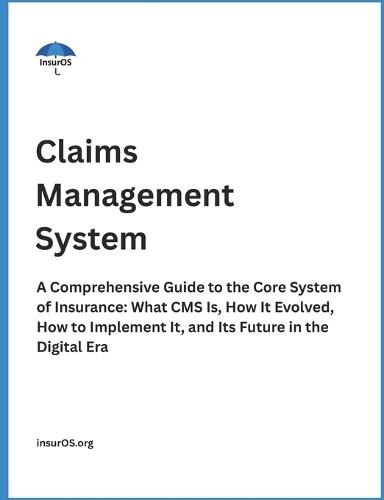
Claims are a post-loss business process that is continuously evolving, data-driven, digitally executed, and ecosystem-orchestrated. At the center of this process sits the Claims Management System (CMS)-the platform that transforms loss events into structured decisions, coordinated actions, financial outcomes, and regulatory records, while connecting policy administration, assessment capabilities, payments, partners, and the broader enterprise architecture. This book offers a comprehensive, end-to-end exploration of insurance through the lens of the Claims Management System. It begins by reframing insurance itself as a systems-based business and positioning claims not merely as a downstream function, but as a structurally distinct form of execution that operates under uncertainty, evidence accumulation, and continuous decision-making. From foundational insurance concepts to the unique nature of claims compared with pre-loss functions, the book establishes the conceptual groundwork necessary to understand why claims systems must be designed differently. The book dives deeply into how claims operating models are actually designed and executed. It examines the claims lifecycle, operating models across lines of business and insurance domains, and the translation of organizational intent into executable system configurations. It then dissects the core capabilities and architecture of a modern Claims Management System, compares life and general insurance CMS platforms, and illustrates how a CMS functions as an orchestration backbone within the enterprise ecosystem. Tracing the evolution of claims from paper files and human judgment to mainframe automation, distributed architectures, and today's API-driven digital ecosystems, the book shows how technology has progressively reshaped claims operations. It reveals how historical design choices-workflow engines, rule coding, data models, and integration patterns-have accumulated into layered legacy architectures that still shape the constraints and possibilities of modern CMS platforms. The later chapters confront the structural challenges that insurers face today: vertically coupled claims functions, hardcoded decision logic, rigid and fragmented claim data models, fragile integrations, and decades of architectural sedimentation hidden behind the familiar term ""CMS."" From there, the book looks forward, exploring next-generation loss scenarios, cloud-native and event-driven architectures, metadata-driven operating models, and the expanding role of AI-from rules and predictive models to generative systems-in redefining how claims are assessed, managed, and settled. Written for insurance executives, claims leaders, product managers, architects, consultants, actuaries, and technologists, this book is both a conceptual framework and a practical guide. It does not treat the Claims Management System as just another operational application, but as a central execution capability and a strategic platform for transformation. Whether you are modernizing a legacy claims environment, selecting a new CMS, or reimagining how claims should operate in a digital and AI-driven world, this book provides the clarity, structure, and perspective needed to navigate that journey.
Full Product Details
Author: Insuros Org
Publisher: Independently Published
Imprint: Independently Published
Dimensions:
Width: 18.90cm
, Height: 1.70cm
, Length: 24.60cm
Weight: 0.553kg
ISBN: 9798245386768
Pages: 308
Publication Date: 24 January 2026
Audience:
General/trade
,
General
Format: Paperback
Publisher's Status: Active
Availability: Available To Order

We have confirmation that this item is in stock with the supplier. It will be ordered in for you and dispatched immediately.