Overview
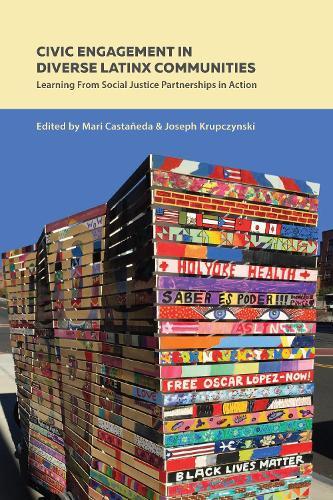
Students, faculty, and community partners alike will find Civic Engagement in Diverse Latinx Communities: Learning From Social Justice Partnerships in Action accessible not only because it includes an array of examples regarding Latinx civic engagement, but it also demonstrates that personal experiences are powerful tools for the production of new knowledge. This book reveals an epistemology of social justice that aims to investigate and develop a new Latinx community-university praxis for how to engage with diverse communities in the twenty-first century.
Full Product Details
Author: Mari Castañeda ,
Joseph Krupczynski ,
Mari Castañeda ,
Joseph Krupczynski
Publisher: Peter Lang Publishing Inc
Imprint: Peter Lang Publishing Inc
Edition: New edition
Volume: 17
Weight: 0.450kg
ISBN: 9781433147265
ISBN 10: 1433147262
Pages: 302
Publication Date: 22 January 2018
Audience:
Professional and scholarly
,
Professional & Vocational
Format: Paperback
Publisher's Status: Active
Availability: Manufactured on demand

We will order this item for you from a manufactured on demand supplier.
Reviews
This is one of the most exciting and important books on civic engagement in higher education in some time. It answers the call from the past decade of scholarship for critical frameworks and social justice approaches to service learning and community engagement. The scholars contributing to this book provide cogent examples of exemplary practices of engagement that enact authentic reciprocity in a context of social justice partnerships that form the basis for collaborative teaching and learning and new knowledge generation. Engagement with Latinx communities, by and with Latinix scholars and students, informs service learning and community engagement practices across disciplines and different sectors of higher education. This is exactly the book the field needs now. I will be including is as required reading in my civic engagement courses. -John Saltmarsh, Professor of Higher Education, University of Massachusetts, Boston The fundamental axis of this book is rooted in the intersection of Latinx experience and civic engagement from a social justice point of view. The authors carefully discuss the ways Latinx communities have knowledge and point of view that is important as well as make a valuable contribution to debates and best practices about engaging communities. They provide empirical evidence that measures the hidden value and contribution of faculty of color in their commitment to social change, which are experiences emerging from U.S. minoritization and the product of a legacy of colonization and conquest. -Julia E. Curry, Associate Professor of Mexican American Studies, San Jose State University Centering Latinx communities and social justice partnerships, this book addresses issues, practices, and communities rarely explored in the literature on civic and community engagement. The focus on diverse Latinx communities creates space to consider how the communities where we partner, the students in our classrooms, the issues being confronted in community spaces, and the identities we claim as facilitators and conveners of these experiences can (and should) inform our praxis in community engagement. The aims of all of the partnerships explored in the text to advance justice and to transform the social concerns that perpetuate inequality is a powerful reminder of the possibility of civically engaged teaching and learning. Civic Engagement in Diverse Latinx Communities is a unique, important and remarkable contribution. -Tania D. Mitchell, Associate Professor of Higher Education, University of Minnesota
“The fundamental axis of this book is rooted in the intersection of Latinx experience and civic engagement from a social justice point of view. The authors carefully discuss the ways Latinx communities have knowledge and point of view that is important as well as make a valuable contribution to debates and best practices about engaging communities. They provide empirical evidence that measures the hidden value and contribution of faculty of color in their commitment to social change, which are experiences emerging from U.S. minoritization and the product of a legacy of colonization and conquest.” —Julia E. Curry, Associate Professor of Mexican American Studies, San Jose State University “This is one of the most exciting and important books on civic engagement in higher education in some time. It answers the call from the past decade of scholarship for critical frameworks and social justice approaches to service learning and community engagement. The scholars contributing to this book provide cogent examples of exemplary practices of engagement that enact authentic reciprocity in a context of social justice partnerships that form the basis for collaborative teaching and learning and new knowledge generation. Engagement with Latinx communities, by and with Latinix scholars and students, informs service learning and community engagement practices across disciplines and different sectors of higher education. This is exactly the book the field needs now. I will be including is as required reading in my civic engagement courses.” —John Saltmarsh, Professor of Higher Education, University of Massachusetts, Boston “Centering Latinx communities and social justice partnerships, this book addresses issues, practices, and communities rarely explored in the literature on civic and community engagement. The focus on diverse Latinx communities creates space to consider how the communities where we partner, the students in our classrooms, the issues being confronted in community spaces, and the identities we claim as facilitators and conveners of these experiences can (and should) inform our praxis in community engagement. The aims of all of the partnerships explored in the text to advance justice and to transform the social concerns that perpetuate inequality is a powerful reminder of the possibility of civically engaged teaching and learning. Civic Engagement in Diverse Latinx Communities is a unique, important and remarkable contribution.” —Tania D. Mitchell, Associate Professor of Higher Education, University of Minnesota
The fundamental axis of this book is rooted in the intersection of Latinx experience and civic engagement from a social justice point of view. The authors carefully discuss the ways Latinx communities have knowledge and point of view that is important as well as make a valuable contribution to debates and best practices about engaging communities. They provide empirical evidence that measures the hidden value and contribution of faculty of color in their commitment to social change, which are experiences emerging from U.S. minoritization and the product of a legacy of colonization and conquest. -Julia E. Curry, Associate Professor of Mexican American Studies, San Jose State University This is one of the most exciting and important books on civic engagement in higher education in some time. It answers the call from the past decade of scholarship for critical frameworks and social justice approaches to service learning and community engagement. The scholars contributing to this book provide cogent examples of exemplary practices of engagement that enact authentic reciprocity in a context of social justice partnerships that form the basis for collaborative teaching and learning and new knowledge generation. Engagement with Latinx communities, by and with Latinix scholars and students, informs service learning and community engagement practices across disciplines and different sectors of higher education. This is exactly the book the field needs now. I will be including is as required reading in my civic engagement courses. -John Saltmarsh, Professor of Higher Education, University of Massachusetts, Boston Centering Latinx communities and social justice partnerships, this book addresses issues, practices, and communities rarely explored in the literature on civic and community engagement. The focus on diverse Latinx communities creates space to consider how the communities where we partner, the students in our classrooms, the issues being confronted in community spaces, and the identities we claim as facilitators and conveners of these experiences can (and should) inform our praxis in community engagement. The aims of all of the partnerships explored in the text to advance justice and to transform the social concerns that perpetuate inequality is a powerful reminder of the possibility of civically engaged teaching and learning. Civic Engagement in Diverse Latinx Communities is a unique, important and remarkable contribution. -Tania D. Mitchell, Associate Professor of Higher Education, University of Minnesota
""The fundamental axis of this book is rooted in the intersection of Latinx experience and civic engagement from a social justice point of view. The authors carefully discuss the ways Latinx communities have knowledge and point of view that is important as well as make a valuable contribution to debates and best practices about engaging communities. They provide empirical evidence that measures the hidden value and contribution of faculty of color in their commitment to social change, which are experiences emerging from U.S. minoritization and the product of a legacy of colonization and conquest."" --Julia E. Curry, Associate Professor of Mexican American Studies, San Jose State University ""This is one of the most exciting and important books on civic engagement in higher education in some time. It answers the call from the past decade of scholarship for critical frameworks and social justice approaches to service learning and community engagement. The scholars contributing to this book provide cogent examples of exemplary practices of engagement that enact authentic reciprocity in a context of social justice partnerships that form the basis for collaborative teaching and learning and new knowledge generation. Engagement with Latinx communities, by and with Latinix scholars and students, informs service learning and community engagement practices across disciplines and different sectors of higher education. This is exactly the book the field needs now. I will be including is as required reading in my civic engagement courses."" --John Saltmarsh, Professor of Higher Education, University of Massachusetts, Boston ""Centering Latinx communities and social justice partnerships, this book addresses issues, practices, and communities rarely explored in the literature on civic and community engagement. The focus on diverse Latinx communities creates space to consider how the communities where we partner, the students in our classrooms, the issues being confronted in community spaces, and the identities we claim as facilitators and conveners of these experiences can (and should) inform our praxis in community engagement. The aims of all of the partnerships explored in the text to advance justice and to transform the social concerns that perpetuate inequality is a powerful reminder of the possibility of civically engaged teaching and learning. Civic Engagement in Diverse Latinx Communities is a unique, important and remarkable contribution."" --Tania D. Mitchell, Associate Professor of Higher Education, University of Minnesota
Author Information
Mari Castañeda (Ph.D., Communication, University of California, San Diego) is Professor and Chair of Communication at University of Massachusetts-Amherst. Joseph Krupczynski (M.Sci., Design, University of Massachusetts-Amherst) is Associate Professor of Architecture and Director of Civic Engagement and Service Learning at University of Massachusetts-Amherst.