Overview
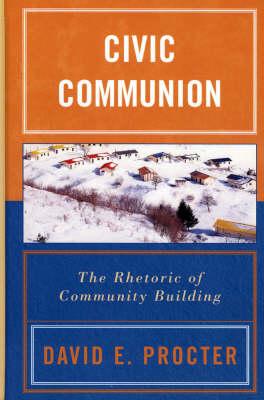
Blending theory and case studies, Civic Communion looks at community-building in rural America and how civic-minded people come together through a variety of ways, such as hosting and attending festivals, addressing conflict, planning the community, and maintaining heritage museums. David Procter's insightful work reveals a specific and significant form of community 'talk' that serves to build and sustain community.
Full Product Details
Author: David E. Procter
Publisher: Bloomsbury Publishing Plc
Imprint: Rowman & Littlefield
Dimensions:
Width: 15.30cm
, Height: 2.00cm
, Length: 23.50cm
Weight: 0.399kg
ISBN: 9780742537026
ISBN 10: 0742537021
Pages: 180
Publication Date: 13 January 2005
Audience:
College/higher education
,
Undergraduate
Format: Hardback
Publisher's Status: Out of Print
Availability: In Print

Limited stock is available. It will be ordered for you and shipped pending supplier's limited stock.
Reviews
Civic Communication is a pleasure to read. It represents a wealth of scholarship, but it is David Procter's unmistakable voice that brings to life the people and their performances as they enact the bonds and practices of civic communion. I find it inspirational and a call to the discipline to pursue this most fruitful line of contribution. Graduate students will benefit from the careful research, undergraduates from its life-expanding vision, and both from the deep sense of civic responsibility that it imparts.--Anderson, James A.
Civic Communication is a pleasure to read. It represents a wealth of scholarship, but it is David Procter's unmistakable voice that brings to life the people and their performances as they enact the bonds and practices of civic communion. I find it inspirational and a call to the discipline to pursue this most fruitful line of contribution. Graduate students will benefit from the careful research, undergraduates from its life-expanding vision, and both from the deep sense of civic responsibility that it imparts. -- James A. Anderson, University of Utah Procter's book is a perceptive contemporary account of rural community and rural community development processes in the Great Plains, with applicability beyond this region. Moreover, he has added a valuable tool to our kit of heuristic devices for facilitating community development processes. * Great Plains Research * Procter is a gifted ethnographer and rhetorician who makes highly productive use of those gifts to make sense of, and to story, the relational, symbolic, and communal aspects of building a shared sense of time, place, and meanings among rural people in the heartland. I highly recommend this book to anyone interested in the study of real people using everyday communication to create meaning in communities. -- Bud Goodall, Arizona State University
Civic Communication is a pleasure to read. It represents a wealth of scholarship, but it is David Procter's unmistakable voice that brings to life the people and their performances as they enact the bonds and practices of civic communion. I find it inspirational and a call to the discipline to pursue this most fruitful line of contribution. Graduate students will benefit from the careful research, undergraduates from its life-expanding vision, and both from the deep sense of civic responsibility that it imparts. -- James A. Anderson, University of Utah Procter's book is a perceptive contemporary account of rural community and rural community development processes in the Great Plains, with applicability beyond this region. Moreover, he has added a valuable tool to our kit of heuristic devices for facilitating community development processes. Great Plains Research Procter is a gifted ethnographer and rhetorician who makes highly productive use of those gifts to make sense of, and to story, the relational, symbolic, and communal aspects of building a shared sense of time, place, and meanings among rural people in the heartland. I highly recommend this book to anyone interested in the study of real people using everyday communication to create meaning in communities. -- Bud Goodall, Arizona State University
Author Information
David E. Procter is associate professor of speech communication and director of the Institute for Civic Discourse and Democracy at Kansas State University.