Full Product Details
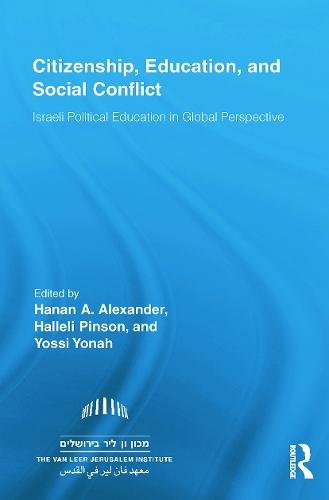
Author: Hanan A. Alexander (Haifa University, Israel) ,
Halleli Pinson (Haifa University, Israel) ,
Yossi Yonah (Ben Gurion University, Israel) ,
Juan Kattan-Ibarra
Publisher: Taylor & Francis Ltd
Imprint: Routledge
Dimensions:
Width: 15.20cm
, Height: 2.00cm
, Length: 22.90cm
Weight: 0.453kg
ISBN: 9780415744256
ISBN 10: 0415744253
Pages: 328
Publication Date: 08 November 2013
Audience:
College/higher education
,
General/trade
,
Tertiary & Higher Education
,
General
Format: Paperback
Publisher's Status: Active
Availability: In Print

This item will be ordered in for you from one of our suppliers. Upon receipt, we will promptly dispatch it out to you. For in store availability, please contact us.
Reviews
Educating for citizenship is never an easy task but it is far more complex when in the context of conflict and incompatible views of citizenship, democracy and equality. Moving from theory to practice, and from the uniqueness of the Israeli/Palestinian context to universalities, this book becomes a necessary and most welcome contribution to the field. - Professor (Emeritus) Gavriel Salomon This volume is a timely reminder that, even though there is much international enthusiasm for civic education, it remains a field of contested theory, practice and policy. The first part of the book discusses these issues. The second part draws vividly on specific examples in Israel, a dynamic society to which many of the assumptions taken for granted in stable Western societies do not apply. Through these rich, insightful and often provocative analyses we see how tensions around identity, religion, ethnicity, inclusion and exclusion play out. This is an illuminating and refreshing contribution to the many difficult debates with which those involved in civic education, globally, must engage. - Helen Haste, Emeritus Professor of Psychology, University of Bath and Visiting Professor, Harvard Graduate School of Education This is an important book. It seeks to develop a conflict theory of citizenship and citizenship education, in distinction to the traditional views of comprehensive liberalism and civic republicanism. Such a conflict theory acknowledges the deep and sometimes intractable frictions among groups in society, in distinction to views that more optimistically seek to reconcile or mitigate such frictions. This starting point strikes me as realistic and honest, without giving up the broader aims of fostering a just, tolerant society. Drawing from a range of post-liberal, critical theory, and poststructural sources, the essays in this book develop, in the first part, a rich and original take on rethinking citizenship education in a diverse global context; and in the second part a set of essays that relate these concerns to a case study context where deep and intractable frictions seem unavoidable: contemporary Israel. The result is a theoretically rich, politically hard-headed and honest engagement with the possibilities and challenges of citizenship education today. Its implications reach far beyond the Israeli contest to touch on difficulties faced by every nation-state, indeed virtually every community, in today's world. - Nicholas C. Burbules, Gutgsell Professor, University of Illinois, Urbana-Champaign
Educating for citizenship is never an easy task but it is far more complex when in the context of conflict and incompatible views of citizenship, democracy and equality. Moving from theory to practice, and from the uniqueness of the Israeli/Palestinian context to universalities, this book becomes a necessary and most welcome contribution to the field. - Professor (Emeritus) Gavriel Salomon This volume is a timely reminder that, even though there is much international enthusiasm for civic education, it remains a field of contested theory, practice and policy. The first part of the book discusses these issues. The second part draws vividly on specific examples in Israel, a dynamic society to which many of the assumptions taken for granted in stable Western societies do not apply. Through these rich, insightful and often provocative analyses we see how tensions around identity, religion, ethnicity, inclusion and exclusion play out. This is an illuminating and refreshing contribution to the many difficult debates with which those involved in civic education, globally, must engage. - Helen Haste, Emeritus Professor of Psychology, University of Bath and Visiting Professor, Harvard Graduate School of Education This is an important book. It seeks to develop a conflict theory of citizenship and citizenship education, in distinction to the traditional views of comprehensive liberalism and civic republicanism. Such a conflict theory acknowledges the deep and sometimes intractable frictions among groups in society, in distinction to views that more optimistically seek to reconcile or mitigate such frictions. This starting point strikes me as realistic and honest, without giving up the broader aims of fostering a just, tolerant society. Drawing from a range of post-liberal, critical theory, and poststructural sources, the essays in this book develop, in the first part, a rich and original take on rethinking citizenship education in a diverse global context; and in the second part a set of essays that relate these concerns to a case study context where deep and intractable frictions seem unavoidable: contemporary Israel. The result is a theoretically rich, politically hard-headed and honest engagement with the possibilities and challenges of citizenship education today. Its implications reach far beyond the Israeli contest to touch on difficulties faced by every nation-state, indeed virtually every community, in today's world. - Nicholas C. Burbules, Gutgsell Professor, University of Illinois, Urbana-Champaign
Educating for citizenship is never an easy task but it is far more complex when in the context of conflict and incompatible views of citizenship, democracy and equality. Moving from theory to practice, and from the uniqueness of the Israeli/Palestinian context to universalities, this book becomes a necessary and most welcome contribution to the field. - Professor (Emeritus) Gavriel Salomon This volume is a timely reminder that, even though there is much international enthusiasm for civic education, it remains a field of contested theory, practice and policy. The first part of the book discusses these issues. The second part draws vividly on specific examples in Israel, a dynamic society to which many of the assumptions taken for granted in stable Western societies do not apply. Through these rich, insightful and often provocative analyses we see how tensions around identity, religion, ethnicity, inclusion and exclusion play out. This is an illuminating and refreshing contribution to the many difficult debates with which those involved in civic education, globally, must engage. - Helen Haste, Emeritus Professor of Psychology, University of Bath and Visiting Professor, Harvard Graduate School of Education This is an important book. It seeks to develop a conflict theory of citizenship and citizenship education, in distinction to the traditional views of comprehensive liberalism and civic republicanism. Such a conflict theory acknowledges the deep and sometimes intractable frictions among groups in society, in distinction to views that more optimistically seek to reconcile or mitigate such frictions. This starting point strikes me as realistic and honest, without giving up the broader aims of fostering a just, tolerant society. Drawing from a range of post-liberal, critical theory, and poststructural sources, the essays in this book develop, in the first part, a rich and original take on rethinking citizenship education in a diverse global context; and in the second part a set of essays that relate these concerns to a case study context where deep and intractable frictions seem unavoidable: contemporary Israel. The result is a theoretically rich, politically hard-headed and honest engagement with the possibilities and challenges of citizenship education today. Its implications reach far beyond the Israeli contest to touch on difficulties faced by every nation-state, indeed virtually every community, in today's world. - Nicholas C. Burbules, Gutgsell Professor, University of Illinois, Urbana-Champaign
Author Information
Hanan A. Alexander is Professor of Philosophy of Education at the University of Haifa and Goldman Visiting Professor in the Graduate School of Education at the University of California, Berkeley specializing in political, moral, spiritual, religious, and Jewish education. His publications include Reclaiming Goodness: Education and the Spiritual Quest which won a 2002 National Jewish Book Award and Spirituality and Ethics in Education: Philosophical, Theological and Radical Perspectives. Halleli Pinson is a lecturer at Ben-Gurion University of the Negev. Her research focuses on young people’s political identities, citizenship education and social conflict and the interface between government immigration and educational policy. She recently won the prestigious Alon Fellowship. Her publications include Education, Asylum and the ‘Non-Citizen’ Child. Yossi Yonah is Associate Professor in the Department of Education at the Ben Gurion University of the Negev specializing in multiculturalism and education. His publications include In Virtue of Difference: Israel as a Multicultural Society and with Yehouda Shenhav What is Multiculturalism?