Overview
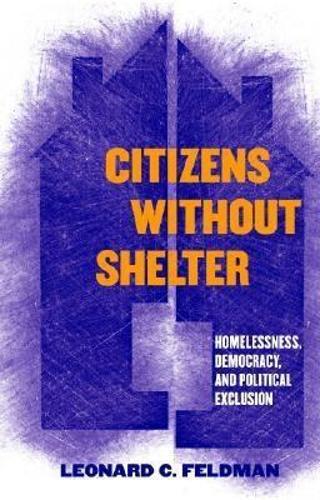
One of the most troubling aspects of the politics of homelessness, Leonard C. Feldman contends, is the reduction of the homeless to what Hannah Arendt calls ""the abstract nakedness of humanity"" and what Giorgio Agamben terms ""bare life."" Feldman argues that the politics of alleged compassion and the politics of those interested in ridding public spaces of the homeless are linked fundamentally in their assumption that homeless people are something less than citizens. Feldman's book brings political theories together (including theories of sovereign power, justice, and pluralism) with discussions of real-world struggles and close analyses of legal cases concerning the rights of the homeless.In Feldman's view, the ""bare life predicament"" is a product not simply of poverty or inequality but of an inability to commit to democratic pluralism. Challenging this reduction of the homeless, Citizens without Shelter examines opportunities for contesting such a fundamental political exclusion, in the service of homeless citizenship and a more robust form of democratic pluralism. Feldman has in mind a truly democratic pluralism that would include a pluralization of the category of ""home"" to enable multiple forms of dwelling; a recognition of the common dwelling activities of homeless and non-homeless persons; and a resistance to laws that punish or confine the homeless.
Full Product Details
Author: Leonard C. Feldman
Publisher: Cornell University Press
Imprint: Cornell University Press
Edition: New edition
Dimensions:
Width: 15.50cm
, Height: 1.30cm
, Length: 23.50cm
Weight: 0.454kg
ISBN: 9780801472909
ISBN 10: 0801472903
Pages: 200
Publication Date: 30 January 2006
Audience:
College/higher education
,
Professional and scholarly
,
Undergraduate
,
Postgraduate, Research & Scholarly
Format: Paperback
Publisher's Status: Active
Availability: Awaiting stock

The supplier is currently out of stock of this item. It will be ordered for you and placed on backorder. Once it does come back in stock, we will ship it out for you.
Reviews
In Citizens without Shelter, Leonard Feldman writes about homelessness and about those who write about the homeless... He argues-correctly, I believe-that the homeless typically are excluded from democratic politics. -Mark Carl Rom, Georgetown University, Perspectives on Political Science Vol 33 No 4, Fall 2004 Feldman provides a thoughtful and nuanced examination of the cultural messages that undergird the wide range of arguments that structure both national and local debates in the United States over appropriate public responses to homelessness... This extremely interesting work is highly recommended to anyone interested in the politics of homelessness or, more broadly, in the development of the 'frames' that both organize and become the grounds for contestation in public policy debates. -D. R. Imig, University of Memphis, Choice, April 2005 Citizens without Shelter traces the development of homelessness policy by analyzing local regulations and their judicial challenges. Leonard Feldman argues that cities and the courts are now criminalizing the very activities that homeless citizens must carry out in order to live. He also explores the changing definitions of 'the public sphere,' 'citizenship,' and 'home' in political philosophy, and how the interaction among these definitions has had an impact on the evolution of homelessness regulations. -Political Science Quarterly Citizens without Shelter engages an important social problem in the most theoretically sophisticated and morally engaged manner. This is a rare combination. In addition, it is a very good read that shows what first-rate interdisciplinary scholarship is all about. -Austin Sarat, William Nelson Cromwell Professor of Jurisprudence and Political Science, Amherst College In Citizens Without Shelter, Leonard Feldman engages recent debates about homelessness to raise fundamental questions about the material conditions of political agency. Through nuanced readings of material from law, public policy, sociology, and history, Feldman goes beyond standard dichotomies between the voluntary and involuntary, conduct and status, liberty and order, to argue that homeless people have been widely defined in terms of rudimentary physical needs that exclude them from full citizenship. This is an illuminating and disturbing book. -Morris B. Kaplan, author, Sexual Justice: Democratic Citizenship and the Politics of Desire In this wonderful book, Leonard C. Feldman analyzes the politics of bare life-in context, rigorously examining in empirical and theoretical detail the scapegoating of homeless people. While dominant treatments of homelessness see it as a problem to be solved (administratively, juridically), Feldman calls for an alternative, more politicized, agency enhancing, and potentially transformative response to homelessness, one that ought properly to be part of any democratic agenda. Citizens without Shelter is a fine book about a topic of enduring importance. -Bonnie Honig, Professor, Political Science, Northwestern University, and Senior Research Fellow, American Bar Foundation
In this wonderful book, Leonard C. Feldman analyzes the politics of bare life-in context, rigorously examining in empirical and theoretical detail the scapegoating of homeless people. While dominant treatments of homelessness see it as a problem to be solved (administratively, juridically), Feldman calls for an alternative, more politicized, agency enhancing, and potentially transformative response to homelessness, one that ought properly to be part of any democratic agenda. Citizens without Shelter is a fine book about a topic of enduring importance. -Bonnie Honig, Professor, Political Science, Northwestern University, and Senior Research Fellow, American Bar Foundation
Author Information
Leonard C. Feldman is Assistant Professor of Political Science at the University of Oregon.