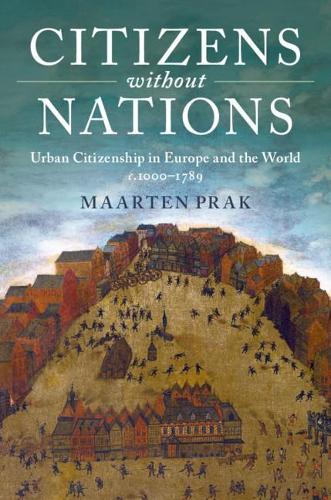
Full Product Details
Author: Maarten Prak (Universiteit Utrecht, The Netherlands)
Publisher: Cambridge University Press
Imprint: Cambridge University Press
Dimensions:
Width: 15.20cm
, Height: 2.00cm
, Length: 22.30cm
Weight: 0.720kg
ISBN: 9781107504158
ISBN 10: 1107504155
Pages: 442
Publication Date: 16 August 2018
Audience:
Professional and scholarly
,
College/higher education
,
Professional & Vocational
,
Tertiary & Higher Education
Format: Paperback
Publisher's Status: Active
Availability: Manufactured on demand

We will order this item for you from a manufactured on demand supplier.
Reviews
'A profoundly original book. Prak shows how much of what historians and social scientists think they know about citizenship and the rise of democratic politics is simply wrong. Uncovering the errors that have blinded so many, he proceeds to construct a historically grounded foundation for a new understanding of the meaning of citizenship that instructs us about the past and the present.' Jan de Vries, University of California, Berkeley 'This is a major contribution to emancipating citizenship from the nation. Tracing varieties of citizenship before its invention as nationality, Prak makes a compelling case for understanding citizenship as a practical activity without binary oppositions: European versus non-European, urban versus rural, or national versus international. The result is a riveting narrative, forcefully inviting us to think differently and historically about citizenship.' Engin Isin, Queen Mary University of London 'This is a large, richly researched, provocative study which repositions the pre-modern city, its citizens and agencies, at the centre of the European political stage. It is a brilliant exemplar of the New Urban History, setting European developments in a broad global perspective.' Peter Clark, University of Helsinki 'In this wide ranging and bold book, Maarten Prak offers a penetrating analysis of urban citizenship in pre-modern Europe. He both revises a Weberian narrative about the distinctiveness of western European civic institutions in comparison to those in Asia and the Americas and undoes assumptions about the superiority of national citizenship post-1789.' Martha Howell, Columbia University, New York 'A profoundly original book. Prak shows how much of what historians and social scientists think they know about citizenship and the rise of democratic politics is simply wrong. Uncovering the errors that have blinded so many, he proceeds to construct a historically grounded foundation for a new understanding of the meaning of citizenship that instructs us about the past and the present.' Jan de Vries, University of California, Berkeley 'This is a major contribution to emancipating citizenship from the nation. Tracing varieties of citizenship before its invention as nationality, Prak makes a compelling case for understanding citizenship as a practical activity without binary oppositions: European versus non-European, urban versus rural, or national versus international. The result is a riveting narrative, forcefully inviting us to think differently and historically about citizenship.' Engin Isin, Queen Mary University of London 'This is a large, richly researched, provocative study which repositions the pre-modern city, its citizens and agencies, at the centre of the European political stage. It is a brilliant exemplar of the New Urban History, setting European developments in a broad global perspective.' Peter Clark, University of Helsinki 'In this wide ranging and bold book, Maarten Prak offers a penetrating analysis of urban citizenship in pre-modern Europe. He both revises a Weberian narrative about the distinctiveness of western European civic institutions in comparison to those in Asia and the Americas and undoes assumptions about the superiority of national citizenship post-1789.' Martha Howell, Columbia University, New York
'A profoundly original book. Prak shows how much of what historians and social scientists think they know about citizenship and the rise of democratic politics is simply wrong. Uncovering the errors that have blinded so many, he proceeds to construct a historically grounded foundation for a new understanding of the meaning of citizenship that instructs us about the past and the present.' Jan de Vries, University of California, Berkeley 'This is a major contribution to emancipating citizenship from the nation. Tracing varieties of citizenship before its invention as nationality, Prak makes a compelling case for understanding citizenship as a practical activity without binary oppositions: European versus non-European, urban versus rural, or national versus international. The result is a riveting narrative, forcefully inviting us to think differently and historically about citizenship.' Engin Isin, Queen Mary University of London 'This is a large, richly researched, provocative study which repositions the pre-modern city, its citizens and agencies, at the centre of the European political stage. It is a brilliant exemplar of the New Urban History, setting European developments in a broad global perspective.' Peter Clark, University of Helsinki 'In this wide ranging and bold book, Maarten Prak offers a penetrating analysis of urban citizenship in pre-modern Europe. He both revises a Weberian narrative about the distinctiveness of western European civic institutions in comparison to those in Asia and the Americas and undoes assumptions about the superiority of national citizenship post-1789.' Martha Howell, Columbia University, New York
'A profoundly original book. Prak shows how much of what historians and social scientists think they know about citizenship and the rise of democratic politics is simply wrong. Uncovering the errors that have blinded so many, he proceeds to construct a historically grounded foundation for a new understanding of the meaning of citizenship that instructs us about the past and the present.' Jan de Vries, University of California, Berkeley 'This is a major contribution to emancipating citizenship from the nation. Tracing varieties of citizenship before its invention as nationality, Prak makes a compelling case for understanding citizenship as a practical activity without binary oppositions: European versus non-European, urban versus rural, or national versus international. The result is a riveting narrative, forcefully inviting us to think differently and historically about citizenship.' Engin Isin, Queen Mary University of London 'This is a large, richly researched, provocative study which repositions the pre-modern city, its citizens and agencies, at the centre of the European political stage. It is a brilliant exemplar of the New Urban History, setting European developments in a broad global perspective.' Peter Clark, University of Helsinki 'In this wide ranging and bold book, Maarten Prak offers a penetrating analysis of urban citizenship in pre-modern Europe. He both revises a Weberian narrative about the distinctiveness of western European civic institutions in comparison to those in Asia and the Americas and undoes assumptions about the superiority of national citizenship post-1789.' Martha Howell, Columbia University, New York `A profoundly original book. Prak shows how much of what historians and social scientists think they know about citizenship and the rise of democratic politics is simply wrong. Uncovering the errors that have blinded so many, he proceeds to construct a historically grounded foundation for a new understanding of the meaning of citizenship that instructs us about the past and the present.' Jan de Vries, University of California, Berkeley `This is a major contribution to emancipating citizenship from the nation. Tracing varieties of citizenship before its invention as nationality, Prak makes a compelling case for understanding citizenship as a practical activity without binary oppositions: European versus non-European, urban versus rural, or national versus international. The result is a riveting narrative, forcefully inviting us to think differently and historically about citizenship.' Engin Isin, Queen Mary University of London `This is a large, richly researched, provocative study which repositions the pre-modern city, its citizens and agencies, at the centre of the European political stage. It is a brilliant exemplar of the New Urban History, setting European developments in a broad global perspective.' Peter Clark, University of Helsinki `In this wide ranging and bold book, Maarten Prak offers a penetrating analysis of urban citizenship in pre-modern Europe. He both revises a Weberian narrative about the distinctiveness of western European civic institutions in comparison to those in Asia and the Americas and undoes assumptions about the superiority of national citizenship post-1789.' Martha Howell, Columbia University, New York
'A profoundly original book. Prak shows how much of what historians and social scientists think they know about citizenship and the rise of democratic politics is simply wrong. Uncovering the errors that have blinded so many, he proceeds to construct a historically grounded foundation for a new understanding of the meaning of citizenship that instructs us about the past and the present.' Jan de Vries, University of California at Berkeley 'This is a major contribution to emancipating citizenship from the nation. Tracing varieties of citizenship before its invention as nationality, Prak makes a compelling case for understanding citizenship as a practical activity without binary oppositions: European versus non-European, urban versus rural, or national versus international. The result is a riveting narrative, forcefully inviting us to think differently and historically about citizenship.' Engin Isin, Queen Mary University of London 'This is a large, richly researched, provocative study which repositions the pre-modern city, its citizens and agencies, at the centre of the European political stage. It is a brilliant exemplar of the New Urban History, setting European developments in a broad global perspective.' Peter Clark, University of Helsinki 'In this wide ranging and bold book, Maarten Prak offers a penetrating analysis of urban citizenship in pre-modern Europe. He both revises a Weberian narrative about the distinctiveness of western European civic institutions in comparison to those in Asia and the Americas and undoes assumptions about the superiority of national citizenship post-1789.' Martha Howell, Columbia University
Author Information
Maarten Prak is Professor of Social and Economic History at the Department of History and Art History, Universiteit Utrecht, The Netherlands. He is on the Board of the Royal Netherlands Academy of Arts and Sciences.