Overview
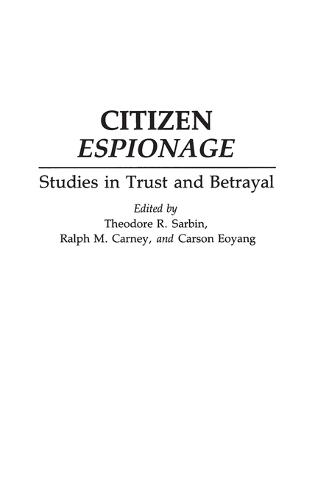
This is the first work to examine the phenomena of citizen espionage from the point of view of trust betrayal. Here is an effort to illuminate the social, political, and psychological conditions that influence trusted American citizens to spy against their country. The volume combines historical inquiry, sociological studies, psychological insights, and criminological analysis. It is especially timely when many nations, friend and foe alike, have instituted programs to obtain trade secrets and classified technology from American military and industrial sources.
Full Product Details
Author: Ralph M. Carney ,
Carson Eoyang ,
Theodore R. Sarbin ,
Carson Eoyang (Director of Training and Development, Office of Human Resources and Education, NASA, USA)
Publisher: Bloomsbury Publishing Plc
Imprint: Praeger Publishers Inc
Dimensions:
Width: 15.60cm
, Height: 2.20cm
, Length: 23.50cm
Weight: 0.539kg
ISBN: 9780275947521
ISBN 10: 0275947521
Pages: 224
Publication Date: 27 April 1994
Recommended Age: From 7 to 17 years
Audience:
College/higher education
,
Professional and scholarly
,
Undergraduate
,
Postgraduate, Research & Scholarly
Format: Hardback
Publisher's Status: Active
Availability: Manufactured on demand

We will order this item for you from a manufactured on demand supplier.
Reviews
Citizen Espionage: Studies in Trust and Betrayal is a grabber. How can we detect very, very low probability events where the failure to do so can have catastrophic consequences? Psychologists have tried to answer that question, often in situations quite different from spying and betrayal, for the nearly five decades that I have been around. Citizen Espionage with its emphasis on multidisciplinary contributions, has, I believe, moved us closer to that goal. -Contemporary Psychology ?Citizen Espionage: Studies in Trust and Betrayal is a grabber. How can we detect very, very low probability events where the failure to do so can have catastrophic consequences? Psychologists have tried to answer that question, often in situations quite different from spying and betrayal, for the nearly five decades that I have been around. Citizen Espionage with its emphasis on multidisciplinary contributions, has, I believe, moved us closer to that goal.?-Contemporary Psychology
?Citizen Espionage: Studies in Trust and Betrayal is a grabber. How can we detect very, very low probability events where the failure to do so can have catastrophic consequences? Psychologists have tried to answer that question, often in situations quite different from spying and betrayal, for the nearly five decades that I have been around. Citizen Espionage with its emphasis on multidisciplinary contributions, has, I believe, moved us closer to that goal.?-Contemporary Psychology
Author Information
THEODORE R. SARBIN is Professor Emeritus of Psychology and Criminology at the University of California at Santa Cruz. Presently, he is serving as a research psychologist with the Defense Personnel Security Research Center at the Naval Postgraduate School. He is the editor of Narrative Psychology (Praeger, 1986) and (with K. Scheibe) Studies in Social Identity (Praeger, 1983). RALPH M. CARNEY is a Personnel Research Psychologist at the Defense Personnel Security Reserach at the Naval Postgraduate School. CARSON EOYANG is Director of Training and Development in the Office of Human Resources and Education at NASA.