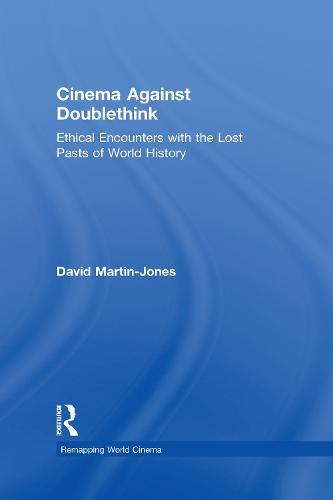
Full Product Details
Author: David Martin-Jones (University of Glasgow, UK)
Publisher: Taylor & Francis Ltd
Imprint: Routledge
Weight: 0.640kg
ISBN: 9781138907942
ISBN 10: 1138907944
Pages: 242
Publication Date: 02 October 2018
Audience:
College/higher education
,
Tertiary & Higher Education
,
Undergraduate
Format: Hardback
Publisher's Status: Active
Availability: In Print

This item will be ordered in for you from one of our suppliers. Upon receipt, we will promptly dispatch it out to you. For in store availability, please contact us.
Reviews
'A major contribution to the unthinking of the axioms of westocentric globalization. In an approach at once worldly, transnational, global, and even planetary, the book offers a remarkable synthesis of political philosophy/theory and film exegesis. Invoking a remarkably wide range of filmic and theoretical references, the book catalyzes a conversation between disciplines, regions, and media. The book offers a welcome tonic in a dystopian age of post-truth .' Robert Stam, New York University, USA 'It is most refreshing and encouraging reading a book that starts from some place else (in this case Enrique Dussel and Latin America) and give its due recognition to Western Europe (in this case Gilles Deleuze). David Martin-Jones has made a signal contribution to the current processes radically shifting from Western universal to pluriversal world histories, celebrating the splendors of global memories and triumphantly denying the Western colonial denial of contemporaneity.' Walter D. Mignolo, Duke University, USA 'The wonderfully ambitious and beautifully crafted Cinema Against Doublethink brings us a view from the global south and world memory through the prism of cinema. The notion of worlds of cinema take us not to the rewriting of history but to a retrieval of lost transnational histories that resist inequality in colonial, postcolonial, and neocolonial contexts. It proposes an encounter with lost pasts that sets in motion a new awareness of the world we live in.' Sandra Ponzanesi, Utrecht University, the Netherlands 'Colonial modernity has sought to erase alternative mappings of past and present. In a dazzling synthesis of film and critical theory, David Martin-Jones uses Deleuze's time-image in inspired conjunction with Latin American decolonial thought and social contract theory to demonstrate how global cinema challenges this oppressive chronopolitics, revealing, against a seemingly ineluctable and all-devouring Orwellian now, different emancipatory times and possibilities.' Charles W. Mills, CUNY, USA
A major contribution to the unthinking of the axioms of westocentric globalization, this concept-rich volume opens up new lines of flight in terms of radical cinema and analysis. In an approach at once worldly, transnational, global, and even planetary, the book offers a remarkable synthesis of political philosophy/theory and film exegesis. Invoking a remarkably wide range of filmic and theoretical references, the book catalyzes a conversation between disciplines, regions, and media. The book offers a welcome tonic in a dystopian age of post-truth. Robert Stam, New York University, co-author of Keywords in Subversive Film/Media Aesthetics (2015) It is most refreshing and encouraging reading a book, sensed and written in Glasgow, that starts from some place else (in this case Enrique Dussel and Latin America) and give its due recognition to Western Europe (in this case Gilles Deleuze). David Martin-Jones has made a signal contribution to the current processes radically shifting from Western universal to pluriversal world histories, celebrating the splendors of global memories and triumphantly denying the Western colonial denial of contemporaneity. Walter D. Mignolo, Duke University, co-author of On Decoloniality: Concepts, Analytics, Praxis (2018) The wonderfully ambitious and beautifully crafted Cinema Against Doublethink brings us a view from the global south and world memory through the prism of cinema. The notion of worlds of cinema take us not to the rewriting of history but to a retrieval of lost transnational histories that resists inequality in colonial, postcolonial, and neocolonial contexts. It proposes an encounter with lost pasts through our ethical engagement that sets in motion a new awareness of the world we live in. Sandra Ponzanesi, Utrecht University, co-editor of Postcolonial Transitions in Europe (2016) Through the various phases of colonial modernity, whether originally as formal Euro-rule or as contemporary transnational neo-liberal capitalist globalization, it has consistently sought to erase rival temporalities, alternative mappings of past and present that might presage more egalitarian futures. In a dazzling synthesis of film and critical theory, David Martin-Jones uses Gilles Deleuze's time-image in inspired conjunction with Latin American decolonial thought and radical social contract theory to demonstrate how recent global cinema challenges this oppressive chronopolitics, revealing-against a seemingly ineluctable and all-devouring Orwellian now-different emancipatory times and possibilities. Charles W. Mills, CUNY, author of Black Rights/White Wrongs (2017)
Author Information
David Martin-Jones is Professor of Film Studies, University of Glasgow, UK. His research uses philosophy to explore world cinemas. He is the author/editor of eight books, has published in numerous international journals (e.g. Cinema Journal, Screen, Third Text), and edits the Bloomsbury series Thinking Cinema.