Overview
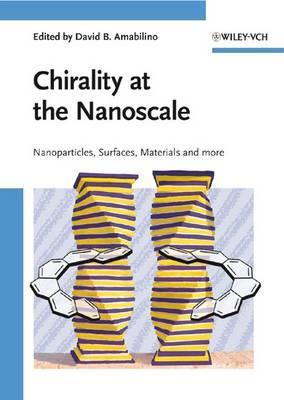
The only standard reference in this exciting new field combines the physical, chemical and material science perspectives in a synergic way. This monograph traces the development of the preparative methods employed to create nanostructures, in addition to the experimental techniques used to characterize them, as well as some of the surprising physical effects. The chapters cover every category of material, from organic to coordination compounds, metals and composites, in zero, one, two and three dimensions. The book also reviews structural, chemical, optical, and other physical properties, finishing with a look at the future for chiral nanosystems.
Full Product Details
Author: David B. Amabilino
Publisher: Wiley-VCH Verlag GmbH
Imprint: Wiley-VCH Verlag GmbH
Dimensions:
Width: 18.10cm
, Height: 2.60cm
, Length: 24.80cm
Weight: 0.964kg
ISBN: 9783527320134
ISBN 10: 352732013
Pages: 440
Publication Date: 28 January 2009
Audience:
Professional and scholarly
,
Professional & Vocational
Format: Hardback
Publisher's Status: Out of Print
Availability: Awaiting stock

Reviews
"""The numerous references to recently developed materials will allow the reader to investigate this very interesting area of material research in considerable detail."" ( IEEE Electrical Insultaion Magazine, June 2010) ""The book is well designed with several well-illustrated color figures. Each chapter ends with a list of references that are updated to 2007. This book is considered to be the first text to be published in the field of chirality in nanoscience. It is highly recommended to analytical chemists, materials scientists and physical chemists among others and its cost is very well justified."" ( Chromatographia, November 2009) ""This book provides a timely insight into how Pasteur's classic concepts translate into the rapidly-growing field of nanotechnology, explaining in one place the wide range of new and intriguing 'nanochiral' phenomena which have recently been observed."" ( Chemistry World , May 2009)"
""The numerous references to recently developed materials will allow the reader to investigate this very interesting area of material research in considerable detail."" ( IEEE Electrical Insultaion Magazine, June 2010) ""The book is well designed with several well-illustrated color figures. Each chapter ends with a list of references that are updated to 2007. This book is considered to be the first text to be published in the field of chirality in nanoscience. It is highly recommended to analytical chemists, materials scientists and physical chemists among others and its cost is very well justified."" ( Chromatographia, November 2009) ""This book provides a timely insight into how Pasteur's classic concepts translate into the rapidly-growing field of nanotechnology, explaining in one place the wide range of new and intriguing 'nanochiral' phenomena which have recently been observed."" ( Chemistry World , May 2009)
This book provides a timely insight into how Pasteur's classic concepts translate into the rapidly-growing field of nanotechnology, explaining in one place the wide range of new and intriguing 'nanochiral' phenomena which have recently been observed. (Chemistry World, May 2009)
Author Information
David Amabilino is a tenured scientist at the Materials Science Institute (ICMAB, CISC) near Barcelona, where he is presently the vice-director. He worked as a postdoc on self-assembly of interlocked molecules in Fraser Stoddart's group (then in Birmingham, Engalnd), on porphyrin-containing assemblies in Jean-Pierre Sauvage's group (ULP, Strasbourg) and chiral polymers in Jaume Veciana's group (ICMAB, CSIC) after receiving both BSc (hons.) and PhD from Royal Holloway and Bedford New College (University of London). His current interests include the influence of supramolecular and stereochemical effects on molecular materials, and especially the expression of chirality at the nanoscale and the effects it has on the hierarchical passage of handedness. In research related to this, he is coordinating two projects founded by the European commission.