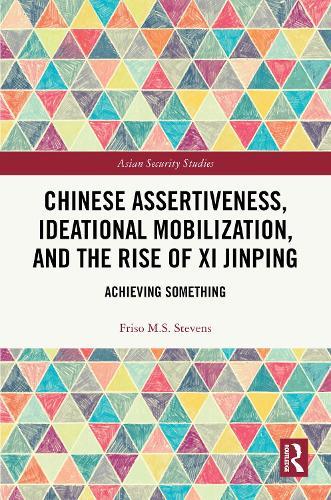
Overview
This book examines the historical, domestic, and leadership drivers behind the repositioning of China toward center stage after 2008. In the years of global turmoil that followed the 2008 global financial crisis, China’s foreign policy of the late Hu Jintao years came to be viewed in Western discourse as increasingly ""assertive."" Displaying a certain cognitive dissonance, China, however, vehemently rejects this viewpoint. Especially after Xi Jinping rose to power in 2012, it is clear that China has abandoned its long-held foreign policy doctrine of ""keeping a low profile."" Analyzing how language has been produced and reproduced over time, this book explains the shift to a more assertive China by examining the intervening ideas about China’s desired place in East Asia’s regional order. The Chinese Communist Party propaganda offers compelling evidence that there is much greater continuity between the Hu and Xi eras than is exhibited in the current literature. Moreover, the book traces the deeper ideational sources of Chinese assertiveness back to the New Left movement and the Patriotic Education Campaign of the 1990s. Agency for the turn in the late 2000s and the selection of the compromise candidate Xi is attributed to the choices past leaders made, with some Party elders ""ruling from behind the curtain."" This book will be of much interest to students of Chinese politics and foreign policy, East Asian International Relations, and Security Studies.
Full Product Details
Author: Friso M.S. Stevens
Publisher: Taylor & Francis Ltd
Imprint: Routledge
Weight: 0.440kg
ISBN: 9781032914213
ISBN 10: 1032914211
Pages: 130
Publication Date: 06 May 2025
Audience:
College/higher education
,
Professional and scholarly
,
Tertiary & Higher Education
,
Professional & Vocational
Format: Hardback
Publisher's Status: Active
Availability: In Print

This item will be ordered in for you from one of our suppliers. Upon receipt, we will promptly dispatch it out to you. For in store availability, please contact us.
Reviews
“A lively, wide ranging and learned account which digs below the surface to answer questions about the tone and nature of politics in China today. Rejecting conventional thinking and interpretations, Friso Stevens in this timely account looks at the deeper patterns of continuity between the era before Xi Jinping, and the kind of politics practised after he came to power. Looking at ideas and how they relate to patterns of language and practice, this book calls upon a rich selection of scholarly material in both Chinese and English, and offers valuable new insights, delivered with verve, conviction and passion.” Kerry Brown, Professor of Chinese Studies, King’s College London, UK “[this book] provides a fresh and compelling explanation for China’s shift to a more assertive foreign policy beginning in 2009-2010 with the onset of the global financial crisis. Focusing on ideational drivers and leadership politics, Friso Stevens analyzes the development of a more nationalistic environment in China and the return of conservative political elites to the highest echelons of power that fostered Xi Jinping’s elevation to power. This book is a must-read for anyone interested in understanding the roots and reasons for China’s abandonment of Deng Xiaoping’s dictum to 'keep a low profile' that was the guiding principle of Chinese foreign policy since the collapse of the Soviet Union in the early 1990s.” Bonnie Glaser, Managing Director of the Indo-Pacific Program, German Marshall Fund “Friso Stevens’ book offers a penetrating analysis of China’s shift toward assertiveness in its foreign policy, particularly under Xi Jinping’s leadership. Using an innovative neoclassical realist framework, Stevens argues that China’s assertiveness is not a recent phenomenon but is deeply rooted in historical, ideational, and leadership dynamics. The book critiques oversimplified Western narratives while shedding light on the domestic and international implications of China’s ideological evolution. This is an essential read for scholars, policymakers, and anyone seeking to understand the complexities of Chinese politics and foreign policy.” Xiaoyu Pu, Associate Professor of Political Science, University of Nevada, Reno, USA
Author Information
Friso M.S. Stevens holds a PhD in International Relations from Leiden University and completed postdoctoral fellowships at the European University Institute and the University of Helsinki. Currently, he is a Senior Fellow at The Hague Centre for Strategic Studies.